Research
Market cycles, trading notes, and deep dives.
198 articles found
Beyond Quant Models: Introducing Time-Cycle Intelligence for Institutional Portfolios
Modern finance has become exceptionally good at measuring everything except timing. Institutional investors can model inflation paths, earnings revisions, liquidity conditions, factor exposures, volatility regimes, options surfaces, credit stress, and cross-asset correlations with remarkable precision. Yet market inflection points still tend to evade the best-equipped participants. Major tops often form while macro data still appears resilient. Important bottoms often emerge while recession narratives remain dominant. Trend reversals frequently begin before conventional confirmation frameworks are willing to acknowledge them. This is not a minor weakness. It is one of the core structural limitations of modern investment process. Technical indicators often confirm only after the move is underway. Macroeconomic forecasts are frequently revised after the market has already repriced. Quantitative systems, though powerful in stable regimes, can struggle during nonlinear transitions when relationships compress, correlations shift, and the speed of adjustment accelerates. In practice, institutional portfolios are often strongest in diagnosis and weakest in sequencing. That sequencing problem has created growing interest in a less familiar but increasingly relevant concept: time-cycle intelligence. At its most rigorous, this is not about replacing macro, quant, technical, or fundamental analysis. It is about introducing a structured overlay that focuses on temporal regimes. Financial astrology, interpreted through an institutional lens, belongs in that category. Rather than treating planetary cycles as mystical claims, it treats them as recurring time frameworks that may correlate with volatility, sentiment change, exhaustion phases, and turning-point behavior. The proposition is modest but strategically important: markets may be more cyclical in time than conventional models fully recognize.
Read more
The Missing Layer in Market Timing: Why Institutional Capital Is Exploring Financial Astrology
Modern finance has become extraordinarily efficient at processing information, yet it remains surprisingly inconsistent at processing time. Markets absorb earnings, inflation data, policy signals, geopolitical developments, liquidity conditions, and positioning flows at extraordinary speed. Institutional investors can monitor virtually every traditional variable in real time. Even so, the most consequential market turns often arrive before consensus frameworks are fully prepared for them. Major reversals tend to emerge not when information is absent, but when timing remains misunderstood. This is the central weakness in much of conventional market analysis. Technical indicators often require confirmation after the move has already begun. Macroeconomic forecasts are frequently revised only after the underlying shift is visible. Quantitative strategies can identify relationships with impressive statistical discipline, yet still struggle when regime changes compress decision windows. In practice, markets do not merely respond to data. They respond through cycles of acceleration, exhaustion, sentiment re-pricing, and structural transition. Those cycles are not always captured by price-only models. That gap has led a small but increasingly serious group of professional investors to explore a less conventional but structurally interesting framework: financial astrology. Stripped of popular misunderstandings, financial astrology can be approached as a time-cycle discipline. It attempts to map market behavior against recurring planetary rhythms and historical analogues, not as deterministic prediction, but as a probability-based overlay for identifying periods where volatility, reversals, and sentiment shifts become more likely. For hedge funds, family offices, proprietary desks, and long-duration allocators, this is not about replacing rigorous analysis. It is about examining whether markets contain an overlooked temporal layer that can improve timing decisions where traditional frameworks remain weakest.
Read more
Risk Management Through Financial Astrology: Avoiding High-Risk Trading Weeks
In financial markets, survival is more important than brilliance. Many traders can identify good opportunities, but far fewer can consistently protect capital during unfavorable periods. The difference between long-term success and eventual failure is not just about returns. It is about drawdown control, volatility awareness, and disciplined risk management. Most trading losses do not occur because of poor analysis. They occur because exposure is taken at the wrong time. Markets enter unstable phases where volatility expands, correlations rise, and price behavior becomes unpredictable. During these periods, even strong strategies can fail. Stops get hit more frequently. Breakouts fail. Trends reverse without warning. Confidence erodes. This is where financial astrology offers a unique advantage. It provides a timing-based framework to identify high-risk trading weeks in advance. Instead of reacting to volatility after it appears, traders can prepare for it. They can reduce exposure, adjust strategy, and protect capital before conditions deteriorate.
Read more
From Data to Timing: How Financial Astrology Terminal Enhances Technical and Fundamental Analysis
In modern financial markets, the gap between information and performance has never been wider. Investors today have access to unprecedented amounts of data. Earnings reports are instant. Economic indicators are widely tracked. Technical tools provide detailed insights into price behavior. Yet despite this abundance of information, consistent performance remains elusive for many. The reason is simple. Information alone does not create an edge. Timing does. An investor may correctly identify a strong company using fundamental analysis and still suffer losses because the entry timing was poor. A trader may identify a perfect technical breakout and still get stopped out because the broader market environment was unstable. The missing link is not knowledge. It is context. Specifically, timing context. This is where the Financial Astrology Terminal becomes relevant. It does not replace technical or fundamental analysis. It enhances them. It acts as a timing overlay, helping traders and investors understand when conditions are favorable, when risk is elevated, and when patience is required. It transforms analysis from static interpretation into dynamic decision-making.
Read more
Institutional Edge: Why Hedge Funds and Family Offices Are Exploring Financial Astrology
In professional investing, edge rarely comes from having access to more news. By the time a major headline reaches everyone, markets have usually begun pricing it in. The same is true for earnings commentary, macro commentary, and many popular technical signals. This is why serious investors continually search for non-consensus frameworks that can improve timing, risk control, and capital allocation. They are not simply looking for more information. They are looking for better context. That search has opened the door to alternative data. In recent years, hedge funds, family offices, proprietary desks, and sophisticated allocators have expanded their research process far beyond traditional balance-sheet analysis and standard macro models. They now study satellite data, supply-chain intelligence, web traffic, sentiment analytics, options flows, and cross-asset positioning data. The logic is clear. If markets are shaped by complex interactions between information, psychology, liquidity, and timing, then a differentiated data layer can create meaningful advantage.
Read more
Mapping Market Volatility: How Planetary Cycles Align with Sudden Market Moves
Volatility is the heartbeat of financial markets. It is the force that creates opportunity, risk, momentum, and panic. Traders chase it, investors fear it, and institutions attempt to manage it. Yet despite decades of quantitative models, volatility often arrives unexpectedly. Markets remain calm for extended periods and then suddenly erupt into sharp moves. Corrections appear without warning. Rallies accelerate beyond logic. Fear spreads faster than data can explain. Volatility is the heartbeat of financial markets. It is the force that creates opportunity, risk, momentum, and panic. Traders chase it, investors fear it, and institutions attempt to manage it. Yet despite decades of quantitative models, volatility often arrives unexpectedly. Markets remain calm for extended periods and then suddenly erupt into sharp moves. Corrections appear without warning. Rallies accelerate beyond logic. Fear spreads faster than data can explain.
Read more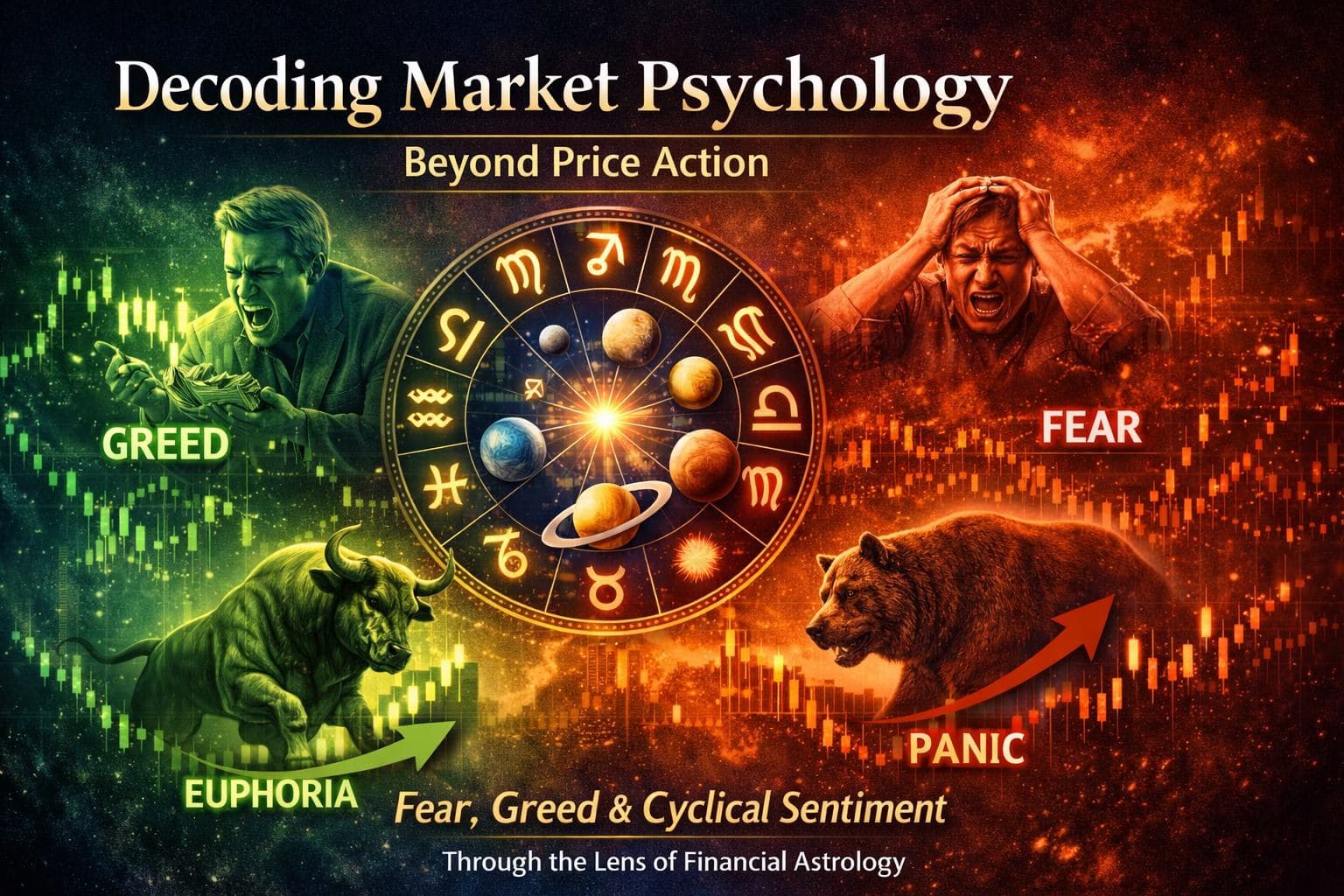
Beyond Price Action: How Financial Astrology Helps Decode Market Psychology and Sentiment
Financial markets are often described as rational systems driven by earnings, interest rates, inflation, liquidity, and economic expectations. Yet anyone who has spent enough time watching markets knows that price does not move on logic alone. Fear can erase months of gains in days. Greed can push overvalued assets far beyond any reasonable estimate of fair value. A rumor can shake a sector. A political event can trigger panic. A sudden wave of optimism can create momentum that feeds on itself. In other words, markets are not just mechanisms of valuation. They are living expressions of collective psychology. This is where the conversation becomes more interesting. Traditional analysis explains what is happening in terms of data and structure. Technical analysis studies trend, momentum, resistance, and participation. Fundamental analysis studies revenues, margins, debt, and macroeconomic conditions. Both are important. However, neither fully captures the timing and emotional rhythm of market behavior. Markets often move before the news is fully understood. They peak when sentiment is euphoric and bottom when fear is deepest. The emotional cycle often leads the narrative, not the other way around. Financial astrology enters this gap as a timing-oriented interpretive framework. It does not need to replace economics, charts, or valuation models. Instead, it adds a different layer by examining recurring cycles, periods of tension, and moments when collective sentiment may shift sharply. When used with discipline, financial astrology offers a way to think about crowd psychology through time rather than through price alone. It asks not only where the market is trading, but what kind of emotional environment is developing beneath the surface.
Read more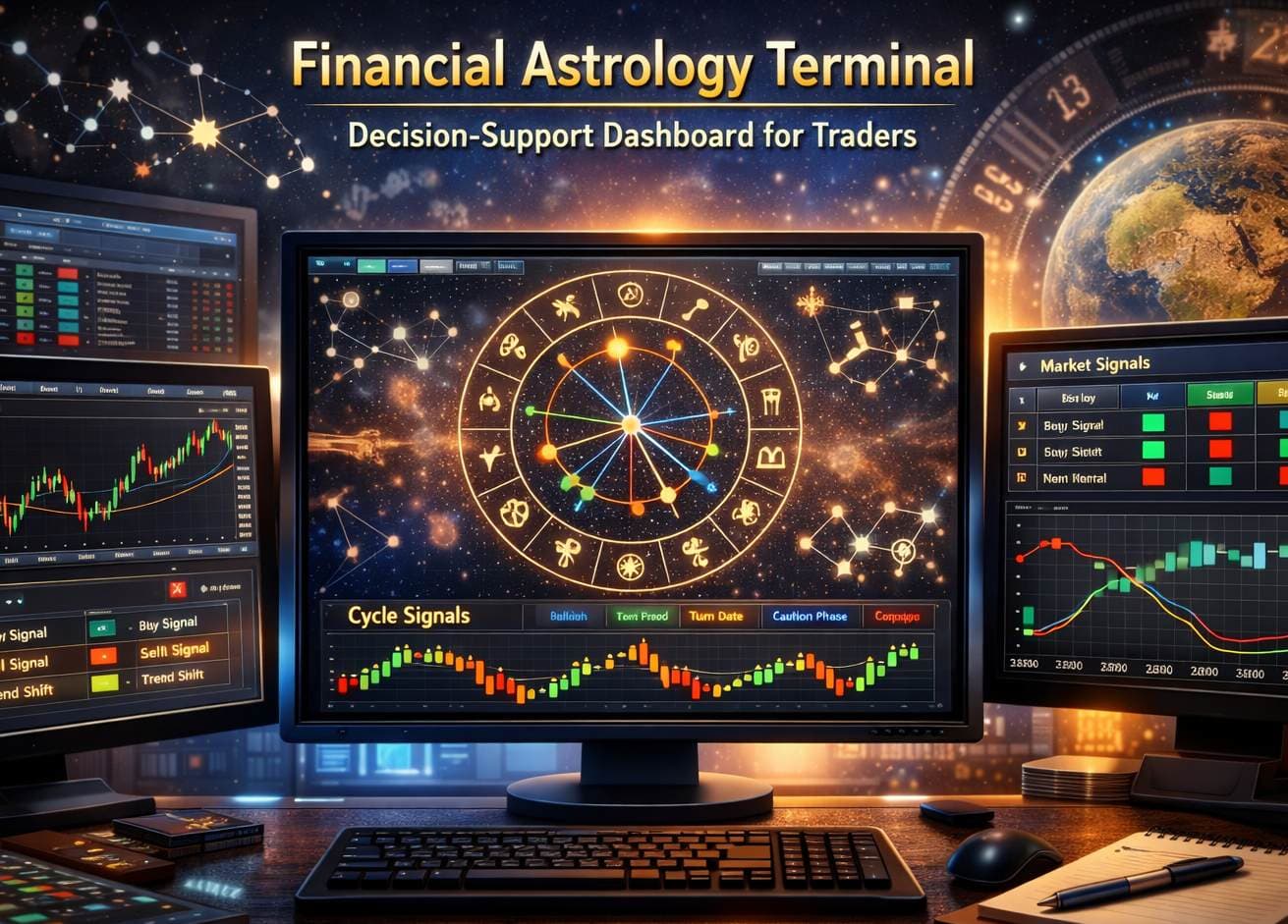
Financial Astrology Terminal as a Decision-Support System: A Practical Framework for Traders
Modern trading is no longer a simple exercise in watching charts and reacting to headlines. Markets move across multiple layers at once. Price responds to liquidity, sentiment, macro policy, earnings expectations, geopolitical tension, and crowd behavior. A trader may have access to more data than ever before, yet still struggle with one central problem: timing. Knowing what to buy or sell is only part of the challenge. Knowing when to act, when to stay patient, and when to reduce risk often makes the difference between disciplined trading and emotional trading. This is where the idea of a Financial Astrology Terminal becomes meaningful. It is not a replacement for technical analysis, macro research, or risk management. Rather, it functions as a decision-support system that brings together data, cycles, and signals into a single working framework. In practical terms, it acts like a dashboard for market timing. It helps traders organize information, understand the emotional climate of the market, track cycle-sensitive windows, and interpret signals with greater context.
Read more
Multi-Asset Timing Strategy: Using Financial Astrology Across Indices, Commodities, and Crypto
Financial markets today are deeply interconnected. Equity indices react to interest rates, commodities respond to geopolitical stress, currencies shift with capital flows, and crypto markets amplify global risk sentiment. In such an environment, analyzing a single asset in isolation is no longer sufficient. The real edge lies in understanding how cycles move across markets simultaneously. Traditional analysis focuses on price, macro data, and technical structure within each asset class. However, it often struggles to explain why multiple markets turn at the same time or why volatility suddenly expands across sectors. This is where financial astrology offers a broader framework. It provides a time-based lens that connects indices, commodities, and crypto through shared cycles of sentiment, liquidity, and behavioural shifts. A multi-asset timing strategy built on financial astrology does not replace data-driven investing. Instead, it integrates timing awareness into cross-market analysis. It helps investors identify when global sentiment is shifting, when risk appetite is expanding, and when contraction phases may begin. This perspective becomes particularly powerful when analysing major indices like the Dow and Nasdaq, commodities like gold and crude oil, and high-volatility assets such as cryptocurrencies.
Read more