Research
Market cycles, trading notes, and deep dives.
198 articles found
Hang Seng Turning Points - How Professionals Separate Forecasts From Tradable Confirmation
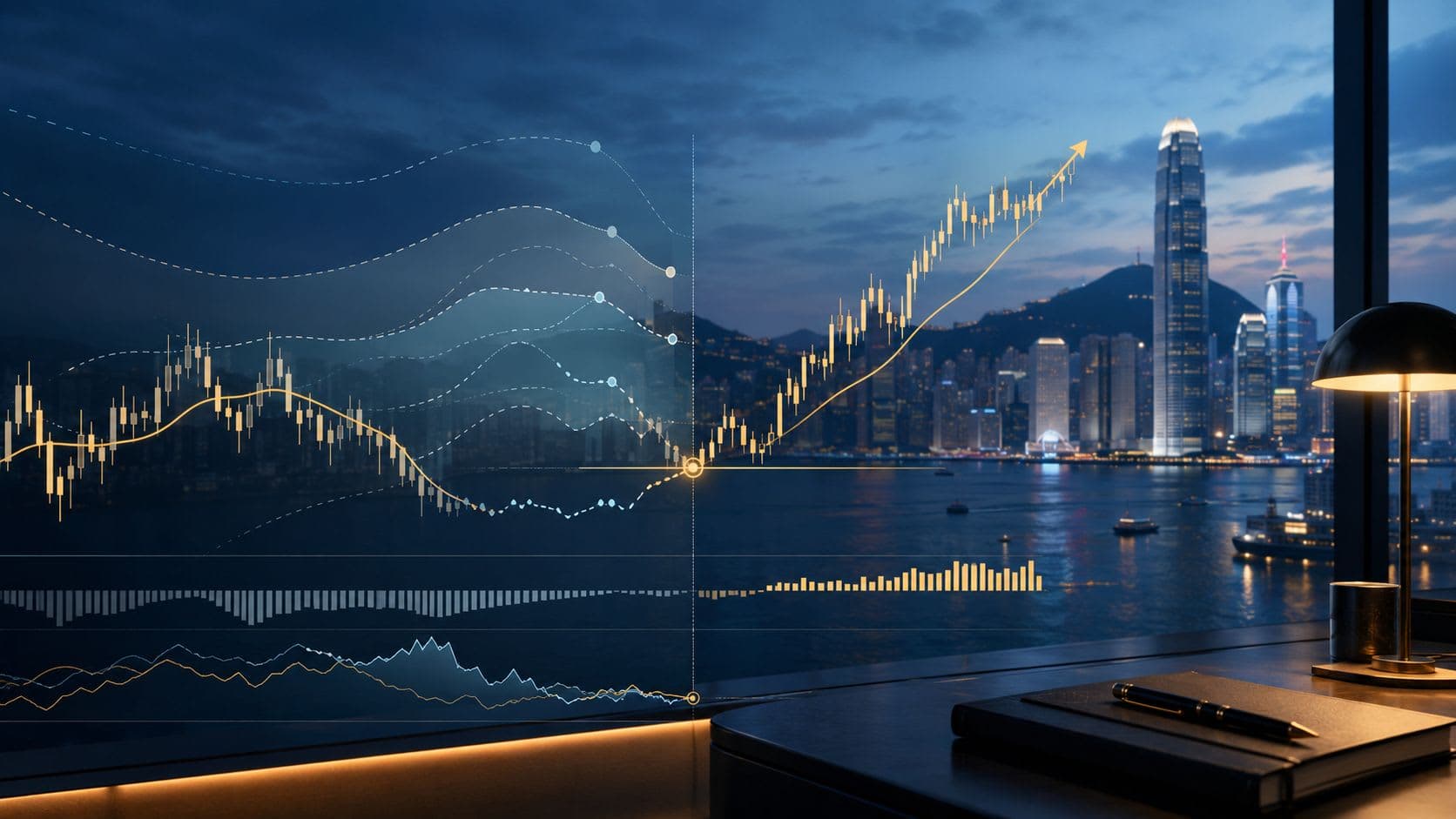
A Hang Seng forecast should identify a period in which the probability of a meaningful change in trend, volatility, liquidity, or market leadership may be higher than normal. It should not be interpreted as an instruction to buy or sell the Hang Seng Index at a predetermined time. Professional investors separate the forecast window from the entry signal because markets can reach an expected turning period and still continue in the existing direction. A potential bottoming window, for example, may initially produce only slower selling, reduced volatility, or a failed attempt to make a new low. The actual entry signal may develop several sessions later. Similarly, a projected peak may first cause sideways consolidation before sellers gain control. This distinction is especially important in Hong Kong because the Hang Seng Index reacts to Mainland Chinese policy, Stock Connect flows, US interest rates, offshore renminbi movements, property-market conditions, and global technology sentiment. A useful forecast therefore states the expected time window, anticipated market behaviour, probability range, evidence required for confirmation, and conditions that would invalidate the hypothesis. The forecast defines when professionals should become more attentive; observable market behaviour determines whether they should commit capital.
Read more
Can Alternative Data Improve Timing Decisions For Singapore Asset Managers?
Alternative data gives Singapore asset managers another way to study market behaviour beyond financial statements, price charts, and economic reports. It can include fund-flow trends, web activity, supply-chain signals, sentiment data, transaction patterns, and market-cycle variables. However, a new data source is not automatically useful simply because it is different. It must be tested, documented, and compared against existing investment research. The purpose is to improve timing awareness, not to create unverified market predictions.
Read more
Stock Connect Timing: A Framework for Reading Northbound and Southbound Risk Appetite
Stock Connect has become an important bridge between Mainland China and Hong Kong’s equity markets. Through Northbound trading, eligible investors in Hong Kong and overseas can access selected shares listed in Shanghai and Shenzhen. Through Southbound trading, eligible Mainland investors can access selected Hong Kong-listed securities. These two channels provide valuable information about how capital is moving across the China–Hong Kong market ecosystem. For China equity funds, Hong Kong brokers, and institutional investors, Stock Connect flows can help identify shifts in risk appetite, liquidity preferences, and market leadership. However, daily flow data should not be treated as an automatic buy-or-sell signal. A large inflow may reflect index rebalancing, passive fund activity, short covering, or temporary event positioning rather than a lasting change in investment conviction. The more effective approach is to use Stock Connect flows as one confirmation layer within a broader Hong Kong–China investment strategy. Market breadth, volatility, the offshore renminbi, technical structure, macroeconomic expectations, and cycle windows must all be considered before changing portfolio exposure.
Read more
Institutional Market Timing For ASEAN Exposure: A Singapore-Based Framework
Singapore is a natural decision hub for institutional ASEAN exposure. Regional portfolio managers, ASEAN funds, private banks, and family offices often use Singapore to assess capital flows across Indonesia, Malaysia, Thailand, Vietnam, the Philippines, and other Southeast Asian markets. However, ASEAN should not be treated as one uniform market. Each country has its own growth cycle, currency dynamics, political environment, sector structure, and domestic liquidity conditions. At the same time, global factors such as US yields, the US dollar, commodity prices, China-related demand, and international fund flows can influence the entire region. An institutional market-timing framework helps investors separate broad regional risk from country-specific opportunity. It supports better decisions about when to increase ASEAN exposure, when to rotate between markets, and when to retain liquidity.
Read more
Gold Timing For Singapore Wealth Portfolios: Hedge, Opportunity Or Both?
Gold can serve two very different roles in a Singapore wealth portfolio. First, it can act as a strategic allocation: a long-term store of value intended to diversify equity, currency, and geopolitical risk. Second, it can be managed tactically, with position size adjusted as market conditions change. These roles should not be confused. A family office may hold gold as strategic insurance even when short-term price momentum is weak. At the same time, it may choose to increase, reduce, or hedge tactical exposure when real yields, the US dollar, liquidity, and volatility point to a changing risk environment. Gold investment timing does not require abandoning a long-term allocation. It helps advisers and investors decide whether conditions favour accumulation, confirmation of a trend, or a more protective stance.
Read more
Hong Kong’s Next Investment Edge: Timing Intelligence Across China and Global Markets
Mainland policy remains one of the strongest forces shaping Hong Kong-listed assets. Changes in fiscal support, property regulation, technology policy, credit conditions and consumer stimulus can quickly alter expectations for Chinese companies. However, a favourable policy announcement does not automatically create a favourable investment window. Its market impact depends on implementation, liquidity and investor confidence. A stimulus measure may initially lift the Hang Seng Index, yet the rally can weaken if offshore capital remains cautious or the renminbi continues to depreciate. Institutional investors should therefore examine whether policy support is being confirmed by stronger market breadth, rising turnover, improving earnings expectations and sustained capital flows. Global liquidity adds another layer. Because the Hong Kong dollar is linked to the US dollar, changes in Federal Reserve policy and US Treasury yields influence local financing conditions. Higher US rates can tighten Hong Kong liquidity, increase funding costs and pressure rate-sensitive sectors such as property and real estate investment trusts. Falling rates may improve conditions, but they do not guarantee an immediate recovery if Mainland demand or corporate confidence remains weak. A reliable Hong Kong market outlook must therefore combine Chinese policy direction with US monetary conditions rather than treating them as separate stories.
Read more
Why Global Portfolios Managed From Singapore Need 24-Hour Timing Intelligence
Singapore is uniquely positioned between the US market close and the opening of major Asian markets. For global asset managers, trading desks, and family offices, this creates an advantage as well as a responsibility. Events that occur in New York overnight can shape trading conditions in Singapore, Tokyo, Hong Kong, Shanghai, Sydney, and across emerging Asia within hours. A portfolio may hold US equities, Asian shares, global bonds, commodities, foreign currencies, and alternative assets at the same time. These markets do not react simultaneously. They pass information from one session to another, often through overnight futures, currency movements, bond yields, and changing risk appetite. Twenty-four-hour timing intelligence helps investment teams monitor this transmission continuously. It provides context for decisions that need to be made before the next market session begins.
Read more
SGD, US Rates And Asian Equities: A Timing Framework For Singapore Portfolios
Singapore portfolios are closely connected to global financial conditions. US Treasury yields, US dollar movements, Asian equity breadth, commodity prices, and regional capital flows can all influence local asset prices and investor risk appetite. For macro funds, FX desks, and private banks, this means that portfolio decisions cannot be based only on Singapore-specific data. A change in US rate expectations can affect the cost of capital, currency hedging decisions, equity valuations, and liquidity across Asian markets. A timing framework helps investment teams observe these connections in a structured way. It does not attempt to predict every policy decision or market move. Instead, it helps identify whether several cross-asset signals are confirming a risk-on, neutral, or defensive market environment.
Read more
The Singapore Investor’s Guide to Cross-Asset Risk Windows
Singapore investors operate at the intersection of global capital flows, Asian growth, currency movements and commodity-driven inflation. A portfolio may hold Singapore equities, US technology shares, bonds, gold, REITs and foreign-currency assets at the same time. Looking at each market separately can hide the bigger picture. Cross-asset risk windows help investors understand whether these markets are sending a consistent message about growth, inflation, liquidity and risk appetite. They do not predict every price move. Instead, they provide a structured way to identify periods when several market signals align, when uncertainty is increasing, and when portfolio risk may need closer attention. For asset managers, treasury teams and sophisticated investors in Singapore, this framework can turn scattered market data into a more practical weekly decision process.
Read more