Research
Market cycles, trading notes, and deep dives.
198 articles found

Apple’s Walled Garden: How Control, Integration, and Trust Shape a Powerful Ecosystem
Apple’s walled garden refers to the tightly controlled ecosystem in which Apple designs the hardware, operating systems, software frameworks, and distribution channels that power its products. In this environment, Apple decides how devices interact with apps, how data flows across services, and how developers reach users. The idea of a “garden” captures the user experience: once inside, everything works smoothly together, but movement in and out is carefully managed. For consumers, this control often feels like simplicity and reliability. Devices sync seamlessly, updates are coordinated, and security standards are consistent. For Apple, the walled garden reinforces brand loyalty and creates switching costs, because the more products and services a user adopts, the harder it becomes to leave without sacrificing convenience. This structure is not accidental; it is a strategic choice that prioritises end-to-end integration over open interoperability. By owning the full stack, Apple can optimise performance, battery life, privacy controls, and design coherence in ways that are difficult for more fragmented platforms to replicate.
Read more
Anti-ESG Investing: What It Means, Why It’s Gaining Attention, and How Investors Evaluate It
Anti-ESG investing is an approach that pushes back against the idea that environmental, social, and governance factors should meaningfully influence investment decisions. It is not one single strategy, but rather a family of viewpoints that share a common theme: investors should prioritise traditional financial objectives, such as risk-adjusted returns, cash flows, balance-sheet strength, and competitive positioning, without embedding social or political goals into capital allocation. In practice, anti-ESG investing often shows up in two ways. First, it can be a philosophical stance that rejects ESG frameworks as subjective, inconsistent, or vulnerable to marketing spin, and therefore not reliable for making disciplined investment decisions. Second, it can be a portfolio stance that intentionally includes sectors and companies sometimes screened out by ESG funds, such as energy, mining, defence, tobacco, or certain industrials, on the belief that these industries remain economically essential and can offer attractive valuations and cash yields when they are unpopular. Anti-ESG investing has gained visibility because ESG itself became mainstream across asset managers, corporate reporting, and public policy discussions. When a set of ideas becomes influential, it naturally attracts critique. Some critics worry ESG scores reward disclosure rather than real-world outcomes, or they argue that ESG constraints can reduce diversification, increase tracking error, and potentially harm returns. Others argue that ESG can blur the line between shareholder responsibility and stakeholder activism, and they want a stricter separation between investing and social objectives. Regardless of where someone stands, the anti-ESG label usually reflects a desire for clarity: a portfolio should be built on measurable fundamentals and explicit risk management rather than shifting standards or cultural narratives.
Read more
CAPE Ratio: CAPE Ratio and Its Use in Long-Term Market Valuation
The CAPE Ratio measures the relationship between current market prices and the average of real, inflation-adjusted earnings over a long time horizon, typically ten years. This approach helps reduce the distortions caused by economic booms, recessions, and one-time corporate events that can inflate or depress earnings in any given year. By averaging earnings across multiple business cycles, the CAPE Ratio seeks to reflect a more stable and representative measure of a market’s earning power. Because it adjusts for inflation, the CAPE Ratio allows comparisons across different time periods without the noise created by changing price levels. This makes it especially useful for historical analysis. Investors can examine how current valuations compare with past decades and assess whether today’s market prices are unusually high or low relative to long-term norms. As a valuation framework, the CAPE Ratio emphasizes sustainability of earnings rather than short-term profitability.
Read more
Annuities: Turning Savings Into Lifetime Income Without Overlooking Costs
An annuity is a financial contract designed to convert a lump sum or a series of contributions into a steady stream of payments over a specified period or, in some cases, for the rest of a person’s life. Under this arrangement, you deposit money with an insurer or through a financial intermediary, and in return, you receive regular disbursements that begin either immediately or at a future date. Three roles typically exist within an annuity structure: the owner, who funds the contract; the annuitant, whose age and life expectancy help determine the payout schedule; and the beneficiary, who may receive benefits after the annuitant’s death, depending on the contract. Annuities are often used in retirement planning because they can create a predictable income when traditional pensions are unavailable. Their value is not only the promise of payments, but also the psychological stability that comes from knowing a portion of your future cash flow is defined rather than uncertain.
Read more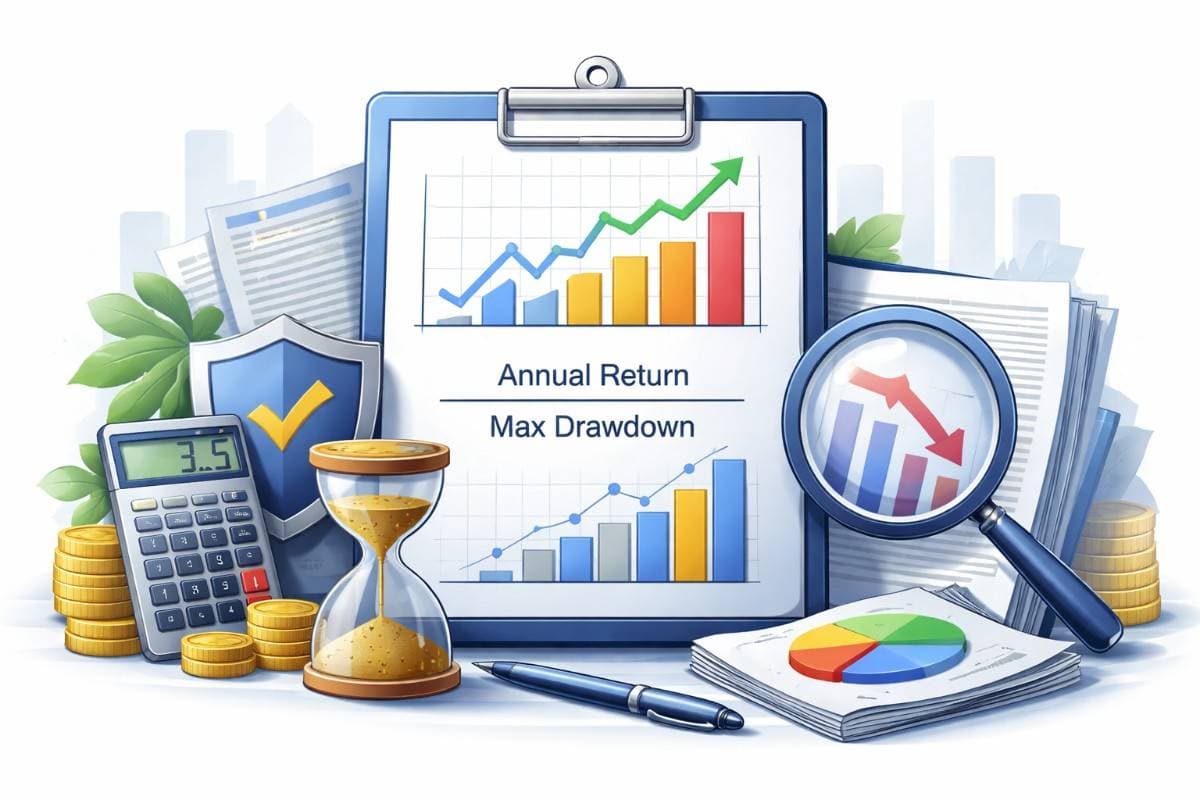
Calmar Ratio: Calmar Ratio Explained and How It Measures Downside Risk
The Calmar Ratio is a performance metric used in finance to evaluate the risk-adjusted returns of an investment, particularly focusing on downside risk rather than overall volatility. It was originally developed to assess the performance of commodity trading advisors, but over time it has become widely used across hedge funds, mutual funds, and portfolio management strategies. Unlike traditional measures that rely heavily on standard deviation, the Calmar Ratio concentrates on how well an investment compensates investors for the worst losses they may experience over a defined period, typically three years. At its core, the Calmar Ratio compares an investment’s average annual return with its maximum drawdown. This makes it especially relevant for investors who prioritize capital preservation and want to understand how severe losses can be during unfavorable market phases. By emphasizing drawdowns, the ratio aligns closely with real investor behavior, since large losses often matter more psychologically and financially than short-term fluctuations. As a result, the Calmar Ratio offers a more practical lens through which long-term performance can be judged.
Read more
Annual Percentage Yield (APY): The Real Return on Your Savings and How to Maximise It
Annual Percentage Yield, or APY, is the percentage that shows how much money you can earn on a deposit or investment over one year when compounding is included. Unlike a simple interest rate that tells you only the base rate paid on your balance, APY captures the effect of interest being added to your account and then earning interest on itself. This matters because compounding is what turns small differences in rates into meaningful differences in outcomes over time, especially when your savings horizon extends beyond a few months. Banks, credit unions, and many financial products use APY to communicate returns in a consistent way, making it easier to compare accounts even if they compound at different frequencies. When you are choosing between savings accounts, fixed deposits, money market accounts, or certificates of deposit, APY is often the most honest single number for expected annual growth, provided the terms are comparable and you understand any conditions attached to the stated yield.
Read more
C-Suite: The Role of the C-Suite in Corporate Strategy and Long-Term Growth
The C-Suite represents the highest level of executive leadership within an organisation and plays a decisive role in shaping corporate strategy. Executives such as the Chief Executive Officer, Chief Financial Officer, Chief Operating Officer, and other chief officers are responsible for defining the long-term vision and ensuring that every strategic initiative aligns with the company’s mission and market position. In finance-driven organisations, this vision is not limited to growth targets alone but also includes capital allocation discipline, risk appetite, and sustainable value creation. By setting clear priorities, the C-Suite ensures that resources are channelled toward initiatives that generate durable competitive advantages rather than short-term gains. Beyond defining direction, the C-Suite acts as the primary decision-making body during periods of uncertainty. Economic cycles, interest rate shifts, regulatory changes, and technological disruption demand a forward-looking perspective that only experienced senior leaders can provide. Through scenario planning and data-driven analysis, C-Suite executives guide organisations in adapting strategy while maintaining long-term objectives. Their collective judgement often determines whether a company can successfully navigate volatility and emerge stronger over time.
Read more
Annual Percentage Rate (APR): The True Cost of Borrowing and How to Use It Wisely
Annual Percentage Rate, commonly known as APR, is a standardised way to express the yearly cost of borrowing money. Instead of looking only at the interest rate printed on a loan or credit product, APR attempts to reflect the broader cost of credit by incorporating certain fees and charges that borrowers typically pay to access that loan. This matters because two loans can advertise the same interest rate yet cost very different amounts once upfront fees, processing charges, and other costs are included. APR exists to create an apples-to-apples comparison across lenders and products, so a borrower can evaluate which option is actually cheaper over time. In everyday use, you will encounter APR with credit cards, personal loans, auto loans, student loans, mortgages, and business financing. When you understand APR properly, it becomes a practical tool for decision-making, because it helps you see what you are paying for the privilege of using someone else’s money and how that cost changes with time, fees, and repayment behaviour.
Read more
Angel Investors: How Early-Stage Backers Fuel Startups and Shape Long-Term Value
Angel investors are individuals who invest their own money into early-stage startups, typically before a company can raise institutional venture capital or secure meaningful bank financing. Because they invest at the riskiest point in a company’s lifecycle, angels often focus on potential rather than proof, backing founders, product vision, and market timing when revenue and traction may still be emerging. In practice, angel capital can fund the first working prototype, initial hires, early marketing tests, regulatory filings, or the runway needed to reach a milestone such as product-market fit or a seed round. This makes angels especially important in the “gap” between bootstrapping and institutional funding, where a company is too early for traditional investors but too ambitious to grow on personal savings alone. Beyond money, angels frequently become high-leverage partners: they introduce talent, customers, and later-stage investors, and they help founders avoid early mistakes in pricing, positioning, hiring, and governance. For startups, the right angel is not just a cheque, it is an early signal of credibility and an accelerator of execution.
Read more