Company Overview
Taiwan Semiconductor Manufacturing Company (TSMC) is the world's largest contract chipmaker, producing chips designed by companies such as Apple, Nvidia, AMD and Qualcomm. Its shares trade in Taiwan (2330) and as American depositary receipts on the NYSE under the ticker TSM.
TSMC was founded in 1987 by Morris Chang and pioneered the dedicated foundry model.
It became the leading manufacturer of advanced chips.
Latest Quarterly Results: Q3 2026
TSMC reported third-quarter 2026 results on October 15, 2026.
Gross margin eased from 67.7% in the second quarter, partly reflecting the cost of ramping overseas fabs and new process nodes. AI demand continues to drive the high-performance computing platform.
Business Model and Revenue Drivers
TSMC leads in advanced process technologies such as 3-nanometer and 2-nanometer, which are used for the most powerful processors.
Demand for AI accelerators has made high-performance computing TSMC's largest platform.
TSMC is building fabs in Arizona, Japan and Germany in addition to Taiwan.
Competitive Landscape
TSMC competes with Samsung Foundry and Intel Foundry.
Its technology lead and manufacturing scale are key advantages.
Revenue Growth and Financial Performance
When reviewing Taiwan Semiconductor Manufacturing's reported results, these measures give the clearest view of growth, profitability and cash generation:
- Revenue by technology node
- Revenue by platform
- Gross margin
- Capital expenditure
- Utilization rates
Profitability and Earnings Quality
Revenue growth is only part of the picture. For Taiwan Semiconductor Manufacturing, it helps to check whether growth comes from higher volumes, higher prices or acquisitions, and whether margins are widening or narrowing as the business scales.
Reported earnings can include one-time items such as restructuring charges, asset sales, tax effects or legal settlements. Separating these from recurring operating results, and comparing like-for-like periods, gives a more reliable view of underlying profitability.
Balance Sheet, Debt and Financial Stability
A review of Taiwan Semiconductor Manufacturing's financial position starts with cash, total debt, lease obligations and how operating cash flow compares with capital spending. A business that funds its investment from its own cash flow is in a different position from one that relies on borrowing or issuing new shares.
Changes in inventory, receivables and working capital are also worth monitoring, because they can absorb cash and signal shifts in demand before they appear in revenue.
TSM Stock Valuation Analysis
Measures such as the price-to-earnings ratio, price-to-sales ratio and enterprise value to EBITDA describe how the market is currently pricing Taiwan Semiconductor Manufacturing relative to its results.
However, a single valuation ratio cannot establish whether a stock is undervalued or overvalued. Earnings quality, free cash flow, margins, competitive position and the growth needed to support the current price all need to be considered together, and compared with similar companies.
Business Outlook and Investment Risks
Management guidance and industry conditions shape expectations for Taiwan Semiconductor Manufacturing, but guidance is an estimate rather than an established outcome. Several uncertainties are specific to this business:
- Geopolitical tension involving Taiwan
- Customer concentration
- High capital requirements
- Higher costs at overseas fabs
From Chip Design To Production
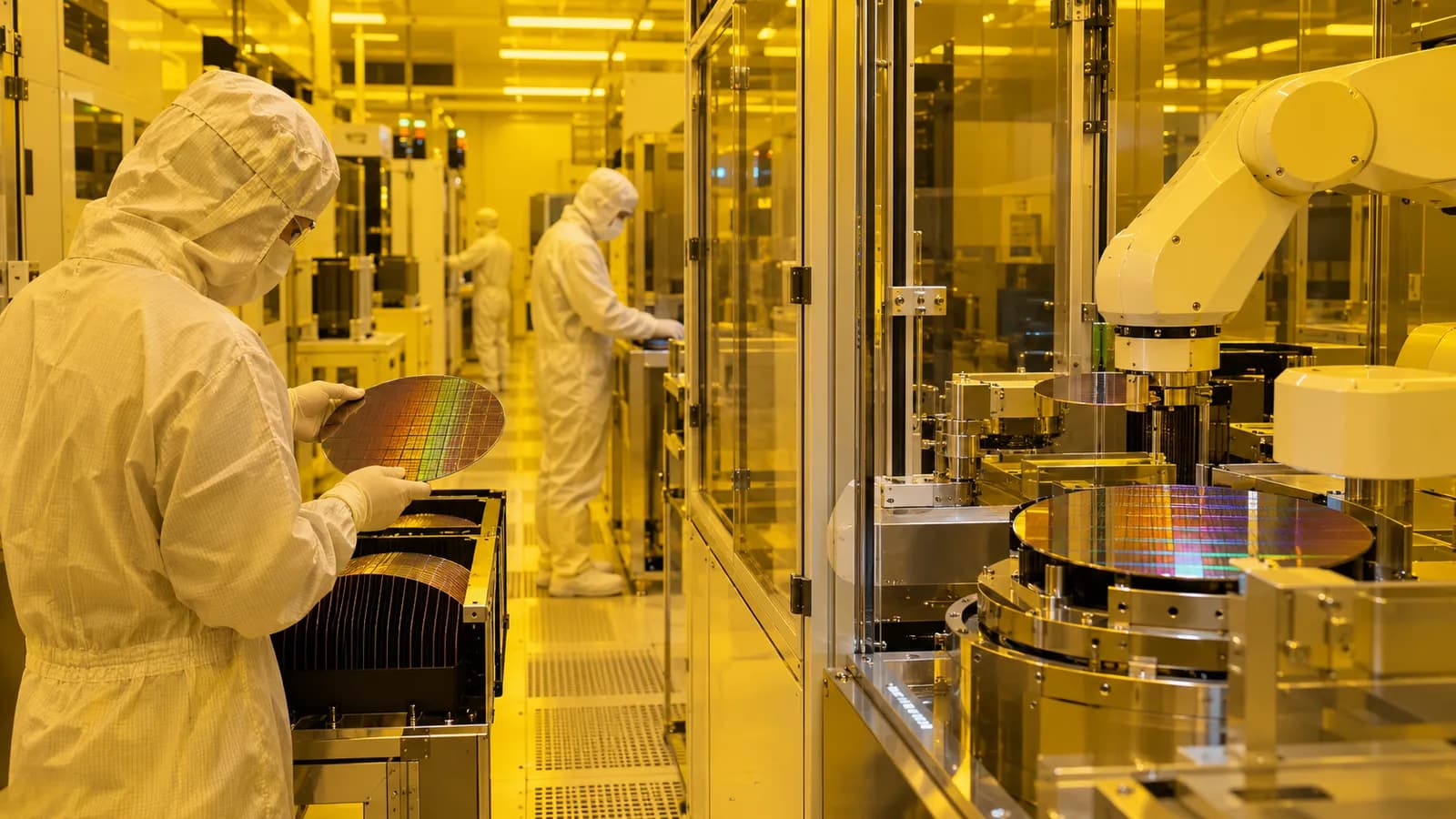
A chip designer and a foundry divide a complex production process. The designer specifies the circuit and uses design software to prepare a layout for a particular manufacturing process. The foundry provides design rules and technical information that help the customer make a layout the factory can produce. Libraries of reusable circuit elements and interfaces also help designers work within those rules. This coordination matters because a design that works in simulation must still be manufacturable at scale.
Before volume production, a design typically goes through verification and a fabrication run that tests whether the physical chip works as intended. Changes can require revised masks, the patterned tools used to transfer circuit features onto wafers. Manufacturing then involves many repeated steps of depositing, patterning and removing materials. The time and expense involved in completing these steps help explain why customers plan designs and production capacity well before finished chips reach their own customers.
The foundry's role also extends beyond making a single processor. A product can contain chips made with different manufacturing processes, each selected for its function. Memory interfaces, analog circuits and power management components do not necessarily benefit from the same process as a dense computing core. This gives established processes continuing industrial uses, even when public discussion focuses on the smallest circuit features. Revenue mix therefore reflects a range of technical requirements rather than a simple ladder of old and new technology.
Yield And Factory Economics
A wafer holds many copies of a chip design, but not every copy necessarily passes testing. Yield describes the share of usable output from a production process. Defects, design characteristics and process variation can all affect the result. Larger chips have more area exposed to possible defects, so comparisons across products require care. A foundry works with customers to identify problems and improve manufacturability, while testing separates functioning chips from those that fail specifications.
Factory economics depend on how fixed costs are spread across output. Equipment, buildings and engineering teams must be supported even when some production capacity is idle. As a new process is introduced, initial output may be limited while engineers refine the production flow and customers complete product qualifications. The cost per usable chip depends on both the amount produced and the share that passes testing. Those factors make a change in reported profitability more complex than a simple change in factory loading.
Depreciation provides another lens on these economics. Spending on a factory or manufacturing tool is generally recorded as an asset and then recognized as an expense over its accounting life, rather than entirely when the cash is paid. Consequently, the timing of cash outflows and the timing of expense recognition differ. Reviewing additions to property and equipment alongside depreciation can help explain why accounting profit and cash flow convey different aspects of the same expansion.
Packaging And The Supplier Network
Fabrication is only part of the journey from a wafer to a working electronic system. Wafers are cut into individual chips, which must be connected, protected and tested before use. Packaging provides electrical connections and a physical structure for those chips. Advanced packaging can place multiple components close together in one package, allowing designers to combine specialized chips rather than put every function on a single piece of silicon. The approach introduces its own engineering and manufacturing requirements.
The industry relies on a network of equipment makers, materials suppliers, software providers, assembly specialists and testing companies. A foundry must coordinate these inputs with customer designs and production schedules. Bottlenecks can occur at stages other than wafer fabrication, so a discussion of manufacturing capacity is more useful when it identifies the relevant process and production step. Packaging capacity, for example, serves a different function from the equipment used to make wafers.
Technical collaboration also shapes how foundries differ in approach. Customers need process documentation, design tools, intellectual property and support that work together as an ecosystem. A manufacturing process is therefore more than a feature size: its practical use depends on design compatibility, performance characteristics and production experience. When comparing foundries, it helps to distinguish announced process capabilities from processes that customers have qualified for particular products and volumes.
Reading Segment And Currency Disclosures
Technology and platform breakdowns answer different questions. A technology breakdown groups revenue by manufacturing process, while a platform breakdown groups it by the application served. A computing customer can use more than one process, and the same process can support several applications. The categories should therefore not be added together as if they described separate businesses. Changes in their shares can reflect a shift in the composition of total revenue as well as changes in individual categories.
Currency translation adds another layer when comparing reported results. TSMC prepares financial statements in Taiwan dollars, while some operating discussions and the ADR market use US dollars. Exchange rate changes can alter translated figures even if the underlying activity is unchanged. For a consistent comparison, check the reporting currency and period used in each figure, and distinguish a translation effect from changes in wafer shipments, product mix or operating costs. Exchange rates can also affect revenue and expenses differently when they arise in different currencies.
Conclusion: Is TSM Stock Worth Analyzing in 2027?
Taiwan Semiconductor Manufacturing has a business model with clear drivers that can be tracked through its reported results, and a set of risks that are specific to its industry and financial position.
A balanced assessment considers growth, profitability, balance-sheet strength, valuation and risk together. TSM is a company worth monitoring for what its results reveal about its business.