Company Overview
SPCX is the Nasdaq ticker for SpaceX, formally Space Exploration Technologies Corp. SpaceX designs, builds and launches rockets and spacecraft, and operates the Starlink satellite internet network.
SpaceX was founded by Elon Musk with the goal of reducing the cost of space access. It developed the Falcon 1, Falcon 9 and Falcon Heavy rockets, and the Dragon spacecraft.
SpaceX became the first private company to send astronauts to the International Space Station, and Starlink grew into a major global internet service.
Latest Quarterly Results: Q3 2026
SpaceX reported third-quarter 2026 results on October 20, 2026, its first quarters as a public company.
SPCX is the Nasdaq ticker for Space Exploration Technologies Corp., which listed in June 2026.
The Super Intelligence (AI) segment generated $7.6 billion of Q3 revenue, ahead of Connectivity. Net income exceeded operating income of $2.8 billion, partly because of other income items, so the composition of earnings is worth reading closely. For the first nine months, SpaceX still reported a net loss of $413 million.
Business Model and Revenue Drivers
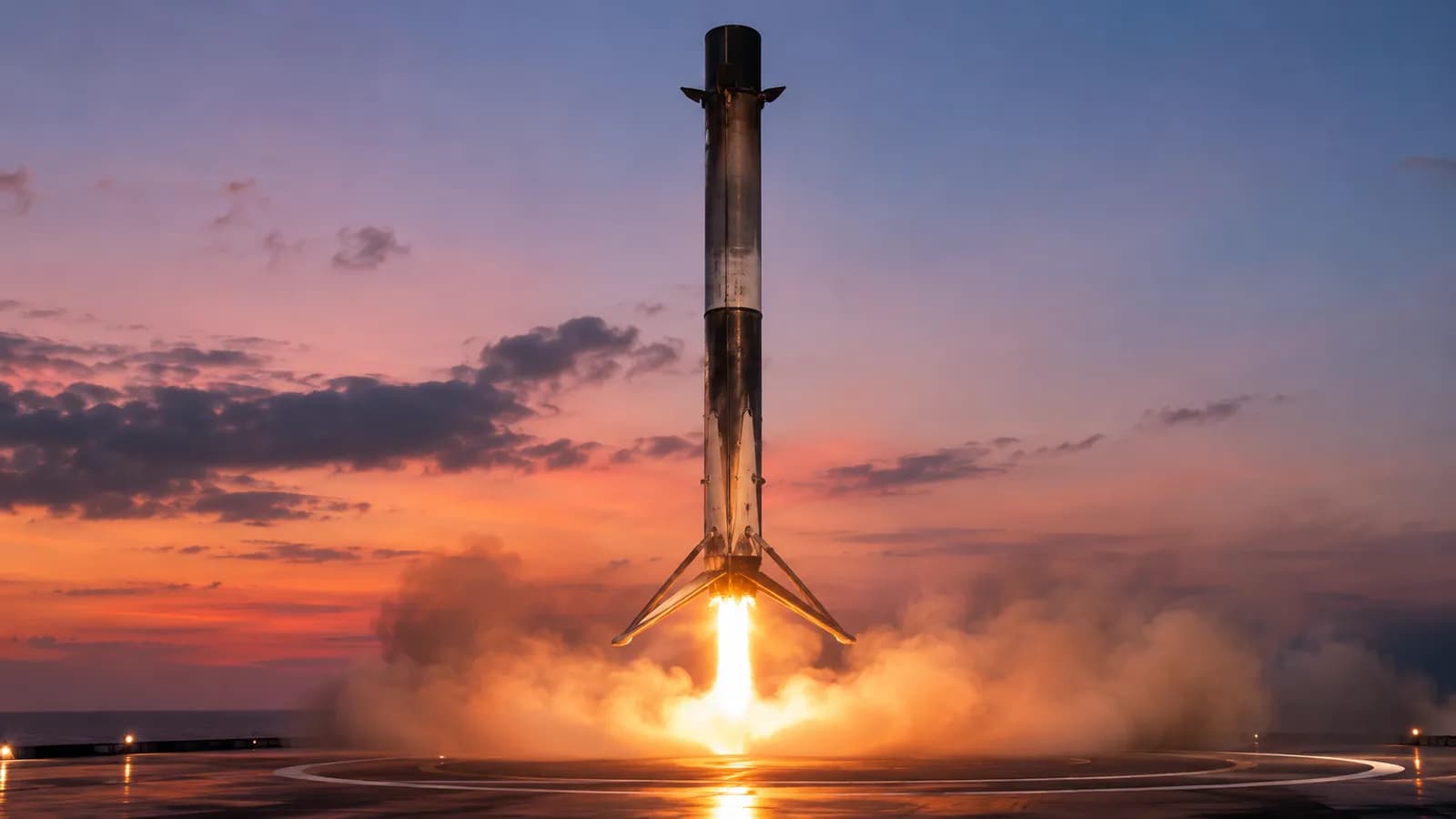
The reusable Falcon 9 first stage changed launch economics by allowing boosters to land and fly again. Dragon carries cargo and astronauts, and Starship is a fully reusable heavy-lift vehicle under development.
Starlink delivers internet through thousands of low-Earth-orbit satellites to households, businesses, ships, aircraft and governments. As a subscription service, it is a recurring revenue business rather than contract-by-contract launches.
Government and defense contracts for launches, crew transport and satellite services are another major source of work.
Competitive Landscape
In launch services, SpaceX competes with United Launch Alliance, Blue Origin, Rocket Lab, Arianespace and others. In satellite internet, it competes with Amazon's Project Kuiper, OneWeb and traditional satellite operators.
Reusability, launch frequency and Starlink's scale are its key competitive advantages.
Revenue Growth and Financial Performance
When reviewing SpaceX's reported results, these measures give the clearest view of growth, profitability and cash generation:
- Launch frequency and cost per launch
- Starlink subscribers and average revenue per user
- Satellite manufacturing and deployment rate
- Government and defense contract awards
- Starship test and development milestones
Profitability and Earnings Quality
Revenue growth is only part of the picture. For SpaceX, it helps to check whether growth comes from higher volumes, higher prices or acquisitions, and whether margins are widening or narrowing as the business scales.
Reported earnings can include one-time items such as restructuring charges, asset sales, tax effects or legal settlements. Separating these from recurring operating results, and comparing like-for-like periods, gives a more reliable view of underlying profitability.
Balance Sheet, Debt and Financial Stability
A review of SpaceX's financial position starts with cash, total debt, lease obligations and how operating cash flow compares with capital spending. A business that funds its investment from its own cash flow is in a different position from one that relies on borrowing or issuing new shares.
Changes in inventory, receivables and working capital are also worth monitoring, because they can absorb cash and signal shifts in demand before they appear in revenue.
SPCX Stock Valuation Analysis
Measures such as the price-to-earnings ratio, price-to-sales ratio and enterprise value to EBITDA describe how the market is currently pricing SpaceX relative to its results.
However, a single valuation ratio cannot establish whether a stock is undervalued or overvalued. Earnings quality, free cash flow, margins, competitive position and the growth needed to support the current price all need to be considered together, and compared with similar companies.
Business Outlook and Investment Risks
Management guidance and industry conditions shape expectations for SpaceX, but guidance is an estimate rather than an established outcome. Several uncertainties are specific to this business:
- Technical setbacks and launch failures
- Regulatory approvals for launches and spectrum
- Competition in satellite broadband
- Concentrated leadership and large capital needs for new vehicles
Launch Contracts And Revenue Recognition
A launch contract can cover more than the flight itself. Customers may purchase mission integration, payload preparation, access to specialized facilities and other services needed to place a spacecraft in a specified orbit. A dedicated mission serves one customer's requirements, while a rideshare combines multiple payloads on a single flight. Rideshare can spread mission costs across customers, but participants must accommodate a common schedule and orbital destination. The contract terms determine which services are bundled and which are priced separately.
Contract awards, scheduled missions and recognized revenue describe different stages of a commercial relationship. A signed agreement may include milestones, deposits, cancellation terms or conditions tied to mission readiness. Revenue recognition depends on the promised goods and services and when control transfers under the applicable accounting rules. Contract liabilities can arise when a customer pays before the related work is recognized as revenue. Reading these balances alongside the contract disclosures helps explain why cash receipts and reported revenue may occur in different periods.
Satellite Network Economics
A satellite broadband service requires ground infrastructure as well as spacecraft. User terminals communicate with satellites, while gateways connect the network to terrestrial internet infrastructure. Satellites and ground equipment must be coordinated to route traffic, manage interference and maintain service as spacecraft move across the sky. The network's effective capacity depends on geography, available spectrum, equipment and how demand is distributed. A subscriber count alone therefore says little about the experience of users in a particular location.
Customer economics also depend on the relationship between subscription revenue and the costs of equipment, installation, support and network operation. Terminal sales or subsidies can affect the timing and margin of revenue associated with a new customer. Business, maritime and aviation customers may require different equipment, service commitments and support from residential users. Disclosures about customer mix and equipment economics can therefore make aggregate connectivity revenue more informative than an undifferentiated subscriber total.
Depreciation And Asset Replacement
Building a satellite network or launch infrastructure creates assets whose costs are generally recognized over their estimated useful lives rather than entirely when cash is spent. Depreciation allocates the recorded cost of qualifying assets across accounting periods. The expense depends on judgments about useful life, residual value and when an asset is ready for use. These judgments matter when comparing operating margins across companies with different asset mixes or accounting estimates.
Depreciation is not a direct measure of the cash needed to replace assets in a particular period. Replacement spending depends on the physical condition of equipment, technology choices and the scope of the network. A company's notes on property and equipment can show broad asset categories, while capital expenditure disclosures show cash invested during the period. Together, these help readers distinguish the accounting allocation of past spending from current construction and replacement activity.
Vertical Integration And Mission Assurance
SpaceX combines activities that other aerospace businesses may divide among separate suppliers and operators. Bringing design, manufacturing and operations closer together can improve coordination and allow engineering feedback from missions to inform later production. It also places more responsibility for factory capacity, component quality and technical decisions within the company. Comparisons with peers are more useful when they account for which activities each company performs itself and which it purchases from outside suppliers.
Mission assurance involves testing, documentation, inspections and configuration control intended to verify that a vehicle and its payload are ready for flight. Customer requirements can vary: a mission carrying people or a sensitive government payload may call for a different review process from a commercial satellite launch. These processes use engineering time and facilities, and their costs can differ across contracts. A larger number of missions does not by itself reveal the complexity or resource requirements of the work performed.
Conclusion: Is SPCX Stock Worth Analyzing in 2027?
SpaceX has a business model with clear drivers that can be tracked through its reported results, and a set of risks that are specific to its industry and financial position.
A balanced assessment considers growth, profitability, balance-sheet strength, valuation and risk together. SPCX is a company worth monitoring for what its results reveal about its business.