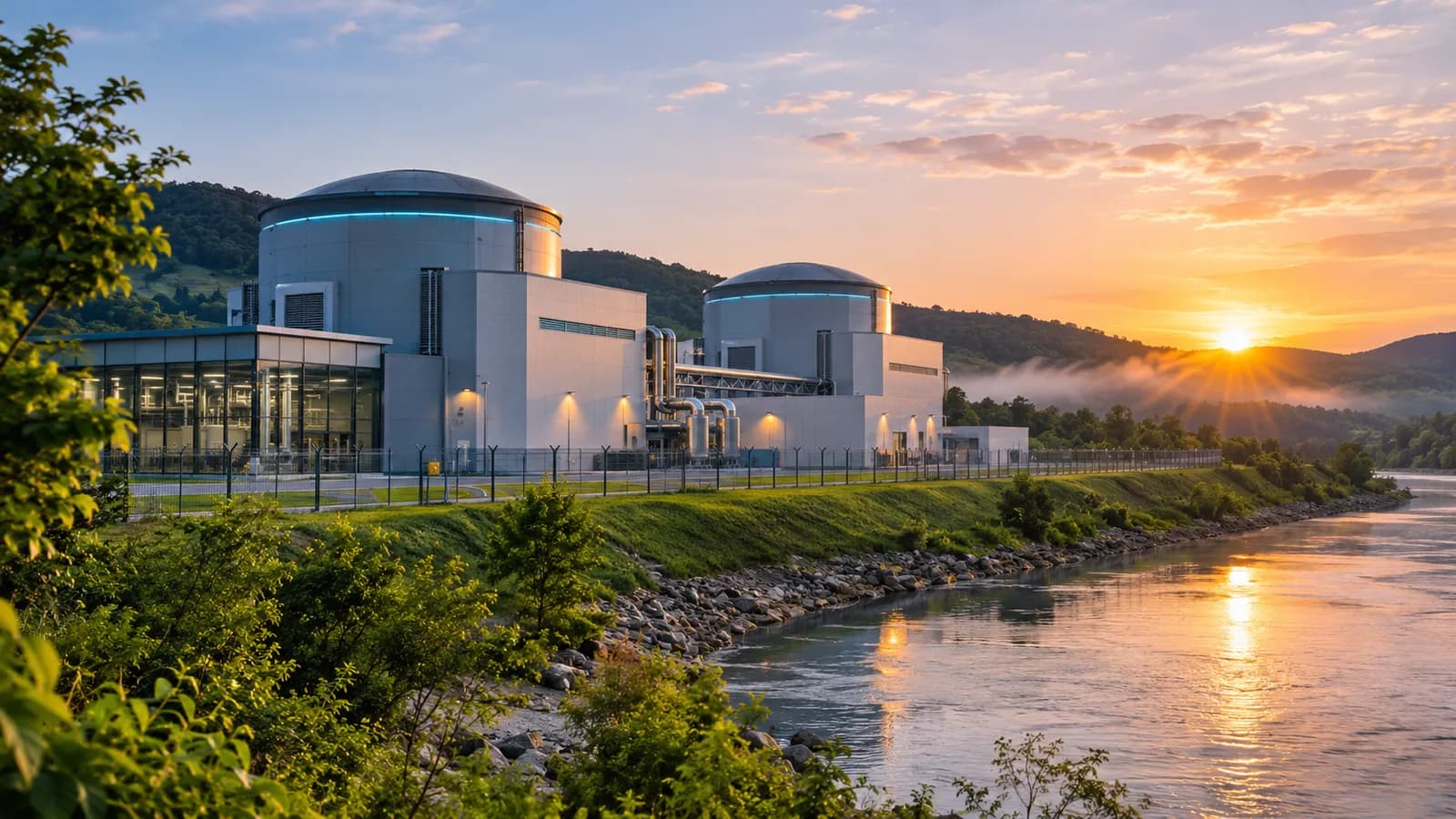
Company Overview
NuScale Power designs small modular reactors (SMRs), factory-built nuclear power modules that can be combined to create plants of different sizes. It trades on the NYSE under the ticker SMR. NuScale's design was the first small modular reactor to receive design approval from the U.S. Nuclear Regulatory Commission.
NuScale grew out of research at Oregon State University and was later backed by engineering firm Fluor. It became public through a merger with a special purpose acquisition company.
Its design received U.S. Nuclear Regulatory Commission approval, a major milestone for small modular reactors.
Latest Quarterly Results: Q3 2026
NuScale Power reported third-quarter 2026 results in early November 2026.
The prior-year loss included a large one-time milestone expense, which is why the loss narrowed so much. The quarter's main event was a reactor coolant system fabrication agreement with Doosan Enerbility.
Revenue fell because engineering work from the prior year did not repeat, showing how uneven revenue can be before commercial plants are built.
Business Model and Revenue Drivers
NuScale earns revenue mainly from engineering services and early equipment work, while large-scale revenue depends on customers committing to build plants.
Interest in nuclear power has grown with rising electricity demand from data centers and the need for carbon-free baseload power.
Fluor is a major shareholder, and NuScale has formed partnerships to deploy its plants.
Competitive Landscape
NuScale competes with other SMR developers such as GE Vernova Hitachi, TerraPower, X-energy, Kairos Power and Oklo, as well as large reactor designs.
Regulatory approvals, cost per megawatt and customer commitments are key competitive factors.
Revenue Growth and Financial Performance
When reviewing NuScale Power's reported results, these measures give the clearest view of growth, profitability and cash generation:
- Revenue and backlog
- Signed plant agreements
- Cash and liquidity
- Operating expenses
- Regulatory milestones
Profitability and Earnings Quality
Revenue growth is only part of the picture. For NuScale Power, it helps to check whether growth comes from higher volumes, higher prices or acquisitions, and whether margins are widening or narrowing as the business scales.
Reported earnings can include one-time items such as restructuring charges, asset sales, tax effects or legal settlements. Separating these from recurring operating results, and comparing like-for-like periods, gives a more reliable view of underlying profitability.
Balance Sheet, Debt and Financial Stability
A review of NuScale Power's financial position starts with cash, total debt, lease obligations and how operating cash flow compares with capital spending. A business that funds its investment from its own cash flow is in a different position from one that relies on borrowing or issuing new shares.
Changes in inventory, receivables and working capital are also worth monitoring, because they can absorb cash and signal shifts in demand before they appear in revenue.
SMR Stock Valuation Analysis
Measures such as the price-to-earnings ratio, price-to-sales ratio and enterprise value to EBITDA describe how the market is currently pricing NuScale Power relative to its results.
However, a single valuation ratio cannot establish whether a stock is undervalued or overvalued. Earnings quality, free cash flow, margins, competitive position and the growth needed to support the current price all need to be considered together, and compared with similar companies.
Business Outlook and Investment Risks
Management guidance and industry conditions shape expectations for NuScale Power, but guidance is an estimate rather than an established outcome. Several uncertainties are specific to this business:
- Long timelines before plants are built
- Cost overruns and customer financing
- Competition from other reactor designs
- Share dilution
From Design To Operating Plant
A reactor design is only one component of a nuclear power project. A plant also needs a suitable site, cooling arrangements, electrical connections, security systems and a workforce trained to operate it. The project owner must coordinate these elements with local authorities, the grid operator, equipment suppliers and construction contractors. Work on the reactor itself can therefore progress at a different pace from work on the surrounding plant. Reading project announcements alongside their stated scope helps distinguish a design-related achievement from progress on the complete facility.
Responsibility is divided among the technology provider, the plant owner and other contractors according to their agreements. A technology provider may supply engineering, intellectual property or specialized equipment, while the owner arranges the site and selects an operator. Construction contracts can allocate responsibility for scheduling, integration and performance in different ways. These distinctions matter when interpreting a project update: an agreement involving one participant does not necessarily establish that every participant has accepted the obligations needed to complete the plant.
Understanding Contract Revenue
The accounting for a contract depends on the promised goods and services and when control passes to the customer. Engineering services may be recognized over time as work is performed, while equipment revenue depends on the terms governing delivery and acceptance. A contract can also contain several distinct obligations. Financial statement notes describing those obligations and the methods used to measure progress help explain why a contract's headline value may differ from revenue recorded in a particular period.
Contract assets and contract liabilities provide another view of the relationship between work and billing. A contract asset can arise when work has been recognized as revenue before the company has an unconditional right to payment. A contract liability can arise when a customer pays before the related work is recognized as revenue. Changes in these balances should be read with the contract terms: billing schedules, customer acceptance requirements and the timing of work can all affect them.
Licensing And Project Responsibility
Nuclear regulation addresses both reactor design and the proposed plant. A design approval concerns the design evaluated by the regulator; a project also requires consideration of site-specific matters and the permissions applicable to construction and operation. Site characteristics, emergency planning and the identity and qualifications of the proposed operator can form part of the broader review. An announcement about a design milestone should therefore be read in the context of the separate applications and approvals relevant to a particular site.
Licensing also creates a continuing documentation and quality-control process. Equipment makers and contractors must demonstrate that work satisfies applicable requirements, and design changes may require additional review. Records linking materials, manufacturing and inspection to the approved specifications help establish that components meet those requirements. These processes affect how suppliers organize their work and how a project owner coordinates engineering and procurement across a long chain of participants.
Operating Economics Beyond The Reactor
A plant owner's economics depend on more than the capacity of its reactor modules. The full project includes site preparation, buildings, cooling systems, grid interconnection and other shared infrastructure. A plant with multiple modules may spread some common costs across more generating capacity, although the actual benefit depends on the site's design and the costs of adding each module. Comparing projects on a consistent basis requires checking which shared facilities and services are included in each reported cost figure.
Once operating, nuclear plants require fuel management, maintenance, security, staffing and periodic inspections. Planned outages can reduce electricity delivered even when a plant has substantial generating capacity. Capacity measures the maximum output under specified conditions, while electricity generation measures output over a period; capacity factor relates actual generation to the amount possible at full capacity over that period. The distinction helps explain why plants with similar stated capacity can produce different amounts of electricity.
Plant owners also have responsibilities at the end of a facility's operating life. Decommissioning involves safely removing a facility from service and managing radioactive materials under applicable rules. Spent fuel management is a separate operational and policy issue, with responsibilities shaped by the jurisdiction and relevant agreements. When reviewing project economics, the treatment of these obligations matters because a comparison focused only on construction or routine operations omits costs associated with the full plant lifecycle.
Conclusion: Is SMR Stock Worth Analyzing in 2027?
NuScale Power has a business model with clear drivers that can be tracked through its reported results, and a set of risks that are specific to its industry and financial position.
A balanced assessment considers growth, profitability, balance-sheet strength, valuation and risk together. SMR is a company worth monitoring for what its results reveal about its business.