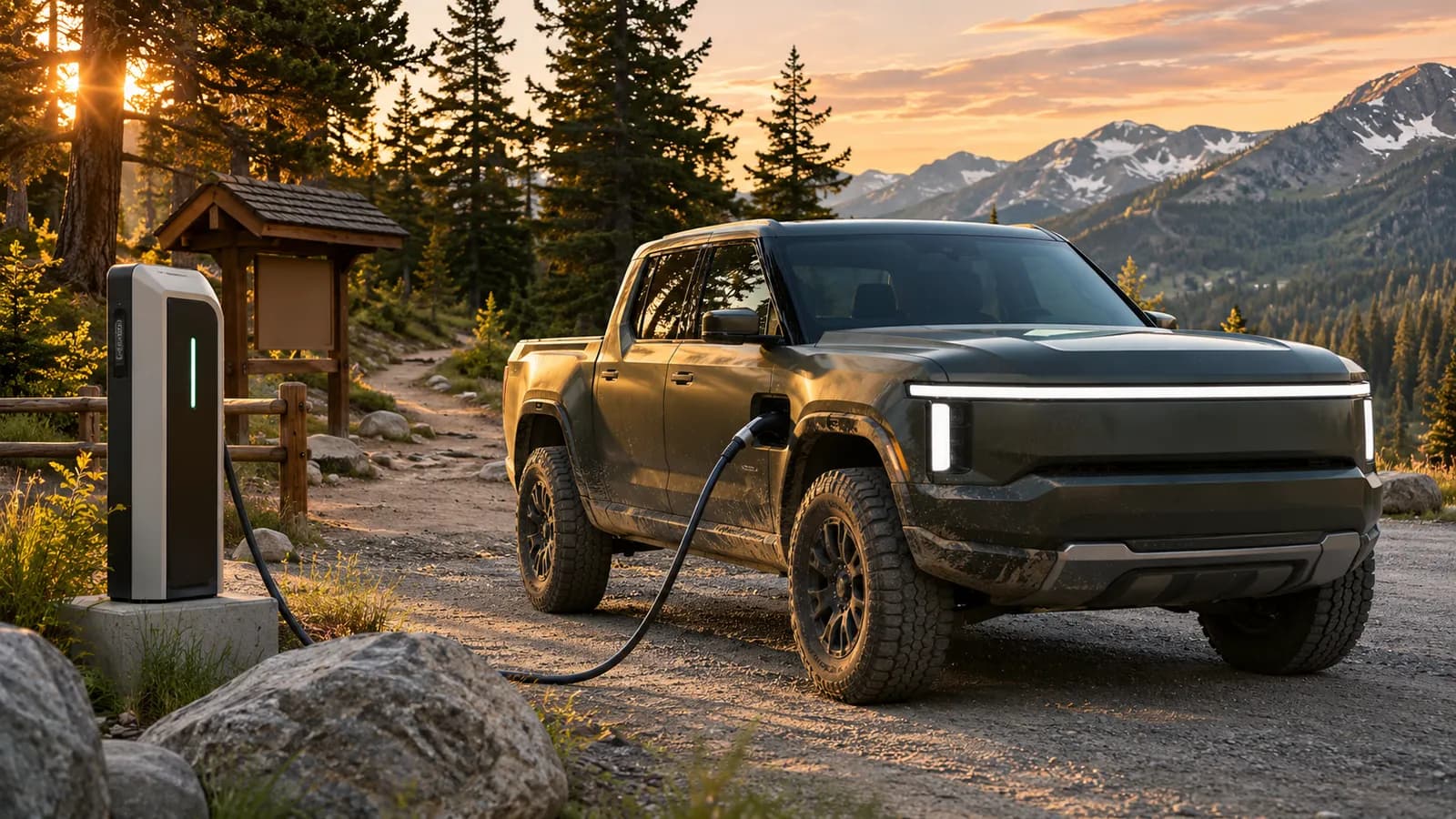
Company Overview
Rivian Automotive designs and manufactures electric vehicles and develops related software and services. Its business analysis includes vehicle demand, manufacturing scale, per-vehicle economics and investment in future products and facilities.
Rivian was founded to build electric vehicles focused on adventure and outdoor use. After years of development, it launched the R1T pickup and R1S SUV and became publicly traded through one of the largest initial public offerings of its time.
Rivian also built electric delivery vans under an agreement with Amazon, giving it a commercial business alongside consumer vehicles. Its manufacturing is centered on its plant in Normal, Illinois, and it has developed the smaller R2 platform to reach a wider market at a lower price.
Latest Quarterly Results: Q3 2026
Rivian released third-quarter 2026 results on October 29, 2026.
The R2 became Rivian's best-selling model by volume in the quarter. Rivian attributed about $120 million of extra cost to the R2 production ramp, and the automotive gross loss narrowed to $80 million from $130 million.
Adjusted EBITDA was -$435 million versus -$602 million a year earlier.
Business Model and Revenue Drivers
Production and deliveries are not the only measures of performance: product mix, pricing, warranty costs and manufacturing efficiency also matter.
The economics of an automaker can change as factories ramp, models launch and supplier or battery costs shift.
Software, services and commercial-vehicle activities should be assessed using their reported scale and profitability rather than assumed future contribution.
Competitive Landscape
Rivian competes with Tesla, established automakers such as Ford, General Motors and Hyundai that sell electric trucks and SUVs, and other EV startups. In commercial vans, it competes with traditional van makers that have introduced electric versions.
Its differentiation rests on vehicle design, off-road capability, software and brand. Competition on price has increased as more EVs enter the market, so lowering production cost is central to Rivian's ability to compete.
Revenue Growth and Financial Performance
When reviewing Rivian Automotive's reported results, these measures give the clearest view of growth, profitability and cash generation:
- Deliveries, production and inventory levels
- Automotive gross profit and margin, including disclosed cost adjustments
- Cash, operating cash flow, capital expenditure and liquidity
- Average selling price, warranty costs and manufacturing utilization
- Research and development spending and share dilution
Profitability and Earnings Quality
Revenue growth is only part of the picture. For Rivian Automotive, it helps to check whether growth comes from higher volumes, higher prices or acquisitions, and whether margins are widening or narrowing as the business scales.
Reported earnings can include one-time items such as restructuring charges, asset sales, tax effects or legal settlements. Separating these from recurring operating results, and comparing like-for-like periods, gives a more reliable view of underlying profitability.
Balance Sheet, Debt and Financial Stability
A review of Rivian Automotive's financial position starts with cash, total debt, lease obligations and how operating cash flow compares with capital spending. A business that funds its investment from its own cash flow is in a different position from one that relies on borrowing or issuing new shares.
Changes in inventory, receivables and working capital are also worth monitoring, because they can absorb cash and signal shifts in demand before they appear in revenue.
RIVN Stock Valuation Analysis
Measures such as the price-to-earnings ratio, price-to-sales ratio and enterprise value to EBITDA describe how the market is currently pricing Rivian Automotive relative to its results.
However, a single valuation ratio cannot establish whether a stock is undervalued or overvalued. Earnings quality, free cash flow, margins, competitive position and the growth needed to support the current price all need to be considered together, and compared with similar companies.
Business Outlook and Investment Risks
Management guidance and industry conditions shape expectations for Rivian Automotive, but guidance is an estimate rather than an established outcome. Several uncertainties are specific to this business:
- Intense competition, changing incentives and consumer demand
- Manufacturing ramp challenges, supplier constraints and quality costs
- High capital needs and ongoing cash consumption
- Price reductions that affect margins and the value of existing inventory
Vehicle Revenue Recognition
A vehicle order, a vehicle produced and a completed sale represent different stages of an automaker's business. An order indicates customer interest, while production adds a finished vehicle to inventory. Revenue generally depends on transferring control to the customer, so the timing of delivery and acceptance matters. Changes in the balance between production and deliveries can therefore affect inventory and cash before they appear in vehicle revenue. The notes to the financial statements explain the company's specific recognition policies.
A reported vehicle sale can also contain more than one promise to the customer. When a contract includes distinct goods or services, accounting rules can require the transaction price to be allocated among them and recognized as each obligation is satisfied. Deferred revenue on the balance sheet represents consideration received or due for obligations that have not yet been fulfilled. Reading the revenue note alongside changes in that balance helps explain why cash collection and recognized revenue can occur in different periods.
Factory Accounting And Capacity
Manufacturing cost includes materials and labor as well as factory overhead, such as depreciation and plant support. Some overhead is assigned to inventory as vehicles are built and enters cost of revenue when those vehicles are sold. Under normal costing rules, unusually low production can leave a portion of fixed overhead unallocated and expensed in the period. Consequently, the relationship between production and reported gross profit is affected by accounting as well as the physical cost of each vehicle.
Capital spending and depreciation appear in different places and at different times. Equipment purchases generally use cash when the assets are acquired, while their depreciable cost is recognized over their useful lives. Depreciation included in vehicle inventory reaches the income statement as that inventory is sold. The cash flow statement, fixed-asset note and cost disclosures together help distinguish current spending on capacity from the accounting expense associated with assets already in service.
Commercial Fleet Economics
A fleet operator evaluates a vehicle as part of a delivery system. Purchase terms matter, but so do charging arrangements, route length, payload, maintenance schedules and the time a vehicle spends out of service. A fleet can standardize routes and charging at a depot, which makes its operating requirements different from those of a household that charges in several locations. These differences influence vehicle specifications, support arrangements and the way a manufacturer develops a commercial offering.
Commercial contracts may combine vehicle purchases with service commitments or other negotiated terms. The identity and concentration of customers can matter because a single fleet may place orders in batches and manage its own replacement schedule. Revenue can therefore be uneven even when the underlying relationship continues. Contract disclosures and customer concentration notes can clarify which activities are included in reported results and how much business depends on particular counterparties.
Software Architecture And Collaboration
A vehicle's electrical architecture connects computers, sensors and electronic components throughout the vehicle. Software coordinates functions across these systems, while updates can change supported features after delivery. Developing a common architecture across vehicle programs can reduce duplicated engineering, but integrating hardware and software still requires testing for reliability, security and compatibility. The architecture is therefore both a product design choice and an important part of the engineering process.
A technology collaboration can involve licensing intellectual property, engineering services and ownership interests in a separate entity. Each has a different accounting treatment: a payment for services can be recognized differently from a license fee, while an equity interest may be accounted for separately from operating revenue. To interpret a partnership's contribution, read the transaction terms, revenue disclosures and investment notes together. Cash received under an agreement should be distinguished from revenue earned and from any share of a venture's results.
Conclusion: Is RIVN Stock Worth Analyzing in 2027?
Rivian Automotive has a business model with clear drivers that can be tracked through its reported results, and a set of risks that are specific to its industry and financial position.
A balanced assessment considers growth, profitability, balance-sheet strength, valuation and risk together. RIVN is a company worth monitoring for what its results reveal about its business.