Company Overview
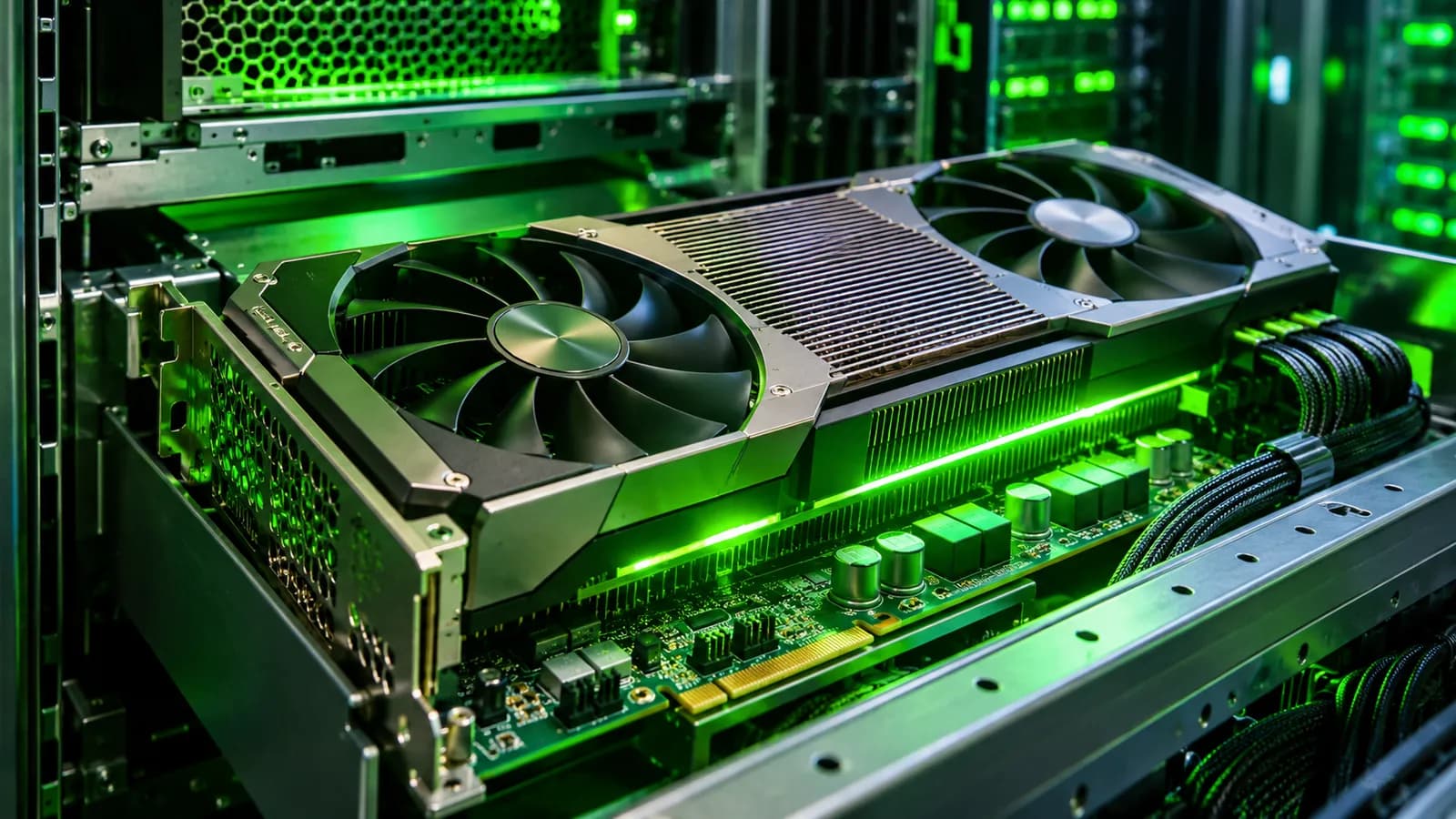
Nvidia designs graphics processing units (GPUs) and related systems used for AI, data centers, gaming, professional visualization and automotive. It trades on Nasdaq under the ticker NVDA. Data center sales of AI accelerators have become by far its largest business.
Nvidia was founded in 1993 by Jensen Huang, Chris Malachowsky and Curtis Priem.
It invented the GPU for gaming and later expanded into AI computing.
Latest Quarterly Results: Fiscal Q2 2027
Nvidia reported fiscal second-quarter 2027 results (quarter ended July 26, 2026) in late August 2026.
Data Center sales made up more than 90% of revenue. Nvidia's outlook assumed no Data Center compute revenue from China.
Analyst price targets for Nvidia vary widely because they depend on each analyst's assumptions about AI spending, margins and valuation multiples.
Business Model and Revenue Drivers
Nvidia's CUDA software platform and networking products help make its GPUs the standard for training and running AI models.
Large cloud providers and AI companies are its biggest customers, so their capital spending plans heavily influence Nvidia's results.
Analyst price targets are estimates of where individual analysts think a stock could trade over a period, usually 12 months. They are based on assumptions about future earnings and valuation and often differ widely between analysts.
Competitive Landscape
Nvidia competes with AMD, Intel and custom chips from cloud providers such as Google, Amazon and Microsoft.
CUDA software is a key advantage.
Revenue Growth and Financial Performance
When reviewing Nvidia's reported results, these measures give the clearest view of growth, profitability and cash generation:
- Data center revenue
- Gross margin
- Customer concentration
- Product transitions between chip generations
- Export restrictions
Profitability and Earnings Quality
Revenue growth is only part of the picture. For Nvidia, it helps to check whether growth comes from higher volumes, higher prices or acquisitions, and whether margins are widening or narrowing as the business scales.
Reported earnings can include one-time items such as restructuring charges, asset sales, tax effects or legal settlements. Separating these from recurring operating results, and comparing like-for-like periods, gives a more reliable view of underlying profitability.
Balance Sheet, Debt and Financial Stability
A review of Nvidia's financial position starts with cash, total debt, lease obligations and how operating cash flow compares with capital spending. A business that funds its investment from its own cash flow is in a different position from one that relies on borrowing or issuing new shares.
Changes in inventory, receivables and working capital are also worth monitoring, because they can absorb cash and signal shifts in demand before they appear in revenue.
NVDA Stock Valuation Analysis
Measures such as the price-to-earnings ratio, price-to-sales ratio and enterprise value to EBITDA describe how the market is currently pricing Nvidia relative to its results.
However, a single valuation ratio cannot establish whether a stock is undervalued or overvalued. Earnings quality, free cash flow, margins, competitive position and the growth needed to support the current price all need to be considered together, and compared with similar companies.
Business Outlook and Investment Risks
Management guidance and industry conditions shape expectations for Nvidia, but guidance is an estimate rather than an established outcome. Several uncertainties are specific to this business:
- Customer concentration among large cloud providers
- Competition from AMD, custom chips and others
- Export restrictions to China
- Changes in AI spending
From Chip Design To Finished Systems
Nvidia operates as a fabless semiconductor company: it designs chips but relies on outside manufacturers to produce them. A design must move through fabrication, packaging, testing and assembly before it becomes part of a usable product. Each stage involves different suppliers and technical constraints. Advanced packaging is particularly relevant to processors that combine multiple pieces of silicon and high bandwidth memory in a single package. A constraint at one stage can affect the availability of finished systems even when other components are ready.
The final product can range from an individual processor to a complete computing system. The mix matters when interpreting revenue because a system may contain processors, networking components and other hardware with different costs. Manufacturing commitments and supplier arrangements also shape how quickly production can be adjusted. Reading the notes on purchase obligations alongside management's discussion of supply provides context that a revenue figure alone cannot show. These obligations are commitments, not necessarily expenses recognized in the same period.
How Accelerated Computing Works
A general purpose processor is designed to handle a wide variety of tasks, while a GPU can perform many operations in parallel. That architecture is useful when a workload can be divided into similar calculations, as in rendering images or processing large arrays of data. Performance depends on more than the processor itself. Memory capacity, memory bandwidth, data movement and the way software divides work across devices can all determine how much of the available computing capability an application can use.
Training and inference place different demands on computing systems. Training adjusts a model's parameters using data and typically involves repeated calculations across large datasets. Inference uses a trained model to produce an output from a new input. Inference workloads can vary in response time requirements, batch size and memory needs. Comparing hardware for either task therefore requires an understanding of the complete workload and system configuration, rather than relying on a single theoretical performance measure.
Software affects how readily a workload can use parallel hardware. Developers must choose suitable numerical methods, manage memory and coordinate operations across processors. Libraries provide prewritten functions for common calculations, while compilers and other tools translate programs into instructions the hardware can execute. A change in application code or numerical precision can alter both speed and resource use. Meaningful comparisons therefore describe the software settings and the quality of the output as well as the hardware being used.
Networking And System Design
When a computing task spans many processors, the connections between them influence how efficiently they work together. Devices must exchange intermediate results and coordinate calculations; waiting for data can leave expensive computing resources idle. Nvidia supplies interconnect technologies as well as networking equipment used to link systems. The usefulness of these products depends on how the entire installation is designed, including the network topology, the software and the distribution of work across machines.
A larger installation also requires power delivery, cooling and physical space. These are practical elements of the system rather than details captured by a chip specification. For a customer, utilization matters: a machine that is active only part of the time spreads its fixed costs over less work. Measures such as completed tasks, energy use and response time can be more informative than peak computing capacity when assessing how a particular deployment operates.
Reading Revenue And Expense Disclosures
Revenue recognition describes when a company records a sale, which may differ from when a customer orders or pays for a product. The financial statement notes explain the relevant policies and any material contract balances. For arrangements containing several goods or services, accounting rules can require consideration to be allocated among separate obligations. The timing of recognition may then differ across components, making the composition of an arrangement useful context for comparing reporting periods.
Operating expenses are separate from the direct costs reflected in gross profit. Research and development spending supports activities such as chip design and software engineering, while sales, general and administrative expenses cover other operating functions. Stock based compensation is included in relevant expense categories, although it does not use cash at the time the expense is recognized. The cash flow statement adds it back when reconciling net income to operating cash flow; dilution is better examined through share counts and equity disclosures.
The distinction between operating cash flow and net income also reflects noncash expenses and the timing of receipts and payments. Deferred revenue can arise when payment is received before the associated obligation is fulfilled. Its presence does not by itself indicate when cash will next arrive or how much profit a contract will produce. The notes and cash flow statement should be read together to understand the nature of these balances and how they relate to the reported income statement.
Conclusion: Is NVDA Stock Worth Analyzing in 2027?
Nvidia has a business model with clear drivers that can be tracked through its reported results, and a set of risks that are specific to its industry and financial position.
A balanced assessment considers growth, profitability, balance-sheet strength, valuation and risk together. NVDA is a company worth monitoring for what its results reveal about its business.