Company Overview
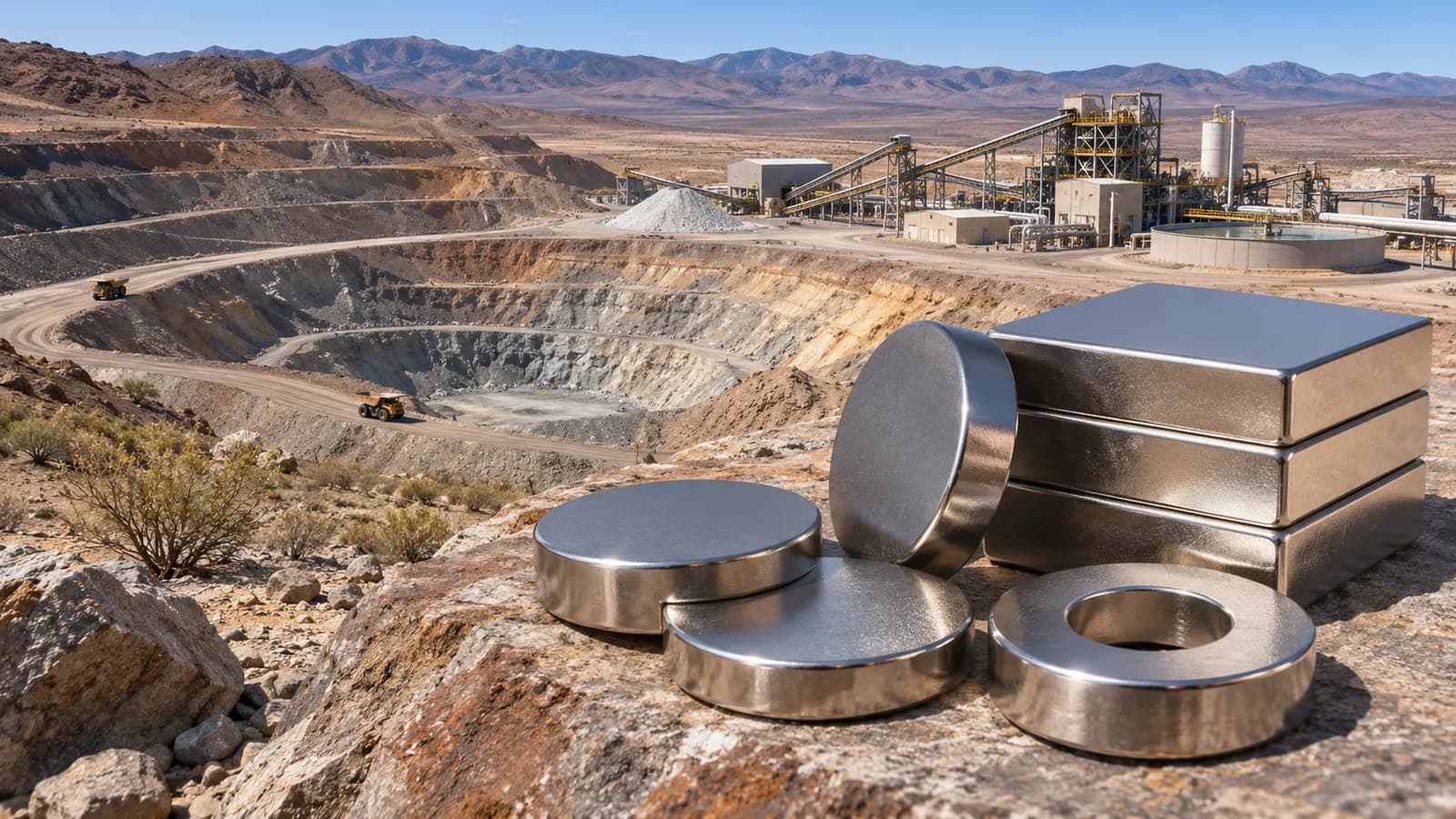
MP Materials owns and operates Mountain Pass in California, the largest rare earth mine in the Western Hemisphere. It trades on the NYSE under the ticker MP. It produces rare earth concentrate and neodymium-praseodymium (NdPr) oxide and is building magnet production in Texas.
Mountain Pass was once the world's leading rare earth source before closing in the early 2000s. MP Materials bought it in 2017.
MP went public through a SPAC merger in 2020.
Latest Quarterly Results: Q3 2026
MP Materials reported third-quarter 2026 results on November 5, 2026.
About $31.6 million of revenue came from a one-time sale of SEG+ material to a U.S. aerospace and defense customer.
General Motors magnet qualification was completed, with saleable deliveries expected to begin in the fourth quarter of 2026.
Business Model and Revenue Drivers
In 2025 the U.S. Department of Defense agreed to invest in MP Materials and set a price floor for NdPr, with price protection payments.
Magnets made from NdPr are used in electric vehicles, wind turbines, electronics and defense systems.
General Motors is a key magnet customer.
Competitive Landscape
Chinese companies dominate rare earth processing and magnets. Lynas Rare Earths is a major producer outside China.
MP is the largest U.S. rare earth producer.
Revenue Growth and Financial Performance
When reviewing MP Materials's reported results, these measures give the clearest view of growth, profitability and cash generation:
- NdPr production and sales
- Realized NdPr price
- Segment adjusted EBITDA
- Magnet production
- Capital spending
Profitability and Earnings Quality
Revenue growth is only part of the picture. For MP Materials, it helps to check whether growth comes from higher volumes, higher prices or acquisitions, and whether margins are widening or narrowing as the business scales.
Reported earnings can include one-time items such as restructuring charges, asset sales, tax effects or legal settlements. Separating these from recurring operating results, and comparing like-for-like periods, gives a more reliable view of underlying profitability.
Balance Sheet, Debt and Financial Stability
A review of MP Materials's financial position starts with cash, total debt, lease obligations and how operating cash flow compares with capital spending. A business that funds its investment from its own cash flow is in a different position from one that relies on borrowing or issuing new shares.
Changes in inventory, receivables and working capital are also worth monitoring, because they can absorb cash and signal shifts in demand before they appear in revenue.
MP Stock Valuation Analysis
Measures such as the price-to-earnings ratio, price-to-sales ratio and enterprise value to EBITDA describe how the market is currently pricing MP Materials relative to its results.
However, a single valuation ratio cannot establish whether a stock is undervalued or overvalued. Earnings quality, free cash flow, margins, competitive position and the growth needed to support the current price all need to be considered together, and compared with similar companies.
Business Outlook and Investment Risks
Management guidance and industry conditions shape expectations for MP Materials, but guidance is an estimate rather than an established outcome. Several uncertainties are specific to this business:
- Rare earth price changes
- Competition from Chinese producers
- Execution of magnet ramp
- Government policy
From Ore To Separated Products
Rare earth production begins with ore that contains a mixture of minerals, rather than a ready-to-use magnet ingredient. At Mountain Pass, beneficiation concentrates the rare earth-bearing mineral and removes some unwanted material. The concentrate must then undergo chemical treatment and separation to produce individual rare earth products. Each step has its own recovery rate, meaning the quantity of material entering a process is not the same as the quantity of saleable product leaving it. Comparing output at different stages therefore requires attention to the product description, chemical form and unit of measurement.
Separation is difficult because rare earth elements have similar chemical properties. Producers commonly use a sequence of chemical extraction steps to separate them into groups and then into individual products. Reagents, water, energy, equipment reliability and waste handling all influence the cost and consistency of this work. Product purity also matters: a material suitable for one industrial use may require further processing before it meets another customer's specifications. A facility's stated capacity describes a potential throughput under defined conditions, while actual output depends on operating time, feed quality and process performance.
The mineral deposit contains several rare earth elements in proportions determined by geology. A producer cannot simply alter those proportions to match the quantities customers want. Separating more of a desired element also produces other materials that need an outlet, storage or additional treatment. This creates a distinction between the value of the whole mineral basket and the value of any single product. When reading company disclosures, look for the mix of separated products and changes in recoveries as well as the headline amount of ore or concentrate processed.
How Magnet Manufacturing Creates Revenue
An oxide is an intermediate input, not a finished magnet. Making a neodymium-iron-boron magnet involves converting rare earth material into metal, combining it with other ingredients, and processing the alloy into a magnet with the required shape and properties. Subsequent steps can include machining, coating, magnetization and inspection. Each stage adds processing cost and can generate scrap. The revenue attached to a finished magnet reflects this wider set of activities, so a dollar of magnet sales should not be treated as directly equivalent to a dollar of oxide sales.
Industrial customers usually define magnet requirements around a particular application. Specifications can cover magnetic performance, dimensions, resistance to corrosion and behavior at elevated temperatures. Qualification tests whether a supplier's product and manufacturing process meet those requirements. A completed qualification demonstrates acceptance against a defined specification; it does not by itself establish the quantity or timing of subsequent orders. Commercial terms, delivery schedules and the customer's own production needs determine how a qualified product translates into reported sales.
When a company operates across several stages, internal transfers can complicate a segment comparison. Material produced by one segment may become an input for another, and segment reports can include transactions between them. Consolidated financial statements remove intersegment transactions so that the company's total revenue does not count the same internal sale twice. Segment measures are useful for understanding each activity, but readers should use the reconciliation in the filing before adding segment figures or comparing them with consolidated revenue. The transfer pricing method can also affect the profit shown within each segment.
Reading Production Costs And Assets
Cost of sales combines expenses associated with the products sold during a period, which need not match the full cost of everything produced in that period. Production costs can first enter inventory and then move to cost of sales when the goods are sold. As a result, a buildup or drawdown of inventory can make reported unit costs differ from the cash spent running a plant. Reviewing production and sales quantities together with inventory accounting disclosures helps explain why a change in gross margin may not have a single operational cause.
Depreciation allocates the recorded cost of long-lived assets over their useful lives. A new processing line or magnet facility can therefore affect reported operating expenses over many periods after the original construction spending. Cash spent on construction generally appears in investing cash flow, whereas depreciation is a noncash charge in earnings. The accounting treatment depends on when an asset is ready for its intended use and on the nature of the expenditure. Notes on property, plant and equipment can clarify what has been placed in service and what remains under construction.
A mining operation also records costs connected with the eventual closure and reclamation of a site. An asset retirement obligation represents the estimated present value of certain legal obligations associated with retiring an asset. Its measurement depends on assumptions such as the work required, timing and discount rate, and estimates can change. The related accounting can affect both the balance sheet and expenses over time. Looking at the obligation and its accompanying note provides context for liabilities that are distinct from ordinary trade payables or financial debt.
Supply Chains And Contract Terms
Rare earth supply chains are divided among mining, chemical separation, metal and alloy making, and magnet fabrication. A company can participate in one stage or several, while other firms specialize in individual steps. Integration gives management more direct control over handoffs and technical specifications, but it also requires different kinds of expertise and equipment. A specialist can rely on suppliers and customers for adjoining stages. Comparing business models therefore involves mapping which activities each company actually performs and which products it purchases or sells, rather than comparing mine output alone.
Contracts can specify product purity, delivery timing, quantities, pricing formulas and remedies when material does not meet a specification. These provisions shape the relationship between an industry reference price and the revenue ultimately recorded by a supplier. A reported average realized price may also reflect the mix of products and customers sold during a period. To interpret it, check the company's definition, the sales quantities in the calculation and whether the comparison covers the same material. Revenue recognition depends on the terms that determine when control of the product passes to the customer.
Government support and commercial sales can appear in different parts of a company's financial reporting. The accounting depends on the form and terms of an arrangement, including whether it involves a sale, financing, a grant or another contractual right. Cash received and income recognized can also occur in different periods. Reading the agreement description alongside the income statement, cash flow statement and relevant notes helps distinguish the economic purpose of a payment from its accounting classification. That distinction matters when comparing operating performance across periods or with companies using different arrangements.
Magnet Design And Material Choices
A permanent magnet produces a magnetic field without a continuous supply of electric current. In a motor, that field interacts with fields generated by electrical windings to create motion. Neodymium-iron-boron magnets have a strong magnetic field for their size, which can help engineers design compact motors. The relevant comparison, however, is the performance of the whole machine: motor geometry, cooling, operating speed and control electronics also affect efficiency and size. A change in magnet material may therefore require changes elsewhere in the design.
Some applications use other permanent magnet materials, while some motor designs use no permanent magnets at all. Each approach involves trade-offs among magnetic strength, temperature tolerance, weight, manufacturing complexity and operating characteristics. A customer choosing among them considers the needs of the specific device rather than the material in isolation. For a supplier such as MP Materials, this means that demand for a particular magnet material is connected to design decisions made by equipment manufacturers, as well as to the number of devices they produce.
Recycling offers another route for recovering rare earth materials from manufacturing scrap and products at the end of their useful lives. The economics depend on collecting and sorting material, separating magnets from assemblies and restoring recovered material to a usable specification. Scrap from a known manufacturing process can be easier to identify than magnets dispersed across many kinds of discarded equipment. Recycling should therefore be understood as a collection and processing system, not simply as a property of the material. Its contribution depends on access to suitable feedstock and the requirements of the eventual user.
Conclusion: Is MP Stock Worth Analyzing in 2027?
MP Materials has a business model with clear drivers that can be tracked through its reported results, and a set of risks that are specific to its industry and financial position.
A balanced assessment considers growth, profitability, balance-sheet strength, valuation and risk together. MP is a company worth monitoring for what its results reveal about its business.