Company Overview
Lam Research makes equipment used to manufacture semiconductors, especially etch and deposition tools. It trades on Nasdaq under the ticker LRCX. Its customers include memory makers and foundries such as Samsung, SK hynix, Micron and TSMC.
Lam Research was founded in 1980 by David Lam.
It became a leader in etch and deposition equipment.
Latest Quarterly Results: Fiscal Q1 2027
Lam Research reported record fiscal first-quarter 2027 results on October 21, 2026.
The shares fell about 10% after the report despite record results, as investors focused on supply constraints.
Business Model and Revenue Drivers
Lam's equipment is critical for making memory chips and advanced logic, including 3D NAND and gate-all-around transistors.
Spending on fabrication equipment is cyclical and depends on chipmakers' capital budgets.
Customer Support Business Group revenue from services and upgrades provides recurring income.
Competitive Landscape
Lam competes with Applied Materials, Tokyo Electron and KLA.
Its etch expertise is a key strength.
Revenue Growth and Financial Performance
When reviewing Lam Research's reported results, these measures give the clearest view of growth, profitability and cash generation:
- Revenue by segment and region
- Gross margin
- Wafer fabrication equipment spending
- Customer support revenue
- Share repurchases
Profitability and Earnings Quality
Revenue growth is only part of the picture. For Lam Research, it helps to check whether growth comes from higher volumes, higher prices or acquisitions, and whether margins are widening or narrowing as the business scales.
Reported earnings can include one-time items such as restructuring charges, asset sales, tax effects or legal settlements. Separating these from recurring operating results, and comparing like-for-like periods, gives a more reliable view of underlying profitability.
Balance Sheet, Debt and Financial Stability
A review of Lam Research's financial position starts with cash, total debt, lease obligations and how operating cash flow compares with capital spending. A business that funds its investment from its own cash flow is in a different position from one that relies on borrowing or issuing new shares.
Changes in inventory, receivables and working capital are also worth monitoring, because they can absorb cash and signal shifts in demand before they appear in revenue.
LRCX Stock Valuation Analysis
Measures such as the price-to-earnings ratio, price-to-sales ratio and enterprise value to EBITDA describe how the market is currently pricing Lam Research relative to its results.
However, a single valuation ratio cannot establish whether a stock is undervalued or overvalued. Earnings quality, free cash flow, margins, competitive position and the growth needed to support the current price all need to be considered together, and compared with similar companies.
Business Outlook and Investment Risks
Management guidance and industry conditions shape expectations for Lam Research, but guidance is an estimate rather than an established outcome. Several uncertainties are specific to this business:
- Semiconductor capital spending cycles
- Export restrictions to China
- Competition from Applied Materials and Tokyo Electron
- Customer concentration
Process Control Inside A Fab
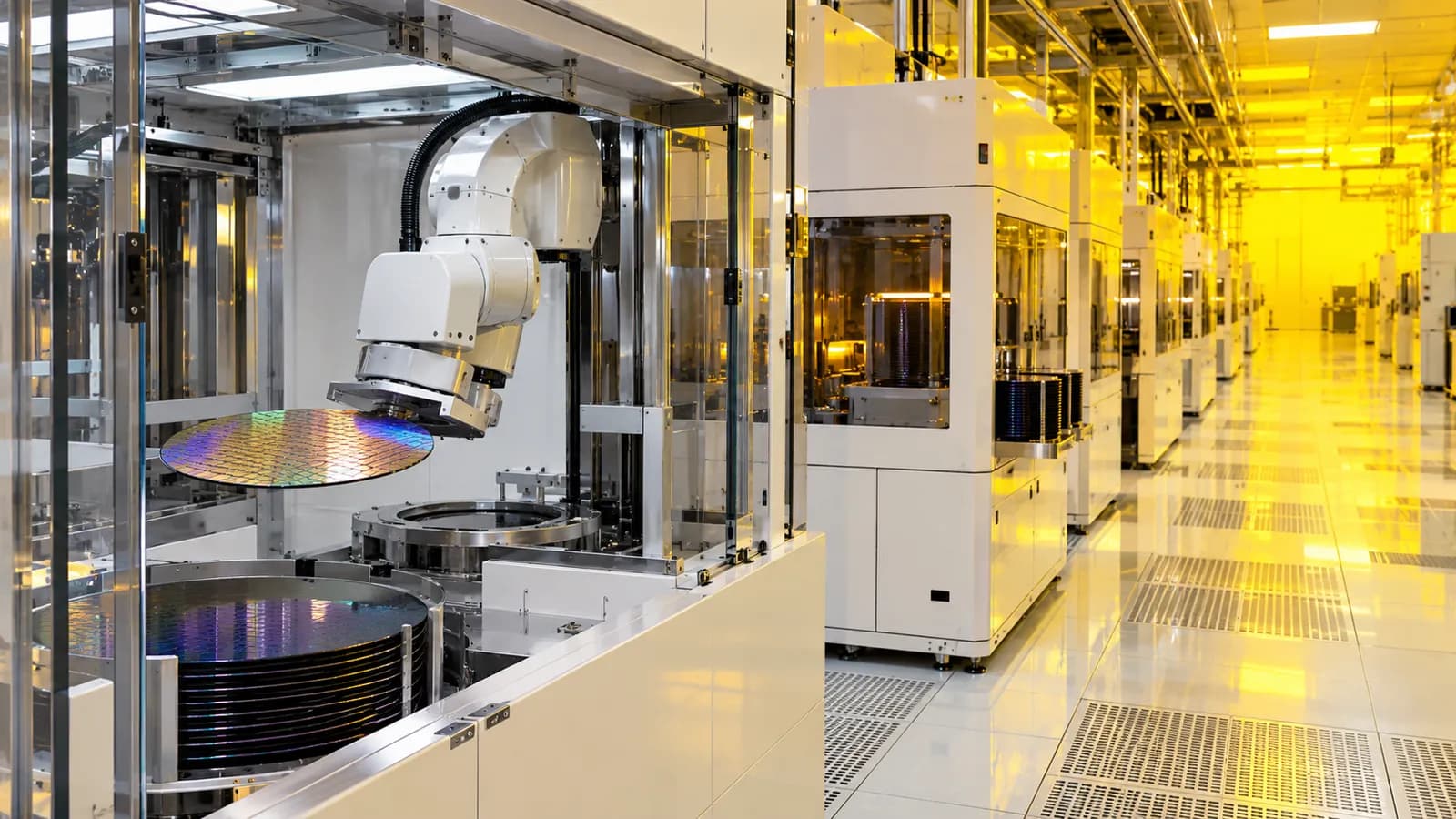
A semiconductor wafer passes through a sequence of tightly coordinated manufacturing steps. The shape produced by one operation affects the starting conditions for the next, so an etch tool is evaluated as part of a larger process rather than in isolation. Chipmakers care about whether a tool can repeat a recipe across wafers and maintain uniform results across each wafer. Small differences in physical features can affect the number of usable chips produced from a batch.
A process recipe specifies conditions inside the equipment, including the gases and other settings used to obtain the intended result. Developing a recipe involves tradeoffs between the desired feature, the materials surrounding it and the time required to process a wafer. A recipe that removes one material while preserving another can help a manufacturer maintain the intended structure. Production also requires monitoring for particles and other sources of defects that can reduce usable output.
Equipment selection therefore involves engineering work between the supplier and the chipmaker. The tool must fit the customer's materials, factory environment and quality requirements, and successful development in a laboratory must translate into repeatable operation in production. Once a process is qualified, changing equipment or recipes can require further testing. That qualification burden helps explain why technical support and a history of reliable operation matter alongside the capabilities described in product specifications.
From Equipment Order To Revenue
An equipment transaction can extend from initial discussions and configuration through shipment, installation and customer acceptance. A system may contain several processing chambers and supporting components, with its configuration tailored to the customer's intended process. Shipment and acceptance are operational milestones, while revenue recognition depends on the contract and applicable accounting requirements. Readers can use the company's accounting policies to understand which obligations must be satisfied before reported sales are recorded.
The interval between ordering and acceptance can make a single quarter an incomplete picture of activity. Factory readiness, delivery logistics and the time needed to install and test equipment can affect when a transaction appears in reported revenue. Contract liabilities or deferred revenue can provide context about payments received before the relevant performance obligations are satisfied. Their movement should be read alongside the company's explanations, since accounting balances can reflect several different contract arrangements.
Product mix also matters when interpreting results. Systems designed for different processes may have different configurations and costs, while service contracts and individual parts transactions have their own economics. A change in the proportion of these activities can affect the relationship between revenue and cost of sales even if no single product has changed price. Notes to the financial statements and management's discussion can help distinguish a mix effect from other explanations.
The Installed Base And Service Work
The installed base is the population of equipment operating at customer facilities. It creates ongoing work because chambers and other components experience wear during repeated processing and require cleaning, maintenance or replacement. Demand for a particular service depends on the equipment's age, configuration and workload, as well as the customer's maintenance practices. An installed system is therefore an opportunity for continuing support, but it does not imply a fixed amount of service revenue.
Support can take several forms, including replacement parts, field engineering and equipment upgrades. An upgrade may modify an existing system to perform a different task or improve its capabilities, allowing a customer to use equipment already in the factory for a new process. Service agreements and individual transactions differ in scope and timing. The reported support category can consequently reflect a mixture of planned maintenance, discretionary modifications and other customer activity.
Utilization is a useful concept when evaluating this business. A tool processing more wafers can consume certain parts more quickly, while a tool that is idle may need less routine intervention. The number of installed systems alone cannot show how intensively they are used or how much support their owners purchase. Comparing management's discussion of factory activity with the composition of support revenue offers a more complete operational picture.
Capacity Decisions And Technology Transitions
Chipmakers can spend on equipment to expand wafer capacity or to change the technology used in an existing facility. These decisions serve different purposes: capacity expansion increases potential output, whereas a technology conversion changes the processes used to make chips. Both can involve new tools, but the amount and type of equipment required depend on the customer's design and manufacturing plan. Grouping all spending together can obscure the reasons behind an equipment order.
Memory manufacturers face a further distinction between adding wafer starts and increasing the amount of data stored on each chip. A manufacturing change can alter the number or complexity of processing steps without a proportional change in wafer starts. For equipment suppliers, the relevant question is which process steps and tool capabilities a customer needs for the new design. A higher step count by itself does not establish how much business any particular supplier receives.
Foundries manufacture chips for other companies, so their equipment decisions reflect the needs of multiple chip designers as well as the foundry's own production strategy. Moving a design into volume manufacturing requires coordination among design rules, materials, equipment and factory processes. In both memory and foundry markets, development work can precede production orders, and the timing of factory spending may differ from the timing of demand for the finished chips.
Conclusion: Is LRCX Stock Worth Analyzing in 2027?
Lam Research has a business model with clear drivers that can be tracked through its reported results, and a set of risks that are specific to its industry and financial position.
A balanced assessment considers growth, profitability, balance-sheet strength, valuation and risk together. LRCX is a company worth monitoring for what its results reveal about its business.