What Happened to LEG Stock?
Leggett & Platt made bedding components such as innersprings, furniture and flooring products, and specialized parts for automotive and aerospace. It traded on the NYSE under LEG until August 26, 2026, when Somnigroup International (formerly Tempur Sealy) completed an all-stock combination, giving 0.1455 Somnigroup shares for each Leggett share.
Leggett & Platt was founded in 1883 in Carthage, Missouri.
Somnigroup announced the combination in 2026 and completed it on August 26, 2026.
Key Facts: Somnigroup's Combination With Leggett & Platt
Somnigroup completed its all-stock combination with Leggett & Platt on August 26, 2026.
Leggett & Platt operates as a separate business unit within Somnigroup.
How Leggett & Platt's Business Works
Leggett & Platt was a longtime supplier to Somnigroup's mattress brands.
It had cut its dividend sharply in 2024 after a long record of increases.
Leggett continues as a separate business unit within Somnigroup.
Somnigroup and Other Bedding Companies
Bedding component makers and mattress companies such as Sleep Number and Purple operate in the same industry.
Somnigroup owns Tempur-Pedic, Sealy, Mattress Firm and Dreams.
Measures That Described Leggett
These measures were central to Leggett's results:
- Bedding volumes
- Raw material costs
- Margins
- Debt
- Integration synergies
Considerations After the Merger
The merger changes how Leggett can be followed:
- No standalone LEG stock
- Housing and furniture demand
- Steel costs
- Integration into Somnigroup
From Wire To Finished Bedding
A mattress reaches a customer through several layers of production. A component supplier can draw and form wire, assemble spring units, and provide other materials to a mattress manufacturer. The manufacturer combines those inputs with cushioning, fabric, and other elements, then sells the finished product through retailers or directly to consumers. Each stage performs a different task and has its own costs. A change in finished mattress sales does not necessarily pass immediately or proportionately through every layer, because customers can adjust their inventories and product mix before changing component orders. A retailer's own stocking decisions can add another delay between a change in consumer purchases and a supplier's production schedule.
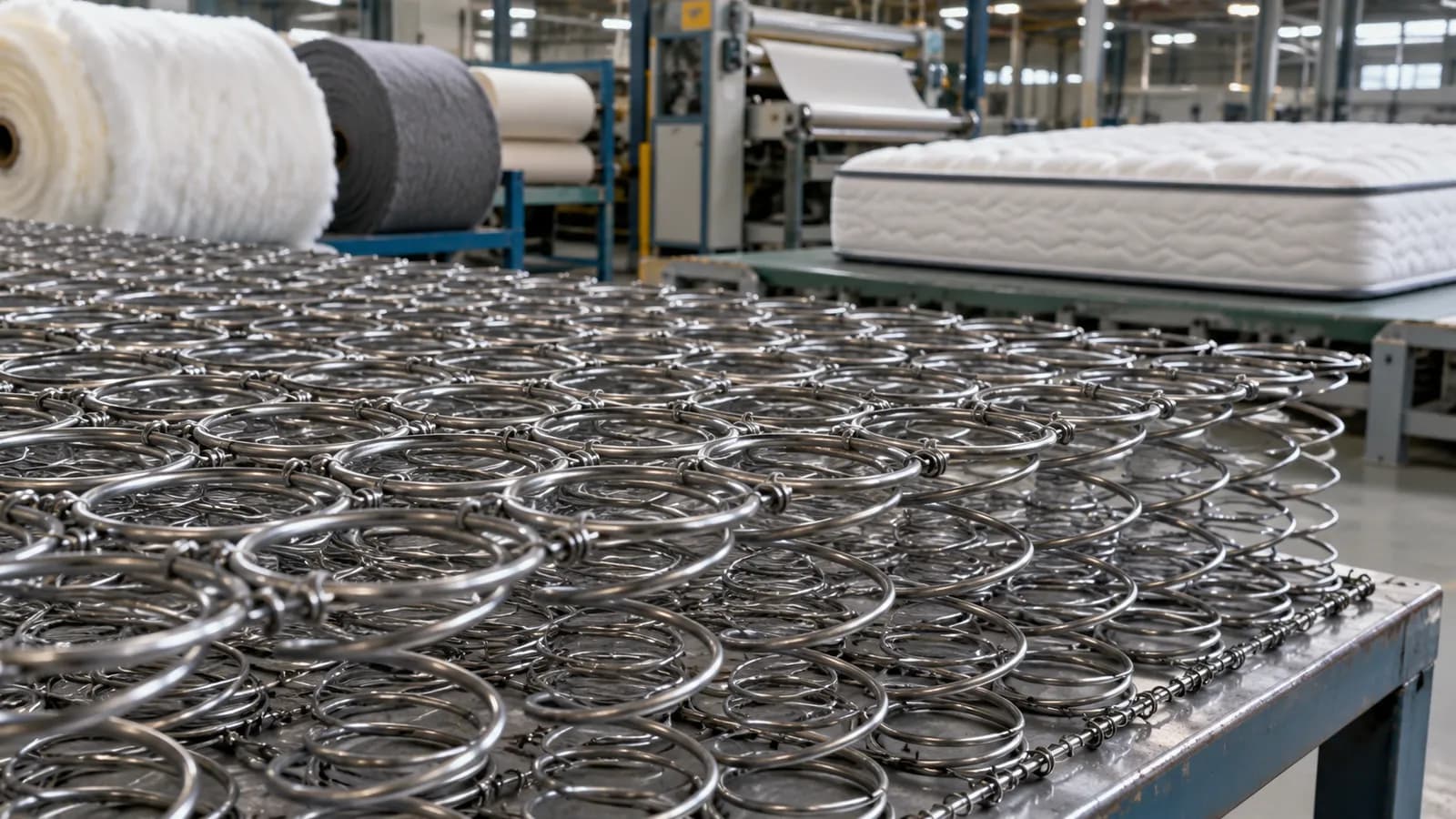
Innerspring units illustrate how a seemingly simple input can involve substantial engineering. Wire gauge, coil shape, spring count, and the way coils are connected all influence the feel and performance of a finished mattress. A supplier must make units that fit a customer's design and manufacturing process consistently. Its work can also include packaging and delivery arrangements that make the parts easier to handle at the customer's plant. Those details matter commercially because an inconsistent component can create waste or slow production further along the chain. Manufacturers may also specify how the assembly should perform in durability tests, giving the supplier a role in meeting the finished product's requirements.
Relationships between a component maker and a mattress producer can involve joint product development as well as routine purchasing. Specifications, testing procedures, tooling, and production schedules may be adapted to a particular design. Changing a supplier can therefore require qualification and coordination, even when competing suppliers make similar products. At the same time, a customer with purchasing scale may have considerable negotiating power. The balance depends on the component's distinctiveness, available capacity, quality requirements, and the practical cost of switching for each party. Contract terms, order forecasts, and the availability of alternative sources can influence how those relationships operate during a change in demand.
The industry also includes different mattress constructions. Some rely heavily on metal springs, while others emphasize foam or combine several materials. A component company's exposure depends on the products it supplies and the designs its customers choose, rather than on the mattress market alone. A shift in consumer preferences can affect the amount or type of components used per mattress even if the number of mattresses sold changes little. Product introductions and redesigns can thus alter a supplier's mix independently of broad industry unit demand. The relevant measure is therefore the content supplied for each design as well as the number of finished units produced.
Orders, Capacity And Working Capital
Manufacturing revenue reflects more than the number of customer orders. The reported amount also depends on the components shipped, their specifications, contractual pricing, and the timing of delivery. A customer may order a more complex assembly in one period and a simpler component in another, changing revenue per unit without a comparable change in physical output. When reading management's discussion, it helps to distinguish volume from price and mix, and to check whether acquisitions, disposals, or currency translation affected the reported comparison. A reconciliation of organic changes, when disclosed, can make the underlying activity easier to distinguish from changes in the business perimeter.
Factories must maintain equipment, supervision, and facilities even when production runs below capacity. When output falls, these costs are spread over fewer units, which can raise the cost assigned to each unit. Higher throughput can have the opposite effect, although overtime, bottlenecks, and expedited shipping can offset some of the benefit. Utilization is therefore an important link between sales volume and operating profit. A revenue change alone does not reveal the full effect: the location of demand and the capacity available at particular plants also matter. Plants do not necessarily have interchangeable equipment or skilled workers, so spare capacity in one location may not solve a constraint elsewhere.
Working capital connects production decisions to cash. A supplier pays for materials and labor, holds some goods in inventory, and generally collects from customers after shipment. It may also receive time to pay its own suppliers. If inventory or customer receivables grow faster than related payables, more cash can be tied up in operations even while reported earnings are positive. The reverse can release cash. Comparing changes in these balances with sales and production activity helps explain why operating cash flow and net income differ. Payment terms, customer collection patterns, and the timing of supplier invoices all influence this relationship from one reporting period to the next.
Inventory deserves particular attention when orders are uneven. Finished goods may build if customers delay deliveries, while raw materials can accumulate when purchasing commitments were made before production schedules changed. Management may reduce inventories by slowing purchasing or production, but that adjustment can also affect factory utilization. Accounting rules require inventory to be assessed for recoverability, so obsolete or less useful goods can lead to charges. The notes and management discussion can provide context for whether a change reflects normal timing or a more persistent mismatch. Inventory turnover and the composition of stock can be useful clues, although they should be considered alongside seasonal patterns and operational changes.
Reading Results Across Business Lines
A diversified component manufacturer serves customers with different production cycles and purchasing practices. Bedding orders may follow mattress manufacturing schedules, while automotive parts depend on vehicle production and the specific programs a supplier supports. Aerospace components can involve lengthy qualification processes and demanding technical documentation. These differences mean that a single sales trend may conceal contrasting conditions across businesses. Segment disclosures, where provided, help readers see which activities contributed to a change and whether a broad corporate result was driven by a narrower part of the portfolio. The duration of customer programs and the time needed to develop a component can also differ substantially between these end markets.
Segment operating results also need context. Some costs may be recorded centrally rather than allocated to individual segments, and reported segment measures may not include every expense shown in consolidated operating income. A reconciliation connects the segment figures to the company-wide result. Comparing the same measure over time is useful, but changes in organizational structure or reporting definitions can complicate the comparison. Footnotes and descriptions of segment changes help establish whether prior periods have been restated on a comparable basis. A segment's margin should therefore be interpreted within the reporting framework used, rather than assumed to represent a fully allocated standalone profit.
The income statement includes expenses that differ from current cash spending. Depreciation spreads the recorded cost of equipment and other long-lived assets over their useful lives, while amortization applies a similar process to certain intangible assets. Capital expenditures appear in investing cash flows when money is spent on assets. These figures serve different purposes and need not match in a given period. Comparing them over several reporting periods, alongside descriptions of maintenance and capacity projects, can clarify how much cash the manufacturing base requires. The timing of a large project can make a single period unusual, while asset sales and acquisitions can also alter the comparison.
Restructuring charges can accompany plant closures, workforce reductions, or changes in the footprint. A reported charge is an accounting recognition of estimated costs, while the related cash payments may occur in other periods. Some effects, such as accelerated depreciation or asset write-downs, may have little immediate cash impact. Readers can follow the notes for the type of charge, cash payments, and remaining obligations. It is also useful to examine subsequent operating results for continuing costs and any changes in production efficiency. Management's estimate can change as plans develop, and a later adjustment may increase or decrease an amount recognized in an earlier period.
Following A Business Inside A Larger Group
Once a company becomes part of a larger group, the amount of public information available for its former operations depends on how the parent organizes and reports its activities. A separate operating unit is not automatically a separately reported financial segment. The parent may combine several activities in one segment, change its internal structure, or discuss a business qualitatively without publishing a complete income statement for it. Readers can use the parent's segment descriptions and financial statement notes to identify what is disclosed and avoid treating group-wide figures as if they belonged to one unit. Changes in reporting categories can also affect comparisons over time, making the accompanying explanations as important as the headline figures themselves.
Transactions within a corporate group also change how revenue is presented. When one subsidiary supplies another, each operation may track the transaction internally for management purposes. In consolidated financial statements, sales and purchases between entities in the group are eliminated so that revenue represents transactions with outside customers. As a result, a component unit's internal activity cannot simply be added to the parent's consolidated sales. The treatment of inventory and profit on goods still held within the group can also affect consolidated results until those goods are sold externally. These eliminations prevent the same economic transaction from being counted repeatedly as materials move through successive operations within the consolidated group.
Acquisition accounting adds another layer to post-combination results. The acquirer records identifiable assets acquired and liabilities assumed using applicable accounting rules, including fair-value measurements at the acquisition date. The resulting amounts can differ from the values previously carried in the acquired company's accounts. Depreciation and amortization based on those recorded amounts can affect later earnings. Goodwill can arise as a residual under acquisition accounting, but it is not a direct measure of a particular factory, customer relationship, or expected operational improvement. Accounting estimates and their subsequent treatment are described in the financial statement notes, which help explain changes in reported asset values.
Cost savings from combining operations are best understood by separating the source of a claimed saving from the expense of achieving it. Examples may include coordinated purchasing, changes to distribution, or consolidation of administrative work. Implementation can involve spending on systems, facilities, or employee transitions, and the timing of costs may differ from the timing of any savings. Disclosures may describe estimates or progress using measures defined by management. Comparing those definitions and looking for related charges can make the reported effects easier to interpret. A saving in one area may also coincide with higher spending elsewhere, so the effect on total expenses requires a broader examination.
Conclusion: Leggett & Platt Inside Somnigroup
Leggett & Platt shareholders became Somnigroup shareholders when the all-stock combination closed in August 2026. Leggett now operates as a business unit within Somnigroup.