Company Overview
Kraken Robotics makes subsea technology, including synthetic aperture sonar, subsea batteries and seabed survey services. It is based in Canada, trades on the TSX Venture Exchange under PNG and in the U.S. over the counter under KRKNF.
Kraken Robotics was founded in 2012 in Newfoundland and Labrador, Canada.
It acquired 3D at Depth in 2024 and completed the acquisition of Covelya Group in July 2026.
Latest Quarterly Results: Q2 2026
Kraken Robotics reported second-quarter 2026 results in August 2026. Figures are in Canadian dollars.
The Covelya acquisition closed after the second quarter ended, so second-quarter results do not include it while the full-year outlook does.
Kraken's revenue can vary between quarters because defense sonar and battery orders are delivered in large, project-based batches.
Business Model and Revenue Drivers
Defense customers use its sonar for mine countermeasures and seabed mapping.
Subsea batteries power underwater vehicles.
Kraken acquired Covelya Group in 2026.
Competitive Landscape
Competitors in subsea sonar and survey include Kongsberg, Teledyne and other marine technology companies.
Its synthetic aperture sonar targets high-resolution seabed imaging.
Revenue Growth and Financial Performance
When reviewing Kraken Robotics's reported results, these measures give the clearest view of growth, profitability and cash generation:
- Revenue by product and services
- Adjusted EBITDA
- Order backlog
- Gross margin
- Acquisition integration
Profitability and Earnings Quality
Revenue growth is only part of the picture. For Kraken Robotics, it helps to check whether growth comes from higher volumes, higher prices or acquisitions, and whether margins are widening or narrowing as the business scales.
Reported earnings can include one-time items such as restructuring charges, asset sales, tax effects or legal settlements. Separating these from recurring operating results, and comparing like-for-like periods, gives a more reliable view of underlying profitability.
Balance Sheet, Debt and Financial Stability
A review of Kraken Robotics's financial position starts with cash, total debt, lease obligations and how operating cash flow compares with capital spending. A business that funds its investment from its own cash flow is in a different position from one that relies on borrowing or issuing new shares.
Changes in inventory, receivables and working capital are also worth monitoring, because they can absorb cash and signal shifts in demand before they appear in revenue.
KRKNF Stock Valuation Analysis
Measures such as the price-to-earnings ratio, price-to-sales ratio and enterprise value to EBITDA describe how the market is currently pricing Kraken Robotics relative to its results.
However, a single valuation ratio cannot establish whether a stock is undervalued or overvalued. Earnings quality, free cash flow, margins, competitive position and the growth needed to support the current price all need to be considered together, and compared with similar companies.
Business Outlook and Investment Risks
Management guidance and industry conditions shape expectations for Kraken Robotics, but guidance is an estimate rather than an established outcome. Several uncertainties are specific to this business:
- Defense budget timing
- Integration risk
- Offshore energy cycles
- Currency
How Sonar Data Becomes A Survey
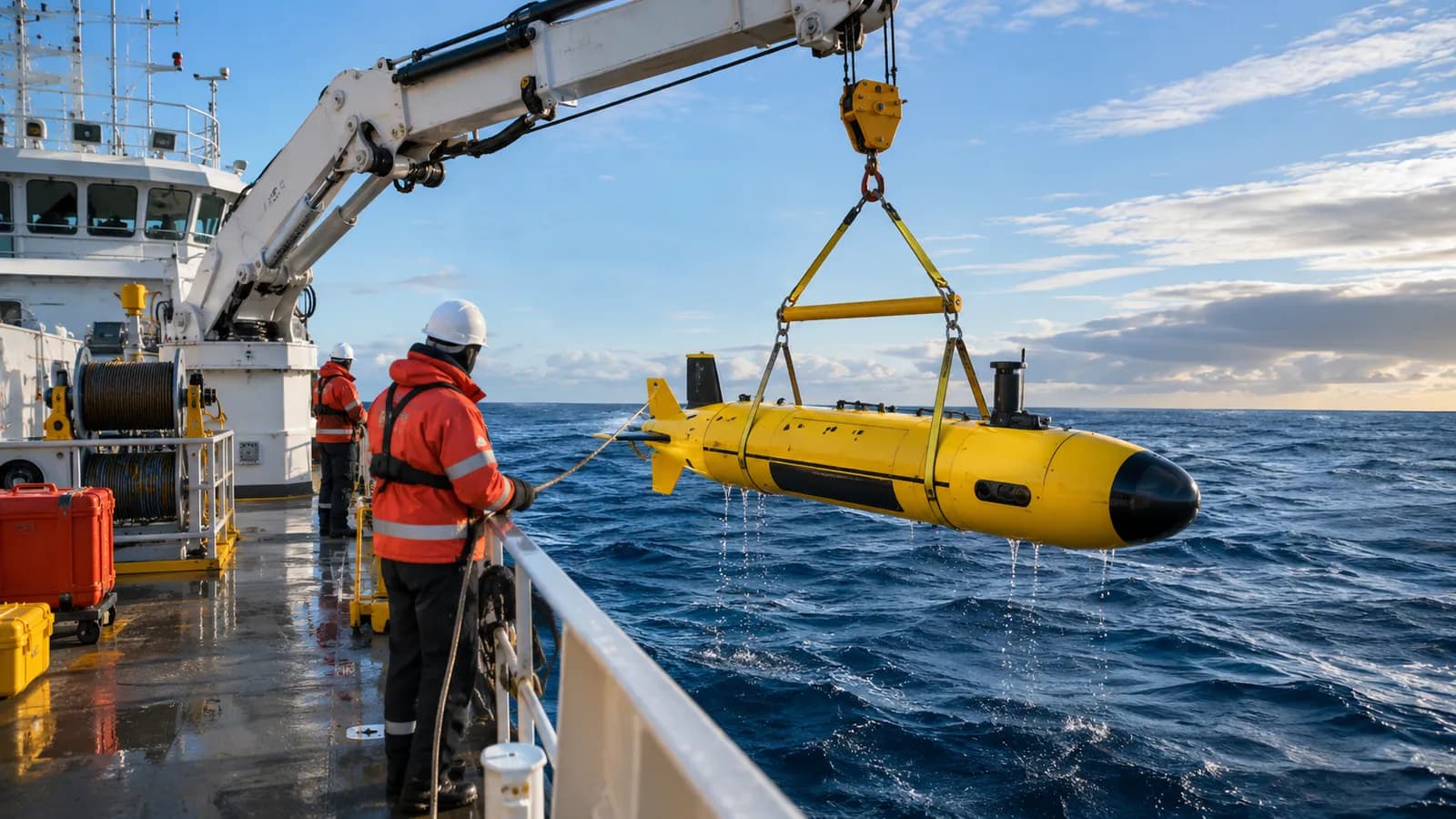
Synthetic aperture sonar combines echoes collected as a sensor moves through water to create a detailed image of the seabed. The system must account for the sensor's motion and the time taken for sound to travel to and from objects. Processing those measurements is central to image quality. Water conditions, seabed composition, vehicle stability and survey geometry can all affect the result, so a sensor's stated resolution alone does not describe the quality of every survey.
A survey typically involves planning a route, deploying a sensor from a vessel or underwater vehicle, collecting overlapping coverage and processing the resulting data. Operators then interpret the imagery and prepare a deliverable suited to the customer's task. Finding an object, identifying what it is and establishing its precise location are related but distinct steps. A clear image can narrow the possibilities without providing every detail needed for a definitive identification.
This workflow helps explain why hardware, software and field services can have different roles in the same project. A customer may operate its own equipment, rely on a specialist crew or combine both approaches. Compatibility with a vehicle, navigation equipment and data-processing tools can influence how easily a system fits into an existing operation. Training, maintenance and access to technical support also affect the work required to keep a system useful over its operating life.
Contract Milestones And Reported Revenue
A customer contract can cover equipment, engineering, installation, training and support. Accounting depends on the promises in that contract and when control of each promised item or service transfers to the customer. Some work may qualify for revenue recognition over time, while other obligations may be recognized at a particular point. The notes to the financial statements can explain the policies used and help readers connect contract terms with the timing of reported sales.
Billing and revenue recognition are separate events. An advance payment can create a contract liability until the associated work is performed, while work recognized before an invoice is due can create a contract asset. These balances are different from ordinary trade receivables, which generally represent an unconditional right to payment. Reading the contract balance disclosures alongside cash flow can clarify why reported revenue and customer cash receipts do not move together in a period.
Long projects can require estimates of total costs, technical progress and remaining obligations. When those estimates change, the amount recognized may also change under the applicable accounting policy. Warranty provisions and costs to complete a project deserve attention for the same reason: they reflect obligations that can extend beyond delivery. The useful question is how management develops and revises its estimates, including whether later disclosures explain meaningful changes in project assumptions.
Integration And The Economics Of Subsea Systems
An underwater vehicle is a system of interdependent components, including propulsion, navigation, communications, sensors and power. Each component must fit constraints on space, weight and energy use while surviving pressure and exposure to seawater. A battery's practical value depends on the vehicle's overall power demand and mission profile, as well as its own capacity. Engineers also consider charging, handling, reliability and the consequences of a component failure when designing an operating system.
Underwater communications have different constraints from communications through air. Radio signals do not travel effectively through seawater in many practical settings, so subsea systems often use acoustic links, physical connections or stored data retrieved after a mission. The choice affects how much information can be sent during an operation and how much processing must happen on the vehicle or after recovery. Those constraints shape the trade-offs between autonomous operation, operator control and the amount of data collected.
Customers evaluating a subsea system must also consider the resources needed to deploy it. Vessel time, crew skills, maintenance intervals and recovery procedures all contribute to the cost of completing a mission. A component that performs well in isolation still has to work reliably with the rest of the equipment and the customer's operating practices. This system perspective helps explain why testing, qualification and operational experience can matter alongside published technical specifications.
Reading Acquired Intangibles
When a company acquires another business, the purchase accounting can place identifiable intangible assets on the balance sheet. Depending on the transaction, these may include developed technology, customer relationships or other rights that can be measured separately. Their assigned values reflect accounting estimates made at acquisition. Goodwill is the remaining amount after the relevant identifiable assets and liabilities are recognized; it is not a separately identifiable piece of equipment or a cash balance.
Intangible assets with finite useful lives are generally amortized over those lives, creating an expense that can continue after the acquisition closes. Goodwill is treated differently and is assessed for impairment under the applicable accounting rules. An impairment charge can reduce reported earnings without representing a cash payment in that period. The acquisition note, accounting policies and subsequent impairment disclosures help readers understand the estimates and expenses associated with an acquired business.
Conclusion: Is KRKNF Stock Worth Analyzing in 2027?
Kraken Robotics has a business model with clear drivers that can be tracked through its reported results, and a set of risks that are specific to its industry and financial position.
A balanced assessment considers growth, profitability, balance-sheet strength, valuation and risk together. KRKNF is a company worth monitoring for what its results reveal about its business.