Company Overview
Intel designs and manufactures processors for PCs and data centers and runs Intel Foundry, which makes chips for Intel and outside customers. It trades on Nasdaq under the ticker INTC. Lip-Bu Tan became CEO in 2025, and the U.S. government took an equity stake in the company that year.
Intel was founded in 1968 by Robert Noyce and Gordon Moore and made the first commercial microprocessor in 1971.
It launched Intel Foundry Services in 2021 to make chips for other companies.
Latest Quarterly Results: Q3 2026
Intel reported third-quarter 2026 results in late October 2026.
Data center revenue nearly caught up with PC revenue, a major shift in Intel's mix.
Intel Foundry's loss narrowed from $2.32 billion a year earlier.
Business Model and Revenue Drivers
Intel lost market share to AMD and to Arm-based chips over the past decade.
Its 18A process technology is central to its manufacturing turnaround plans.
Nvidia and SoftBank also invested in Intel in 2025.
Competitive Landscape
AMD competes in PC and server processors. TSMC and Samsung compete in contract manufacturing. Nvidia dominates AI accelerators.
Arm-based chips compete in PCs and servers.
Revenue Growth and Financial Performance
When reviewing Intel's reported results, these measures give the clearest view of growth, profitability and cash generation:
- Revenue by segment
- Gross margin
- Foundry operating loss
- Capital spending
- Process technology milestones
Profitability and Earnings Quality
Revenue growth is only part of the picture. For Intel, it helps to check whether growth comes from higher volumes, higher prices or acquisitions, and whether margins are widening or narrowing as the business scales.
Reported earnings can include one-time items such as restructuring charges, asset sales, tax effects or legal settlements. Separating these from recurring operating results, and comparing like-for-like periods, gives a more reliable view of underlying profitability.
Balance Sheet, Debt and Financial Stability
A review of Intel's financial position starts with cash, total debt, lease obligations and how operating cash flow compares with capital spending. A business that funds its investment from its own cash flow is in a different position from one that relies on borrowing or issuing new shares.
Changes in inventory, receivables and working capital are also worth monitoring, because they can absorb cash and signal shifts in demand before they appear in revenue.
INTC Stock Valuation Analysis
Measures such as the price-to-earnings ratio, price-to-sales ratio and enterprise value to EBITDA describe how the market is currently pricing Intel relative to its results.
However, a single valuation ratio cannot establish whether a stock is undervalued or overvalued. Earnings quality, free cash flow, margins, competitive position and the growth needed to support the current price all need to be considered together, and compared with similar companies.
Business Outlook and Investment Risks
Management guidance and industry conditions shape expectations for Intel, but guidance is an estimate rather than an established outcome. Several uncertainties are specific to this business:
- Manufacturing execution
- Competition from AMD, Arm and Nvidia
- Foundry losses
- High capital needs
From Chip Design To Finished Product
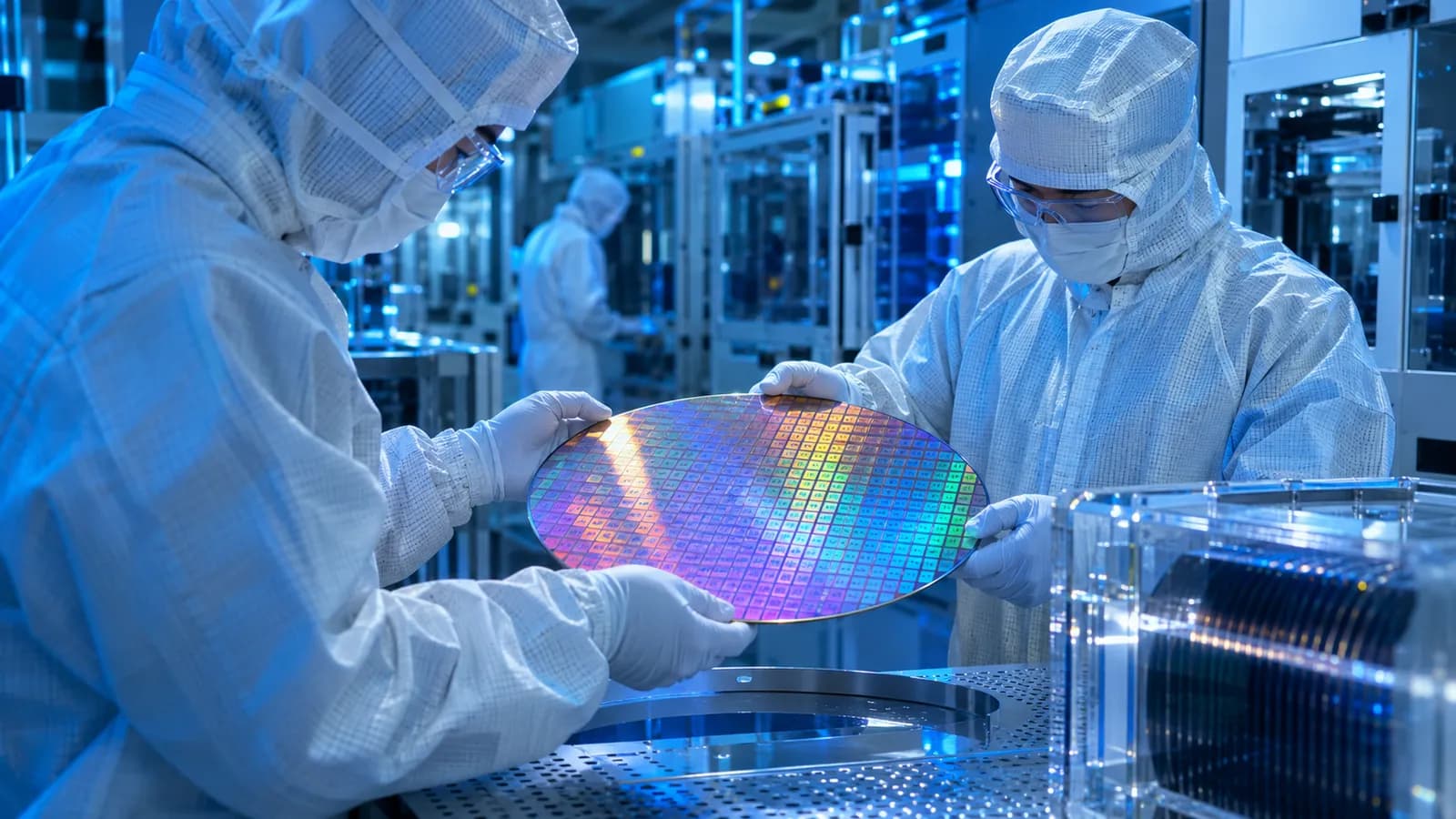
A processor begins as a design, but a usable product depends on several distinct stages. Engineers define its architecture, develop circuit layouts and verify that the design behaves as intended. Manufacturing then builds many copies of the circuits on silicon wafers through repeated steps of deposition, patterning and processing. After fabrication, wafers are tested and cut into individual dies. Packaging connects the dies to the rest of a system, protects them and helps manage heat. Final testing sorts products according to whether they meet their intended specifications.
This sequence matters because design capability and manufacturing capability are related but separate sources of performance. A design can be adapted to the rules of a particular manufacturing process, while the manufacturing process must consistently reproduce the intended structures. Packaging also influences how components communicate and how much heat a system can remove. A product that combines multiple dies may use different manufacturing processes for different pieces, adding choices about cost, supply and integration as well as additional interfaces to validate.
Intel has historically combined chip design with substantial in-house manufacturing, an arrangement often called an integrated device manufacturer model. A fabless designer instead concentrates on design and relies on outside manufacturers for fabrication. Neither label describes every activity in isolation: integrated companies can use external production, and fabless companies still work closely with manufacturers on design rules and testing. The practical distinction is where the company controls assets and decisions, and how much coordination crosses organizational boundaries.
How Foundry Economics Work
A foundry converts customer designs into manufactured wafers under agreed technical and commercial terms. The customer generally owns the chip design and chooses its product specifications, while the foundry supplies a manufacturing process and the supporting services needed to make the design manufacturable. Commercial arrangements can cover engineering work, masks, wafer production and other services. Revenue from a manufacturing order therefore reflects a different transaction from selling a finished processor under Intel's own product brand.
The cost of running a fabrication plant includes equipment, facilities, materials, labor and engineering support. Some costs do not move much with the number of wafers processed in the short term. When more usable output passes through the same facility, those costs can be spread across more units. When equipment is underused, each unit carries a larger share. This makes utilization an important part of interpreting manufacturing profitability, although a higher utilization rate alone does not establish that a particular customer contract is profitable.
Yield is the share of manufactured output that meets the relevant requirements. Defects, process variation and design characteristics can all affect it. A wafer can complete the manufacturing process yet contain dies that fail testing, so wafer starts and saleable chips are different measures. Yield also depends on the specific product and test standard; comparisons across designs or process generations need context. Manufacturing learning involves identifying sources of variation and improving consistency, which connects engineering execution with the cost of usable output.
Outside customers also require confidence in design tools, intellectual property libraries, production capacity and protection of confidential information. A foundry needs a working ecosystem that lets customers translate a design into manufacturing instructions and verify it before production. Customers may also assess how the manufacturer handles changes, testing and continuity of supply. These capabilities are less visible than a process name, but they help explain why establishing a contract manufacturing relationship can involve substantial preparation on both sides.
Reading Segment And Cash Flow Disclosures
Segment reporting can illuminate how product businesses and manufacturing operations contribute to the consolidated company, but the boundaries between them deserve attention. Internal transfers may be recorded when one Intel operation supplies another. The company removes transactions between consolidated entities when preparing its overall results, so adding segment revenue figures without checking the reconciliation can count internal activity twice. Segment results are useful for understanding operating responsibilities, while consolidated statements show the company as a whole.
The terms used for internal transfers and the allocation of shared costs can affect how profit appears across segments. For example, a manufacturing charge paid by a product segment is revenue for the manufacturing segment, but it is not a sale to an outside customer for the consolidated company. Notes and management explanations can clarify which amounts represent external demand and which reflect internal arrangements. Changes in reporting structure or allocation methods also complicate comparisons across periods.
Depreciation connects past spending on equipment and facilities to current accounting expenses. Cash is generally paid when assets are acquired, while their depreciable cost is recognized over their estimated useful lives. As a result, depreciation in a period need not match cash spent on new assets in that period. The difference helps explain why operating income and cash flow can move differently, especially for a company with extensive manufacturing assets. Asset impairments and changes in useful-life estimates can also affect reported expenses.
Cash flow disclosures can be read alongside commitments and financing arrangements to understand the timing of resources used in manufacturing projects. A commitment to purchase equipment is different from cash already paid, and proceeds from a financing arrangement are different from cash generated by selling products. The notes can also explain whether partners share project costs or obtain rights to future output. Reading the terms matters because similar-looking cash receipts can carry different obligations and economic consequences.
Platform Choices And Customer Adoption
A processor is one part of a wider computing platform that includes memory, networking, system software and applications. Customers evaluate whether these components work together as well as the performance of an individual chip. For a server, the relevant decision may involve power consumption, cooling, security features and the ability to run existing workloads. For a PC, device design, battery life and compatibility with familiar software can matter alongside processor specifications. These choices are made at the system level.
The instruction set describes operations that software can ask a processor to perform. Intel processors commonly use the x86 instruction set, while Arm-based processors use a different instruction set. Software may need to be compiled for a particular architecture or run through a translation layer. Compatibility is therefore not simply a hardware specification: operating systems, applications, drivers and development tools all influence the experience. Organizations with extensive existing software may also have testing and migration work when they change architectures.
Customers do not all purchase in the same way. PC manufacturers integrate processors into complete devices, while data center operators and server makers select components for systems serving different workloads. Some large customers design portions of their own hardware or software, changing which features they emphasize in supplier discussions. Product announcements, shipments to system makers and deployment by end users are distinct stages. The timing between them can make reported sales and visible adoption describe different points in the same supply chain.
Performance comparisons also depend on the task and the conditions of the test. A benchmark can emphasize one type of calculation, while a real application may be limited by memory access, networking or software configuration. Power use and the number of components needed to complete a workload can be relevant alongside execution speed. Comparing systems under consistent conditions, and understanding what the test measures, makes published performance claims more informative than treating a single score as a universal ranking.
Demand Cycles And Product Lifecycles
Semiconductor demand passes through several layers before it reaches a chip supplier. A device maker orders components based on its production plans, while distributors and other intermediaries manage their own stock. If finished devices sell more slowly than expected, customers may use components already on hand before placing further orders. The reverse can occur when inventories are depleted. Changes in chip shipments can therefore be larger than changes in end-user purchases, and a single reporting period may reflect inventory adjustments as well as underlying demand. Customer commentary on inventory levels and order patterns can add context, although different customers may be at different stages simultaneously.
Processor product lifecycles also shape the economics of research and development. Engineering teams spend on architecture, design and validation before a product generates revenue, and those costs are generally recognized as expenses as the work occurs. Once released, a product may remain in use while engineers develop its successor and support existing customers. Comparing research and development expense with revenue over several periods can help explain the scale of this ongoing commitment, but the ratio alone does not show the commercial contribution of any individual project.
Conclusion: Is INTC Stock Worth Analyzing in 2027?
Intel has a business model with clear drivers that can be tracked through its reported results, and a set of risks that are specific to its industry and financial position.
A balanced assessment considers growth, profitability, balance-sheet strength, valuation and risk together. INTC is a company worth monitoring for what its results reveal about its business.