Company Overview
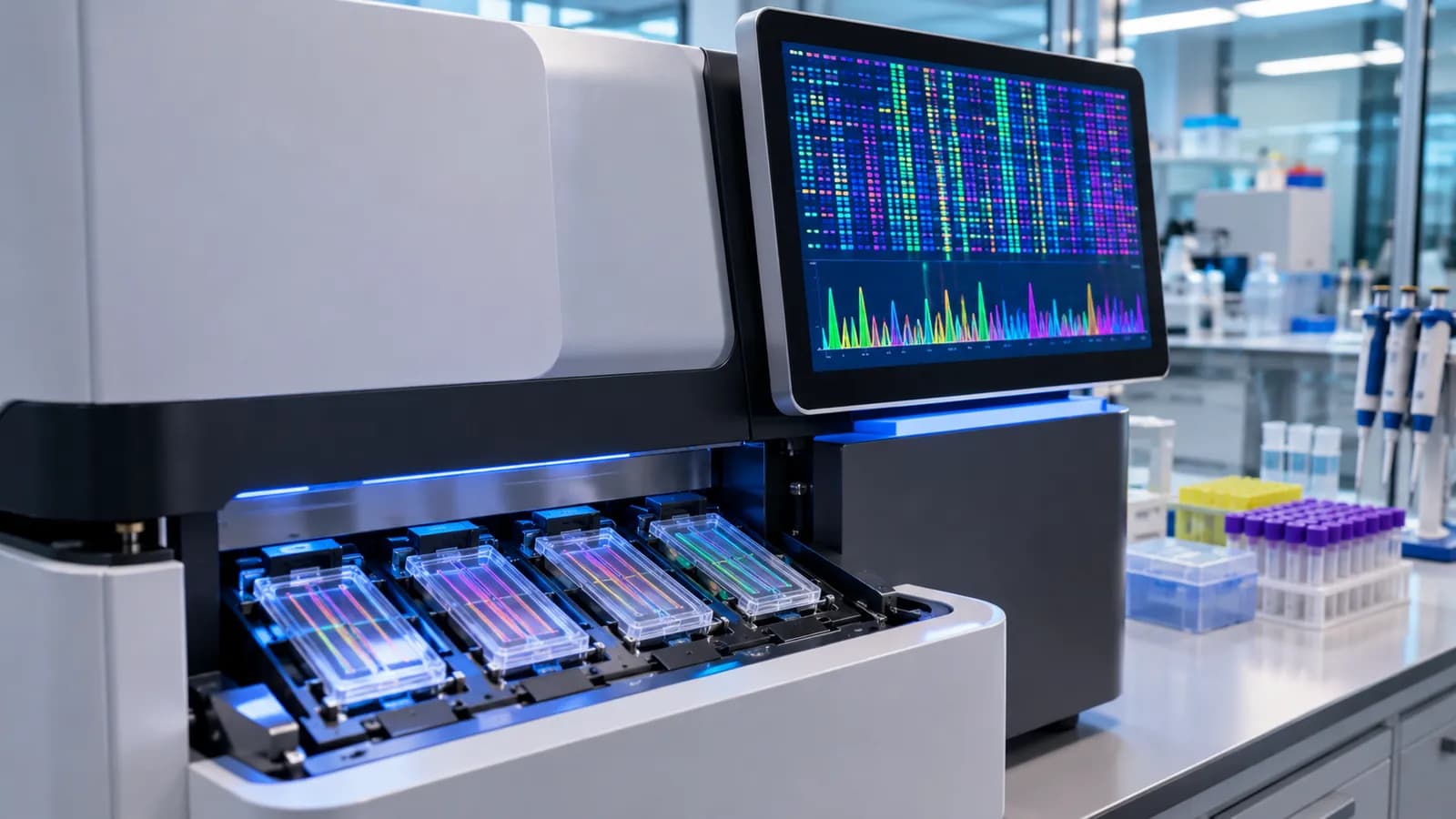
Illumina is the largest maker of DNA sequencing machines and the chemicals used to run them. It trades on Nasdaq under the ticker ILMN. Most of its revenue comes from consumables used repeatedly on its installed base of instruments.
Illumina was founded in 1998 in San Diego.
It became the leading sequencing company after acquiring Solexa in 2007.
Latest Quarterly Results: Q3 Fiscal 2026
Illumina reported third-quarter fiscal 2026 results on October 29, 2026.
China stopped reducing Illumina's growth in the third quarter after lapping the prior year's decline.
Business Model and Revenue Drivers
Illumina spun off GRAIL in 2024 after European regulators opposed the acquisition.
China added Illumina to its Unreliable Entities List in 2025, affecting sales there.
Clinical uses such as cancer testing and genetic disease diagnosis are a growing share of demand.
Competitive Landscape
Thermo Fisher, Pacific Biosciences, Oxford Nanopore, Element Biosciences and Ultima Genomics compete in sequencing.
Chinese competitors such as MGI compete in China.
Revenue Growth and Financial Performance
When reviewing Illumina's reported results, these measures give the clearest view of growth, profitability and cash generation:
- Revenue by product
- Consumables growth
- Instrument placements
- Gross and operating margin
- China revenue
Profitability and Earnings Quality
Revenue growth is only part of the picture. For Illumina, it helps to check whether growth comes from higher volumes, higher prices or acquisitions, and whether margins are widening or narrowing as the business scales.
Reported earnings can include one-time items such as restructuring charges, asset sales, tax effects or legal settlements. Separating these from recurring operating results, and comparing like-for-like periods, gives a more reliable view of underlying profitability.
Balance Sheet, Debt and Financial Stability
A review of Illumina's financial position starts with cash, total debt, lease obligations and how operating cash flow compares with capital spending. A business that funds its investment from its own cash flow is in a different position from one that relies on borrowing or issuing new shares.
Changes in inventory, receivables and working capital are also worth monitoring, because they can absorb cash and signal shifts in demand before they appear in revenue.
ILMN Stock Valuation Analysis
Measures such as the price-to-earnings ratio, price-to-sales ratio and enterprise value to EBITDA describe how the market is currently pricing Illumina relative to its results.
However, a single valuation ratio cannot establish whether a stock is undervalued or overvalued. Earnings quality, free cash flow, margins, competitive position and the growth needed to support the current price all need to be considered together, and compared with similar companies.
Business Outlook and Investment Risks
Management guidance and industry conditions shape expectations for Illumina, but guidance is an estimate rather than an established outcome. Several uncertainties are specific to this business:
- Competition from Element, Ultima and others
- China restrictions
- Research funding cuts
- Pricing pressure
From Sample To Sequence
A sequencing workflow begins before a sample reaches an instrument. A laboratory extracts DNA, assesses its quality and prepares a library: a collection of DNA fragments adapted for sequencing. Preparation can include steps that select particular regions or attach identifiers to samples. These choices influence how much material is needed, how samples can be combined and what questions the resulting data can answer. The workflow therefore involves laboratory protocols, preparation supplies and analytical software as well as the sequencing machine itself. Preparation methods also determine which parts of a sample are represented in the final data.
Illumina's core sequencing approach reads many short DNA fragments in parallel and uses software to assemble or align those reads against a reference. Short reads can support a wide range of applications, including counting gene activity and identifying small genetic variants. Interpretation depends on read length, coverage and the characteristics of the sample. Coverage describes how often a position is represented in the data; greater coverage can help distinguish a genuine signal from an error, although the appropriate depth depends on the task. A reference provides a common coordinate system, but it does not capture every person's genetic variation.
Sequencing output is not the same as a completed answer. Raw signals must be converted into sequence data, checked for quality and processed through an analysis pipeline. A clinical laboratory may then interpret findings in the context of the patient's condition and its own validated procedures. Each stage adds potential sources of variation, from sample handling to software settings. Understanding this chain helps explain why instrument specifications alone do not describe the performance of an entire laboratory workflow. Quality checks can identify insufficient material or contamination before additional resources are committed to analysis.
Other sequencing approaches can produce longer reads or detect different features of genetic material. Long reads can be useful when a question involves repeated sequences or large structural changes that are difficult to resolve with short fragments. The methods also differ in workflow, error characteristics and data analysis requirements. Laboratories choose among technologies according to the biological question, sample constraints, throughput and operating resources; some use more than one method for complementary information. The analytical tools used to process each type of data can also differ substantially.
Laboratory Economics And Utilization
A laboratory's economics depend on how it organizes work across instruments and staff. An instrument with capacity for many samples can spread a run's fixed preparation and operating effort across more tests when demand is sufficient. A smaller batch may be more convenient when samples arrive irregularly or results are needed quickly. This creates a trade-off between utilization and turnaround time, so the lowest theoretical cost per sample may not reflect the cost of a laboratory's actual schedule. Staffing and scheduling constraints can prevent a laboratory from operating at its maximum technical capacity.
Sequencing costs extend beyond the materials loaded into an instrument. Laboratories also pay for sample collection and preparation, quality control, personnel, data storage, computing and interpretation. Failed samples or runs can require repeat work. When comparing published cost figures, it helps to identify which of these stages are included and whether the calculation assumes full runs. Two workflows with similar sequencing costs can have different total costs if they demand different amounts of preparation or analysis. Comparing complete workflows can reveal expenses that are obscured by a focus on a single step.
A sequencing system's capacity is useful only when a laboratory can supply suitable samples and process the resulting data. Shared research centers may combine work from multiple groups to fill runs, while a clinical laboratory may prioritize predictable turnaround and validated procedures. Consequently, the number of instruments in operation does not by itself reveal how intensively they are used. The mix of applications and the frequency of runs provide context for interpreting demand for supplies. A large installed system may consequently serve a different operating model from several smaller systems.
Customers also face switching costs that go beyond replacing equipment. A new workflow may require staff training, revised laboratory procedures, software integration and comparisons with existing results. In clinical settings, laboratories may need to validate a changed method before using it for patient samples. These steps can make established workflows durable, but they do not eliminate competition: a different platform can still attract users when its capabilities fit a laboratory's requirements. Compatibility with existing sample preparation and data systems can influence the effort involved in a transition.
Reading The Product And Service Mix
Sequencing consumables are linked to the work performed on a platform, but the relationship between sample counts and reported revenue is not fixed. Different applications require different amounts of sequencing data, and products can be configured for different run sizes and output levels. A laboratory processing fewer samples with deeper coverage can use more sequencing capacity than another processing more samples with shallow coverage. Product mix and purchasing patterns therefore matter when interpreting a change in consumables revenue. Changes in the balance between whole-genome and targeted work are one example of this distinction.
Instrument revenue reflects equipment purchases, while service revenue can include activities that support installed systems. These categories follow different customer decisions. A laboratory may purchase an instrument to add capacity or replace an older system, then spend on supplies as work is performed and on support over the equipment's life. The timing of these decisions can differ, making a single reporting period an incomplete view of the relationship between equipment sales and subsequent activity. Replacement purchases can maintain a laboratory's capacity without necessarily adding an equivalent amount of new capacity.
Revenue recognition can also differ from the timing of orders and cash collection. An order indicates a customer's intention to purchase under its terms, whereas recognized revenue follows the applicable accounting requirements for transferring control of goods or services. Service arrangements may be recognized over the period in which service is provided. Contract liabilities can arise when a customer pays before the related obligation is satisfied. The notes to the financial statements explain the company's policies and relevant balances. The notes may also describe how arrangements containing multiple goods or services are accounted for.
When reviewing a change in a product category, it is useful to read management's discussion alongside the accounting notes. A shift in the types of instruments or supplies sold can affect the revenue figure even when the underlying number of customer workflows changes differently. Distribution arrangements and the timing of customer purchases can also affect period comparisons. These details help distinguish what a reported category measures from what an observer may infer about laboratory activity. Customer concentration within an application can make purchasing schedules particularly relevant to individual period comparisons.
Evidence In Research And Clinical Markets
Research laboratories and clinical laboratories use sequencing for different immediate purposes. Researchers may explore biological questions, develop methods or generate data for studies whose scope changes as findings emerge. Clinical laboratories work within defined testing processes and report results for patient care. Both groups need reliable data, but they can differ in their requirements for documentation, turnaround, validation and consistency across runs. Those differences influence how a supplier develops products and supports customers. Consistent procedures help laboratories compare results over time and investigate unexpected changes in quality measures.
Clinical adoption depends on more than an instrument's ability to produce a sequence. A test needs evidence that it measures what it claims to measure and that its results can be interpreted for the intended use. Laboratories must also integrate testing into ordering, sample handling, reporting and clinical decision processes. Payment arrangements and applicable oversight can shape whether testing is practical in a given setting. These factors operate at the level of a particular test and jurisdiction, rather than being determined by the sequencing platform alone. A test's clinical role can range from supporting a diagnosis to informing a specific treatment decision.
Research demand has its own institutional structure. Universities, hospitals and other organizations may operate shared sequencing facilities that serve multiple investigators. A facility's purchasing decisions can reflect the studies it supports, available funding and its capacity to prepare and analyze samples. Individual projects can vary in size and sequencing depth. Reading customer and application descriptions alongside financial results helps clarify which activities are represented without assuming that all research spending produces the same sequencing demand. Core facilities often coordinate sample queues and provide standardized procedures for researchers with different technical needs.
Genomic data also creates an ongoing information management task. Sequence files can be large, and laboratories need processes for secure storage, access, transfer and analysis. Interpretation can change as scientific knowledge and reference resources develop, so laboratories may retain data and document analytical methods for later review. These requirements create demand for computational infrastructure and specialized skills alongside laboratory equipment. They also mean that the usefulness of a workflow depends partly on how well data moves through the customer's existing systems. Data retention practices depend on the laboratory's policies, customer arrangements and applicable legal requirements.
Conclusion: Is ILMN Stock Worth Analyzing in 2027?
Illumina has a business model with clear drivers that can be tracked through its reported results, and a set of risks that are specific to its industry and financial position.
A balanced assessment considers growth, profitability, balance-sheet strength, valuation and risk together. ILMN is a company worth monitoring for what its results reveal about its business.