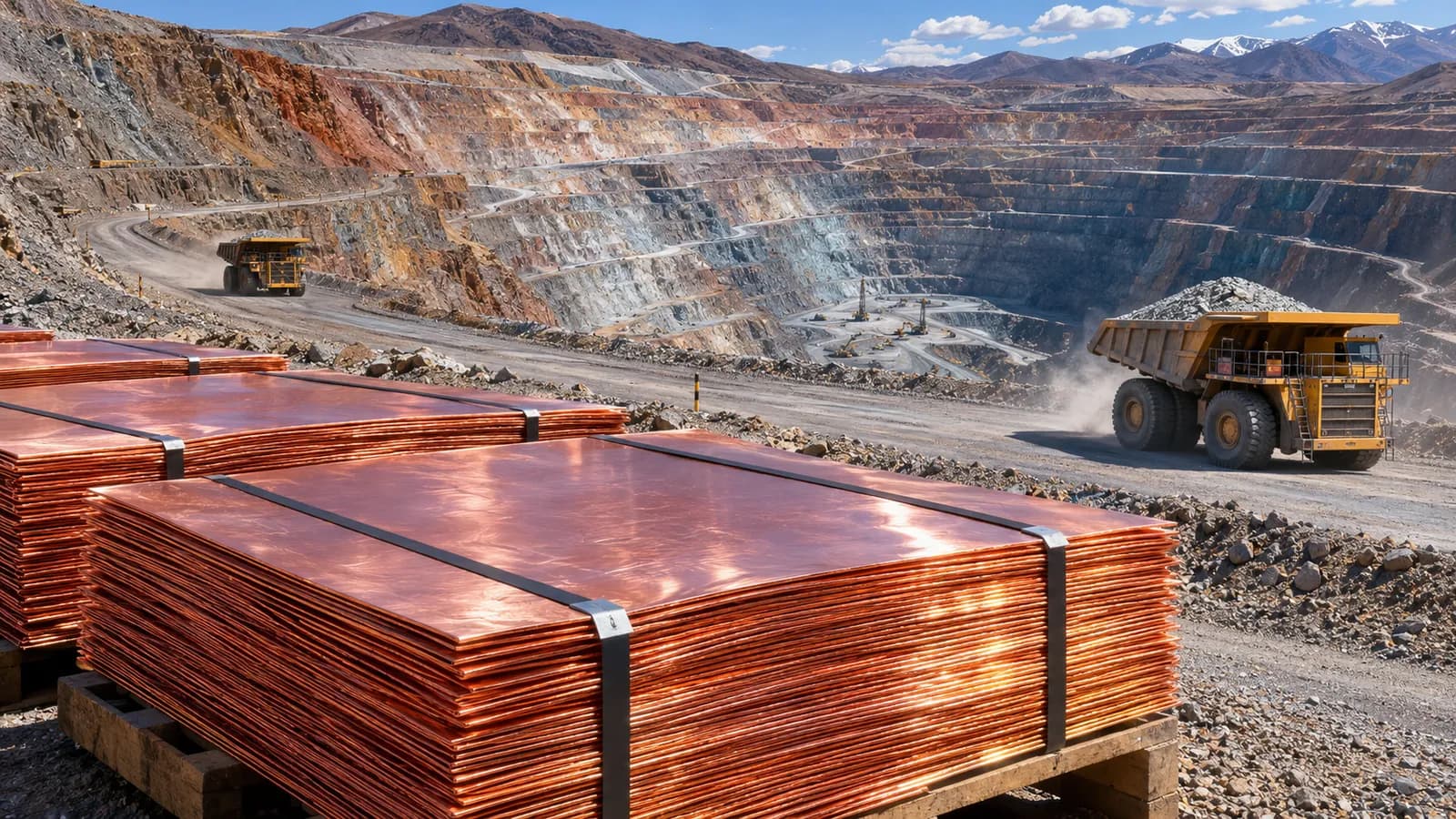
Company Overview
Freeport-McMoRan is one of the world's largest copper producers, with major operations in Indonesia (Grasberg), the Americas and Peru. It trades on the NYSE under the ticker FCX. It also produces gold and molybdenum.
Freeport-McMoRan was formed through mergers, including the 2007 acquisition of Phelps Dodge.
It operates Grasberg in Indonesia through PT Freeport Indonesia, in which the Indonesian government holds a majority stake.
Latest Quarterly Results: Q3 2026
Freeport-McMoRan reported third-quarter 2026 results in October 2026.
Unit net cash costs rose mainly because of lower gold by-product credits while Grasberg was recovering from the mud rush incident.
Idle facility and recovery costs tied to the incident were $244 million in the quarter and were excluded from unit net cash costs.
Business Model and Revenue Drivers
Earnings are highly sensitive to copper prices.
Grasberg is one of the world's largest copper and gold deposits.
Copper demand is linked to construction, electrification and grids.
Competitive Landscape
BHP, Rio Tinto, Southern Copper and Codelco are other major copper producers.
Freeport is one of the largest publicly traded copper companies.
Revenue Growth and Financial Performance
When reviewing Freeport-McMoRan's reported results, these measures give the clearest view of growth, profitability and cash generation:
- Copper production
- Unit net cash costs
- Copper price realized
- Capital expenditure
- Net debt
Profitability and Earnings Quality
Revenue growth is only part of the picture. For Freeport-McMoRan, it helps to check whether growth comes from higher volumes, higher prices or acquisitions, and whether margins are widening or narrowing as the business scales.
Reported earnings can include one-time items such as restructuring charges, asset sales, tax effects or legal settlements. Separating these from recurring operating results, and comparing like-for-like periods, gives a more reliable view of underlying profitability.
Balance Sheet, Debt and Financial Stability
A review of Freeport-McMoRan's financial position starts with cash, total debt, lease obligations and how operating cash flow compares with capital spending. A business that funds its investment from its own cash flow is in a different position from one that relies on borrowing or issuing new shares.
Changes in inventory, receivables and working capital are also worth monitoring, because they can absorb cash and signal shifts in demand before they appear in revenue.
FCX Stock Valuation Analysis
Measures such as the price-to-earnings ratio, price-to-sales ratio and enterprise value to EBITDA describe how the market is currently pricing Freeport-McMoRan relative to its results.
However, a single valuation ratio cannot establish whether a stock is undervalued or overvalued. Earnings quality, free cash flow, margins, competitive position and the growth needed to support the current price all need to be considered together, and compared with similar companies.
Business Outlook and Investment Risks
Management guidance and industry conditions shape expectations for Freeport-McMoRan, but guidance is an estimate rather than an established outcome. Several uncertainties are specific to this business:
- Copper price volatility
- Operational incidents
- Indonesian regulation
- Costs
From Ore To Saleable Metal
A copper mine begins with ore, which contains copper minerals mixed with material that has little commercial value. The grade describes the concentration of the metal in that ore. Mining more rock does not necessarily mean producing more copper: grade and metallurgical recovery, the share of contained metal captured during processing, both matter. Lower grades can require more material handling and processing for the same amount of finished metal, increasing demands on equipment, energy and water.
The processing route depends on the characteristics of the deposit. Sulfide ore is commonly crushed and concentrated before further treatment, while suitable oxide ore can be treated through leaching and processed into copper cathode. Concentrate contains copper along with other materials and requires smelting and refining. These routes have different equipment, input requirements and commercial arrangements, so operating measures from one site should not automatically be treated as equivalent to those from another.
Mine plans also determine which areas are worked and in what sequence. An open pit removes material from the surface, whereas an underground operation uses access routes and extraction methods suited to the deposit. Each approach has distinct constraints on equipment movement, ground stability and ventilation. Changes in the planned mining area can alter the grade or mix of material processed, making a period's operating results partly a function of mine sequencing.
Copper Contracts And Realizations
The copper sales figure represents material sold, which can differ from production during the same reporting period because of shipping schedules and inventory movements. The form of the product also matters. A customer buying concentrate generally takes on further processing, while cathode is refined metal. Contract terms reflect these differences, so a comparison of sales volumes alone does not describe the entire commercial relationship or the revenue generated from each product.
Some concentrate contracts use provisional pricing: the initial invoice is based on a reference price, with the final price determined during a later quotation period. Until that price is settled, changes in the relevant copper price can affect the reported value of outstanding sales. A reader can look for disclosures about provisional pricing and settlement adjustments to distinguish the effect of current-period shipments from revisions to earlier sales.
Concentrate transactions can also include treatment and refining charges, which compensate for converting concentrate into refined metal. The contract may specify deductions for materials that complicate processing or adjustments for recoverable metals. These terms help explain why a company's realized price can differ from a published copper benchmark. The benchmark is useful context, but it is not a complete substitute for the company's own disclosures about contract terms and realizations.
Reading Mine Accounting
Mining financial statements combine current operating costs with the accounting effects of investments made over many years. Development and construction spending that qualifies for capitalization is recorded as an asset and then recognized through depreciation, depletion or amortization as the asset is used. Consequently, an accounting expense in one period can reflect earlier cash spending. The notes describing useful lives and depletion methods help explain how those expenses relate to production.
A reserve is the economically mineable portion of a qualifying mineral deposit under stated assumptions and technical assessments. A resource is a broader classification and should not be read as an equivalent quantity of material ready for profitable extraction. Estimates depend on geological evidence, engineering and assumptions used in the calculation. Comparing disclosures across periods is more informative when accompanied by an examination of changes in those assumptions and the reasons for revisions.
Mine closure obligations are another feature of the accounts. Operators recognize liabilities for certain reclamation and environmental responsibilities, with estimates reflecting expected activities and their timing. Those estimates can change as plans, regulations or assumptions change. The liability on the balance sheet is an accounting measurement, while actual payments can occur over a different timetable. The related notes provide context on the nature of the obligations and changes in their carrying amounts.
Operating Context And Industry Structure
Copper supply is shaped by geology as well as commercial decisions. A deposit must be found, studied and developed, and its location influences infrastructure, labor and logistics. Existing mines must manage changing ore bodies as extraction proceeds. Permits, access to land and water, and arrangements with host communities are integral to operating a mine. These factors differ by location, which limits the usefulness of treating all copper production as operationally interchangeable.
Recycling is another source of copper supply. Scrap can return to the market through collection, sorting and refining, while some clean manufacturing scrap can be reused more directly. The availability and quality of scrap affect how easily it can substitute for newly mined material in particular applications. Recycling and mining therefore participate in the same broad metal system, but their inputs, processing steps and operating constraints are different.
Exposure to multiple metals also complicates comparisons among miners. Gold and molybdenum recovered alongside copper can contribute revenue and influence reported copper unit costs through by-product credits. A higher credit lowers the net figure even if the underlying site spending is unchanged. To interpret a change in that measure, readers can examine both the gross operating costs and the quantity and realized value of the by-products, where the company provides that detail.
Conclusion: Is FCX Stock Worth Analyzing in 2027?
Freeport-McMoRan has a business model with clear drivers that can be tracked through its reported results, and a set of risks that are specific to its industry and financial position.
A balanced assessment considers growth, profitability, balance-sheet strength, valuation and risk together. FCX is a company worth monitoring for what its results reveal about its business.