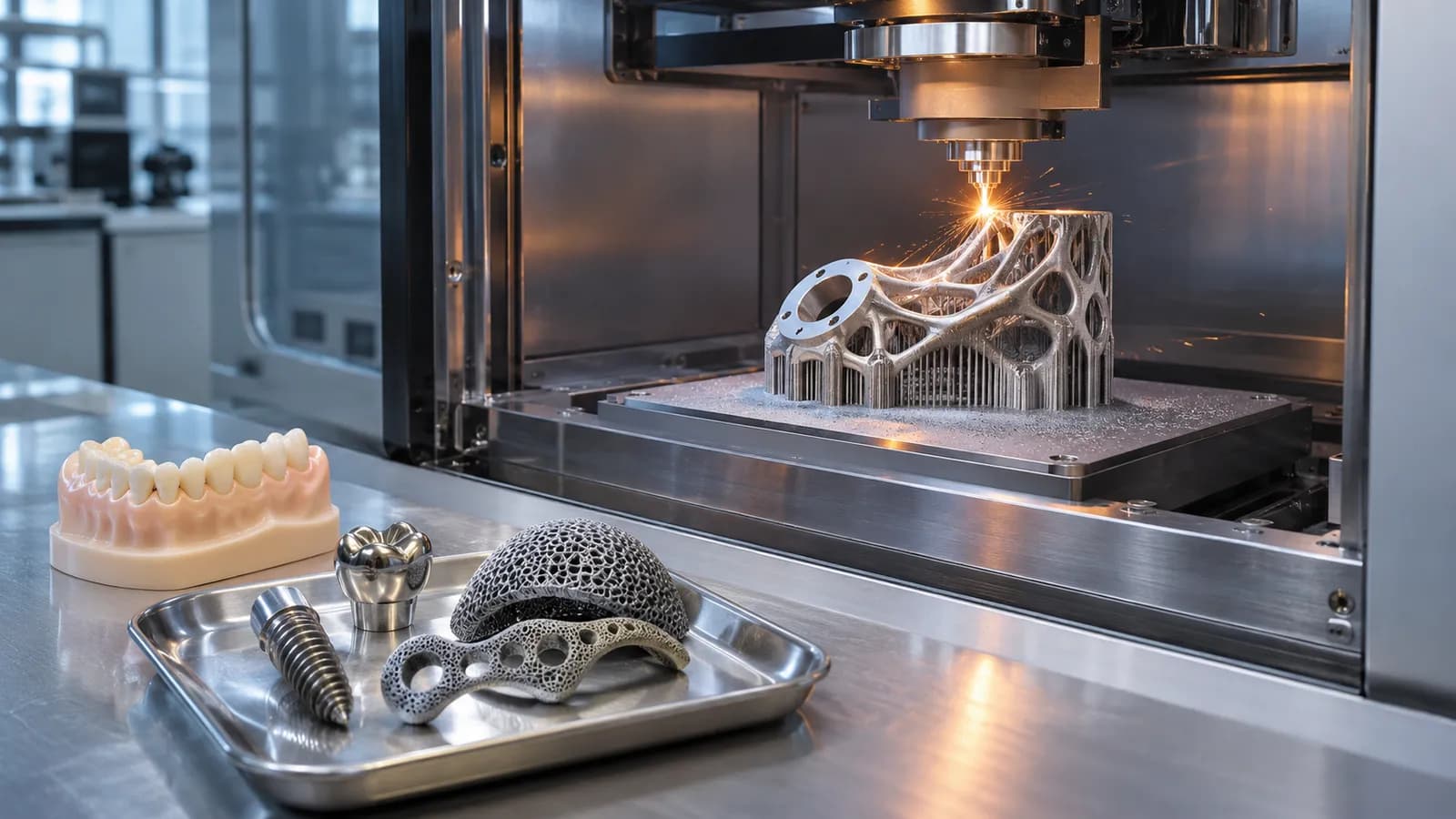
Company Overview
3D Systems makes 3D printers, materials, software and parts manufacturing services. It trades on the NYSE under the ticker DDD. Its Healthcare Solutions segment serves dental, medical device and surgical planning markets, and Industrial Solutions serves aerospace, defense and manufacturing.
3D Systems was founded in 1986 by Chuck Hull, who invented stereolithography.
It became one of the first 3D printing companies and grew through many acquisitions.
Latest Quarterly Results: Q3 2026
3D Systems reported third-quarter 2026 results on November 4, 2026.
Healthcare growth came mainly from dental materials and higher parts manufacturing volumes.
Revenue comparisons are affected by the 2025 sale of software businesses including Oqton and 3DXpert.
Business Model and Revenue Drivers
Chuck Hull, a co-founder, invented stereolithography, one of the first 3D printing methods.
The company sold software businesses including Oqton and 3DXpert in 2025.
Dental aligner materials and services are a significant part of healthcare revenue.
Competitive Landscape
Stratasys, EOS, HP, Formlabs and Nikon SLM Solutions compete in 3D printing.
3D Systems focuses heavily on healthcare applications.
Revenue Growth and Financial Performance
When reviewing 3D Systems's reported results, these measures give the clearest view of growth, profitability and cash generation:
- Revenue by segment
- Gross margin
- Operating expenses
- Cash and debt
- Litigation costs
Profitability and Earnings Quality
Revenue growth is only part of the picture. For 3D Systems, it helps to check whether growth comes from higher volumes, higher prices or acquisitions, and whether margins are widening or narrowing as the business scales.
Reported earnings can include one-time items such as restructuring charges, asset sales, tax effects or legal settlements. Separating these from recurring operating results, and comparing like-for-like periods, gives a more reliable view of underlying profitability.
Balance Sheet, Debt and Financial Stability
A review of 3D Systems's financial position starts with cash, total debt, lease obligations and how operating cash flow compares with capital spending. A business that funds its investment from its own cash flow is in a different position from one that relies on borrowing or issuing new shares.
Changes in inventory, receivables and working capital are also worth monitoring, because they can absorb cash and signal shifts in demand before they appear in revenue.
DDD Stock Valuation Analysis
Measures such as the price-to-earnings ratio, price-to-sales ratio and enterprise value to EBITDA describe how the market is currently pricing 3D Systems relative to its results.
However, a single valuation ratio cannot establish whether a stock is undervalued or overvalued. Earnings quality, free cash flow, margins, competitive position and the growth needed to support the current price all need to be considered together, and compared with similar companies.
Business Outlook and Investment Risks
Management guidance and industry conditions shape expectations for 3D Systems, but guidance is an estimate rather than an established outcome. Several uncertainties are specific to this business:
- Weak industrial capital spending
- Competition from Stratasys and others
- Continued losses
- Litigation
The Economics Of An Installed Printer
A printer sale can begin a longer commercial relationship. Customers need suitable materials, maintenance, replacement components and technical support to keep equipment operating. The value of that relationship depends on how often a machine is used and on the applications it runs, not simply on the number of printers shipped. An installed machine used for occasional prototypes can consume much less material than one incorporated into a regular production workflow. Equipment mix and actual utilization therefore help explain why hardware shipments and subsequent materials revenue need not move together.
The economics also depend on how open a printing system is. Some workflows are designed around materials validated for a particular machine and process, while others allow customers a wider choice of suppliers. Validated combinations can simplify process control, but customers also consider material availability, purchasing terms and the effort required to qualify alternatives. When reading product announcements or customer disclosures, distinguish a new machine placement from evidence of ongoing production use. The latter involves a repeatable workflow, trained staff and a continuing need for printed parts.
From Prototype To Production
Additive manufacturing builds an object from digital instructions in successive layers. Its appeal varies with the job: it can produce complex shapes and customized parts without a dedicated mold for each design, while conventional methods can be more efficient for standardized items made in large volumes. A useful comparison considers the entire production route, including preparation, machine time, finishing, inspection and rejected parts. Printer speed alone does not describe the cost or quality of a finished component.
Moving an application into production requires repeatability across machines, batches and operating conditions. Customers may need to establish specifications for raw materials, document process settings and test the properties of finished parts. Post-processing, such as cleaning, curing or removing support structures, can also influence throughput and consistency. These steps make adoption a workflow decision involving engineering, quality and purchasing teams. They also explain why a promising demonstration and a qualified manufacturing application represent different stages of customer adoption.
Healthcare Workflows And Validation
Healthcare applications illustrate how a digital design can connect a scan or other patient information to a physical product. Depending on the application, the output might be a model used in planning or a component used in treatment. The commercial workflow can include design preparation, material selection, printing, finishing and verification. Different participants may perform these steps, including clinicians, laboratories, device makers and manufacturing service providers. Understanding which step a company supplies helps clarify the source of its revenue and its relationship with the end user.
Requirements differ according to the intended use of the finished item. A planning model and an implantable device do not necessarily face the same evidence, documentation or regulatory requirements. Material properties, traceability, cleaning and consistency can all matter to a customer's qualification process. Changes to a material or production method may require additional validation by the relevant parties. This makes the scope of an application, and the identity of the party responsible for its final use, important details when interpreting healthcare product claims.
Reading Revenue And Cost Disclosures
A segment total can combine products and services with different delivery patterns and cost structures. Equipment transactions may be relatively discrete, while materials and services can reflect activity across an existing customer base. A change in the mix of these offerings can therefore affect segment revenue and gross profit even when the underlying economics of each offering are unchanged. Where disclosures permit, read segment results alongside product and service revenue categories, management's discussion of mix and any changes in the businesses included in the reporting period.
Revenue recognition also depends on the contract. A delivered product, a service performed over time and a support arrangement can have different timing as obligations are fulfilled. Deferred revenue can reflect payments received before all related work has been completed; it is a liability rather than an additional sale to add to reported revenue. Notes to the financial statements can explain the company's performance obligations and accounting policies. Reading those notes alongside segment commentary helps distinguish the timing of accounting recognition from the timing of customer activity.
Technology And Application Fit
Additive manufacturing encompasses several distinct process families, rather than one interchangeable technology. Stereolithography uses light to cure liquid resin, while other approaches fuse or bind powdered material. The choice of process affects the materials available, surface finish, part geometry and equipment needed around the printer. A customer making a visual model may place different weight on those characteristics than a manufacturer producing a functional metal component. Comparing product portfolios by process and intended use can therefore be more informative than comparing the number of machines offered. Different processes may also call for different handling of unused material and different environmental controls in the production area. Those requirements can influence the space, equipment and staff training a customer needs to operate a system.
Material behavior is central to that comparison. Polymers, metals and other materials respond differently to heat, light and mechanical stress, and a printed part's properties can depend on its orientation during the build. Designs developed for machining or molding may need to be changed to take advantage of additive manufacturing. Engineering effort can include redesigning a part, choosing its orientation and deciding how to remove it from the machine. These choices connect a supplier's technical capabilities to the range of jobs customers can practically undertake.
Service And Capacity Economics
Parts manufacturing services give customers access to production capacity without necessarily owning the equipment. The provider must coordinate orders, digital files, materials, machine scheduling and delivery. A varied order book can involve frequent changes in setup and finishing requirements, while repeat orders may allow a more standardized process. Revenue from finished parts reflects the work delivered, but the cost of providing it also includes labor, equipment, facilities and quality procedures. The relationship between order volume and capacity utilization is consequently an important operating consideration.
Capacity utilization can affect service margins because some costs continue even when machines are idle. A busy facility, however, can encounter bottlenecks outside the printer itself, including inspection and finishing. Adding printers alone may not relieve those constraints. When management discusses service performance, useful context includes the types of parts produced, operational efficiency and the balance between available capacity and customer orders. Reported segment results may combine services with other activities, so they do not necessarily isolate the economics of a single facility or production process.
Intangible Assets And Acquisitions
Acquisitions can leave a lasting mark on a technology company's financial statements. Purchased patents, customer relationships and other identifiable intangible assets may be recorded separately from goodwill, which represents the remaining amount paid beyond identifiable net assets. Some intangible assets are amortized over their useful lives, creating an expense that reduces reported earnings. The notes can show the categories of acquired assets and their remaining carrying amounts, helping readers understand how past transactions continue to affect the income statement.
Goodwill and other assets are also subject to impairment assessment under applicable accounting rules. An impairment charge reduces the carrying value of an asset when the relevant accounting conditions are met. It is distinct from the cash paid for an acquisition in an earlier period, although it can provide information about changes in assumptions associated with the acquired business. Read an impairment disclosure together with the description of the affected business and management's explanation, rather than treating the charge alone as a measure of current sales activity. The location of the charge in the income statement and the accompanying notes provide context for comparing periods.
Research And Intellectual Property
Developing a printing platform can require work across hardware, materials, process controls and software. Research and development spending captures part of that effort, although the accounting treatment of particular development costs depends on the applicable rules and circumstances. The expense line does not by itself reveal how much work supports existing products versus new applications. Product releases, technical documentation and management commentary can provide context about where the company is directing its engineering resources and how those efforts relate to its commercial offerings.
Patents and other intellectual property can shape competition by protecting particular inventions or processes for a limited period, subject to the relevant legal requirements. A patent does not automatically establish that a product meets customer specifications or that a manufacturing workflow can be deployed at scale. Practical know-how, process data, service capabilities and relationships with customers can also matter. Reviewing the scope of a claimed technical feature alongside the application it serves helps distinguish a legal right from the broader set of capabilities needed to deliver a finished part.
Conclusion: Is DDD Stock Worth Analyzing in 2027?
3D Systems has a business model with clear drivers that can be tracked through its reported results, and a set of risks that are specific to its industry and financial position.
A balanced assessment considers growth, profitability, balance-sheet strength, valuation and risk together. DDD is a company worth monitoring for what its results reveal about its business.