Company Overview
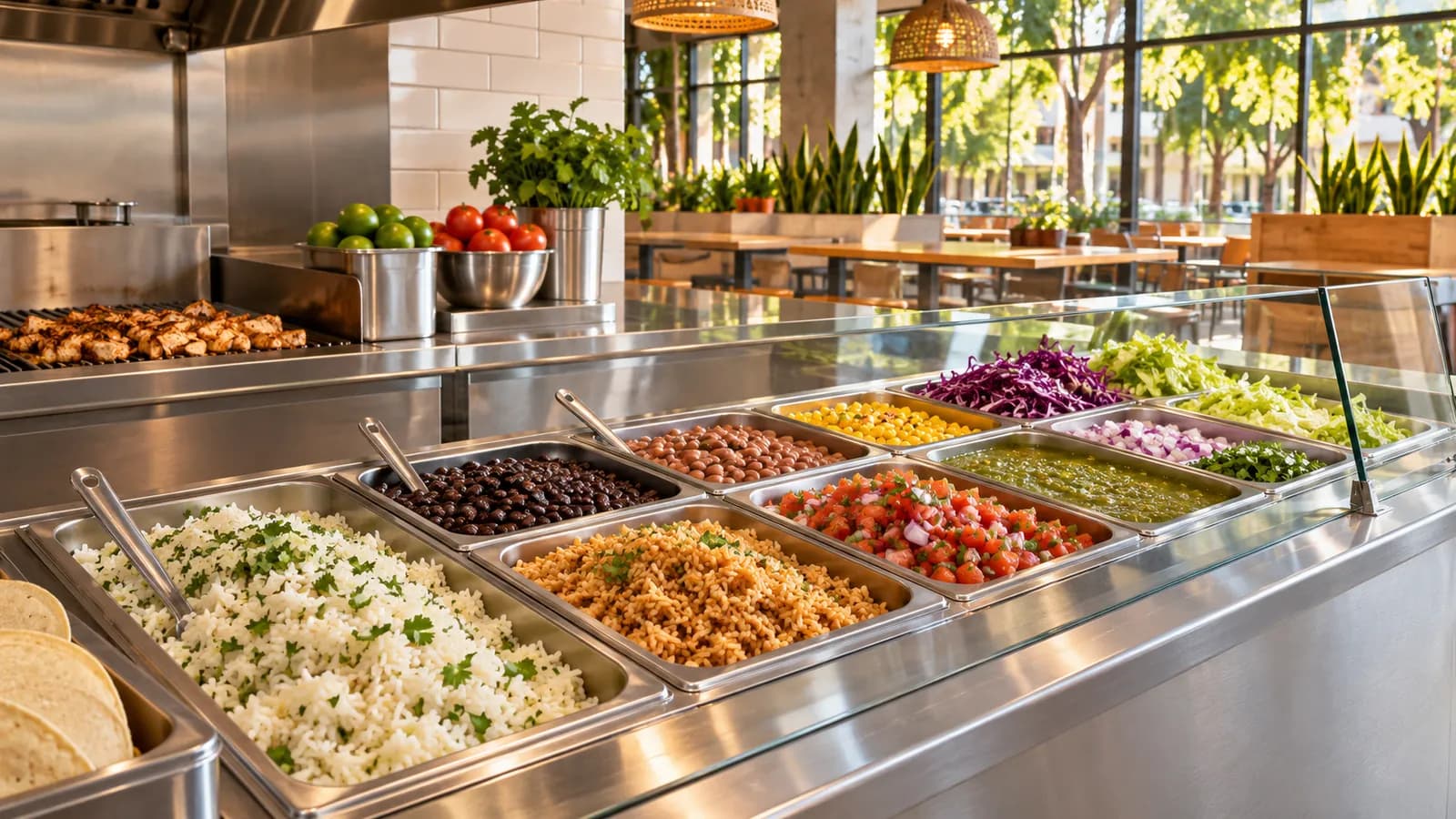
Chipotle Mexican Grill operates fast-casual restaurants serving customizable burritos, bowls, tacos and salads, and trades under the ticker CMG. Unlike most large restaurant brands, it owns and operates nearly all of its restaurants instead of franchising them, so it records full restaurant revenue and also carries the full cost of food, labor, occupancy and new-unit construction.
Chipotle opened its first restaurant in Denver, Colorado, with a simple menu of burritos and tacos made in front of customers. It grew rapidly by keeping the menu short and emphasizing ingredient sourcing and preparation in each restaurant.
The company has faced challenges, including food safety incidents that hurt traffic for a period, followed by a recovery driven by digital ordering, delivery and operational improvements. It has also completed a large stock split, which lowered the price per share without changing the company's value.
Latest Quarterly Results: Q3 2026
Chipotle reported third-quarter 2026 results (quarter ended September 30, 2026) in late October 2026.
Full-year 2025 revenue grew 5.4% to $11.9 billion while net income was roughly flat at $1.54 billion. Comparable restaurant sales fell 1.7% for 2025, the first full-year decline in more than two decades.
In Q3 2026, transactions turned positive again (+0.8%), but margins narrowed, so revenue growth did not translate into higher profit for the quarter.
Business Model and Revenue Drivers
Growth comes from two sources: sales at existing restaurants and the opening of new ones. Comparable sales separate the two, and are usually split into transaction count and average check.
Digital orders, delivery and drive-thru pickup lanes for digital orders change how demand reaches the kitchen and how much each restaurant can handle at peak hours.
Food and labor are the largest cost lines, so commodity prices, wage rules and menu pricing decisions have a direct effect on restaurant-level margins.
Competitive Landscape
Chipotle competes with other fast-casual chains such as Qdoba, Moe's, Sweetgreen and Cava, as well as quick-service restaurants and independent Mexican restaurants. Competition centers on price, speed, food quality and convenience.
Its scale, brand recognition and operating model give it purchasing power and consistent execution. However, the fast-casual category has many new entrants, and consumer preferences can shift.
Revenue Growth and Financial Performance
When reviewing Chipotle Mexican Grill's reported results, these measures give the clearest view of growth, profitability and cash generation:
- Comparable restaurant sales, split into transactions and average check
- Restaurant-level operating margin
- Food, beverage and packaging costs as a share of sales
- New restaurant openings and share of units with digital pickup lanes
- Digital sales mix
Profitability and Earnings Quality
Revenue growth is only part of the picture. For Chipotle Mexican Grill, it helps to check whether growth comes from higher volumes, higher prices or acquisitions, and whether margins are widening or narrowing as the business scales.
Reported earnings can include one-time items such as restructuring charges, asset sales, tax effects or legal settlements. Separating these from recurring operating results, and comparing like-for-like periods, gives a more reliable view of underlying profitability.
Balance Sheet, Debt and Financial Stability
A review of Chipotle Mexican Grill's financial position starts with cash, total debt, lease obligations and how operating cash flow compares with capital spending. A business that funds its investment from its own cash flow is in a different position from one that relies on borrowing or issuing new shares.
Changes in inventory, receivables and working capital are also worth monitoring, because they can absorb cash and signal shifts in demand before they appear in revenue.
CMG Stock Valuation Analysis
Measures such as the price-to-earnings ratio, price-to-sales ratio and enterprise value to EBITDA describe how the market is currently pricing Chipotle Mexican Grill relative to its results.
However, a single valuation ratio cannot establish whether a stock is undervalued or overvalued. Earnings quality, free cash flow, margins, competitive position and the growth needed to support the current price all need to be considered together, and compared with similar companies.
Business Outlook and Investment Risks
Management guidance and industry conditions shape expectations for Chipotle Mexican Grill, but guidance is an estimate rather than an established outcome. Several uncertainties are specific to this business:
- Food-safety incidents and their effect on traffic and brand perception
- Commodity cost inflation for key ingredients
- Labor-cost changes in major operating states
- Sensitivity of restaurant spending to consumer conditions and competition
Throughput And Restaurant Capacity
A restaurant has limited capacity at its busiest moments, so the flow of orders through the service line matters as much as the number of seats. Preparation before a rush, the arrangement of ingredients and the handoff between employees can affect how many guests are served in a given period. A bottleneck at one station can slow the entire line even when other stations have spare capacity. Managers therefore need to coordinate staffing and preparation with the timing and mix of orders.
Capacity is also shared across order channels. An order placed remotely still requires ingredients, preparation space and employee attention, even when the customer does not stand in the dining-room line. A separate preparation line can divide the work, but it also requires space and coordination. When examining operating commentary, distinguish a change in capacity from a change in demand: shorter waits may reflect improved execution, fewer orders, or a combination of the two.
Reading Restaurant Development Costs
Opening a restaurant involves more than the construction bill. Site selection, permitting, equipment, hiring and training all precede the first sale, and some expenses arise before a location contributes revenue. Newly opened restaurants also enter reported results at different points in a reporting period. Consequently, a count of openings alone does not describe the full contribution of those locations to sales or costs during that period.
Capital spending appears in the cash flow statement, while the cost of long-lived assets is generally recognized through depreciation over their useful lives. These measures answer different questions: cash spending shows when funds leave the business, whereas depreciation allocates an asset's recorded cost across accounting periods. Spending on new locations, maintenance and equipment replacement can also serve different purposes, so the composition of capital expenditure is informative when the company provides it.
From Restaurant Profit To Net Income
Restaurant-level operating margin focuses on sales and selected costs associated with running restaurants. It does not capture every expense incurred by the company. Corporate overhead, depreciation and other costs appear elsewhere in the income statement, so a change in restaurant-level margin need not match the change in company-wide operating margin. Comparing both measures helps identify whether a shift is concentrated in restaurant operations or also involves costs outside that measure.
Net income sits further down the income statement and includes items beyond operating profit, such as taxes and interest-related items. The effective tax rate can vary with the mix and timing of tax effects, making net income move differently from operating income. Reading the income statement from revenue through operating income to net income helps separate the performance of the restaurant business from those additional influences.
Menu Mix And Ingredient Management
Average check reflects more than posted menu prices. It can change when customers choose different proteins, add extras, purchase drinks or place orders covering different numbers of people. Those choices can also alter ingredient costs per order. A higher average check therefore does not by itself establish that a price increase occurred or that each transaction became more profitable; the products selected and their associated costs matter too.
A focused menu can make purchasing and preparation more consistent, but many ingredients still have different storage lives and preparation requirements. Restaurants must balance availability against spoilage and waste, while suppliers and distribution networks must deliver ingredients to individual locations. Changes in portions, product mix or waste can affect food usage even when supplier prices are stable. Management discussion of these factors can provide context for changes in reported food costs.
Conclusion: Is CMG Stock Worth Analyzing in 2027?
Chipotle Mexican Grill has a business model with clear drivers that can be tracked through its reported results, and a set of risks that are specific to its industry and financial position.
A balanced assessment considers growth, profitability, balance-sheet strength, valuation and risk together. CMG is a company worth monitoring for what its results reveal about its business.