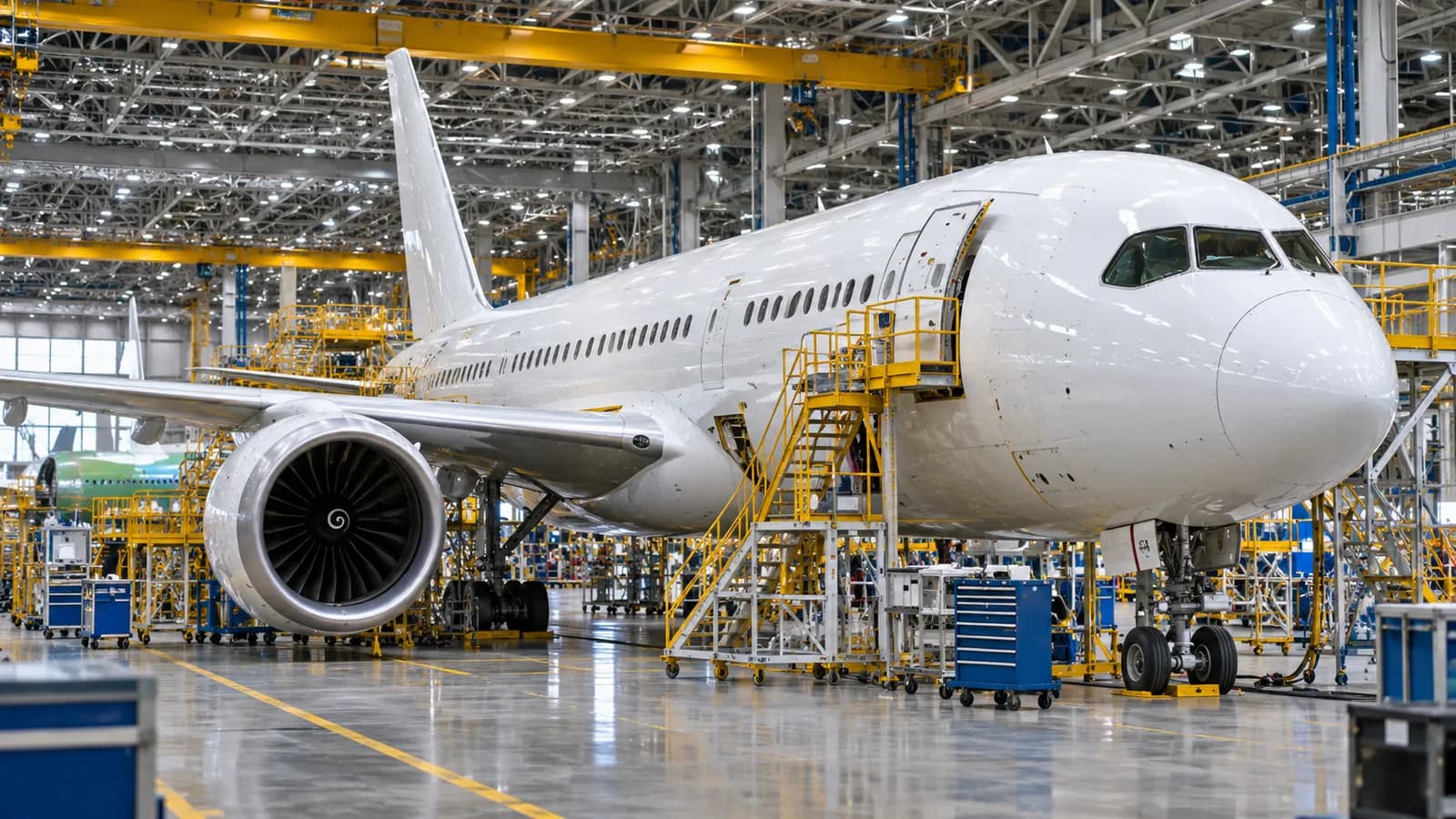
Company Overview
Boeing is one of the world's two largest makers of commercial jets and a major defense and space contractor. It trades on the NYSE under the ticker BA. It reports Commercial Airplanes, which builds the 737, 767, 777 and 787 families; Defense, Space & Security; and Global Services, which provides parts, maintenance and training.
Boeing was founded in Seattle in 1916 and grew into a leading aircraft manufacturer. Its merger with McDonnell Douglas in 1997 combined the two largest U.S. aircraft makers.
The 737 MAX was grounded worldwide after two fatal crashes in 2018 and 2019. Later quality problems, including a 2024 door panel blowout, led to increased FAA oversight, production limits and leadership changes. Boeing also agreed to reacquire key supplier Spirit AeroSystems.
Latest Quarterly Results: Q3 2026
Boeing reported third-quarter 2026 results on October 27, 2026.
Supply-chain challenges and production delays in Commercial Airplanes weighed on the quarter, while the rest of the company showed stronger margins.
The record backlog reflects long-term airline demand, but cash generation depends on how quickly Boeing can raise production and deliveries.
Business Model and Revenue Drivers
Commercial airplane revenue depends on how many jets Boeing can build and deliver each month. Production rates, supply chain capacity and regulatory oversight all limit output.
Boeing has a large order backlog, but quality and safety issues in recent years, including the 737 MAX crashes and a 2024 in-flight door panel incident, led to closer FAA oversight and production limits.
Fixed-price defense development contracts have produced significant charges, while Global Services has been a steadier, higher-margin business.
Competitive Landscape
In commercial aircraft, Boeing's main competitor is Airbus, with which it shares a near duopoly in large jets. China's COMAC is a smaller emerging competitor. In defense, Boeing competes with Lockheed Martin, Northrop Grumman, RTX and General Dynamics.
Boeing's large backlog reflects long-term airline demand, but its ability to deliver depends on production quality and supply chain stability.
Revenue Growth and Financial Performance
When reviewing Boeing's reported results, these measures give the clearest view of growth, profitability and cash generation:
- Monthly 737 and 787 production rates and deliveries
- Free cash flow
- Order backlog and net orders
- Charges on fixed-price defense programs
- Total debt and liquidity
Profitability and Earnings Quality
Revenue growth is only part of the picture. For Boeing, it helps to check whether growth comes from higher volumes, higher prices or acquisitions, and whether margins are widening or narrowing as the business scales.
Reported earnings can include one-time items such as restructuring charges, asset sales, tax effects or legal settlements. Separating these from recurring operating results, and comparing like-for-like periods, gives a more reliable view of underlying profitability.
Balance Sheet, Debt and Financial Stability
A review of Boeing's financial position starts with cash, total debt, lease obligations and how operating cash flow compares with capital spending. A business that funds its investment from its own cash flow is in a different position from one that relies on borrowing or issuing new shares.
Changes in inventory, receivables and working capital are also worth monitoring, because they can absorb cash and signal shifts in demand before they appear in revenue.
BA Stock Valuation Analysis
Measures such as the price-to-earnings ratio, price-to-sales ratio and enterprise value to EBITDA describe how the market is currently pricing Boeing relative to its results.
However, a single valuation ratio cannot establish whether a stock is undervalued or overvalued. Earnings quality, free cash flow, margins, competitive position and the growth needed to support the current price all need to be considered together, and compared with similar companies.
Business Outlook and Investment Risks
Management guidance and industry conditions shape expectations for Boeing, but guidance is an estimate rather than an established outcome. Several uncertainties are specific to this business:
- Quality, safety and regulatory issues affecting production
- Supply chain constraints and labor disputes
- Losses on fixed-price defense programs
- High debt levels and competition from Airbus
Aircraft Orders And Customer Payments
An aircraft order is a contractual commitment with terms that can differ across customers. Airlines may select delivery slots, engine options and cabin configurations well before an aircraft is completed. Contracts can also contain provisions for changes, cancellations or compensation for delays. The order book therefore combines agreements at different stages, and its stated value does not reveal the timing or profitability of each delivery. Reading changes in the book alongside disclosures about cancellations and contractual adjustments provides more context than treating every order as identical.
Customers generally make advance payments during the production process, with a substantial payment due at delivery. Those advances help finance work before the aircraft changes hands, but they also create obligations to complete the aircraft or otherwise settle the contract. Cash received in one period can relate to work recognized as revenue in another. Contract liability disclosures and changes in customer advances can help explain why cash movements and reported sales do not move together in a particular reporting period.
Program Accounting And Inventory
Boeing uses program accounting for certain commercial aircraft programs. Under this method, it estimates revenue and costs across a defined group of aircraft, rather than assigning each delivery only its individual production cost. Early aircraft in a program can cost more to build than the estimated average because manufacturing processes are still being refined. The difference can be recorded as deferred production costs within inventory and recovered through later deliveries if the estimates are achieved.
This approach makes assumptions about production costs, pricing and the number of aircraft in the accounting block especially important. Changes in those estimates can affect the margin recognized on current deliveries, even when the physical aircraft delivered have not changed. Financial statement notes describing program inventory, deferred costs and estimate revisions help readers distinguish the economics of an individual period from the accounting allocation of expected costs across a longer production run.
Defense Contract Accounting
Defense contracts can cover development, production and support, with payment and risk allocation varying by agreement. A cost-type contract generally reimburses allowable costs under its terms, while a fixed-price contract places more of the burden of cost overruns on the contractor. Contracts can also include incentives tied to performance or delivery. These structures matter when comparing reported margins because similar revenue amounts can carry very different exposures to technical difficulty and changes in estimated costs.
For many long-term contracts, revenue is recognized as work progresses using estimates of the total cost and expected contract value. When estimated costs change, Boeing may need to adjust profit already recognized on the work completed. A loss expected on a contract is recognized when identified. Notes about significant estimate changes and contract losses therefore help explain why a period's operating result may reflect reassessments of work performed over several reporting periods.
Installed Fleet And Services Demand
An aircraft can remain in service for many years, creating demand for replacement parts, repairs, engineering support and training after its initial delivery. The size, age and utilization of the installed fleet influence the type and timing of that work. Maintenance requirements also vary by aircraft model and operating conditions. An airline that flies an aircraft intensively may consume parts and require certain maintenance more quickly than an airline operating a similar aircraft less frequently.
Boeing participates in an aftermarket that also includes airlines' own maintenance operations, independent repair providers and equipment manufacturers. Services can be sold through individual transactions or longer-term support agreements, so reported revenue depends on the mix of work as well as fleet activity. A reader can assess changes in services results by considering whether they reflect parts demand, maintenance activity, contract mix or acquisitions, rather than assuming that every increase has the same economic cause.
Conclusion: Is BA Stock Worth Analyzing in 2027?
Boeing has a business model with clear drivers that can be tracked through its reported results, and a set of risks that are specific to its industry and financial position.
A balanced assessment considers growth, profitability, balance-sheet strength, valuation and risk together. BA is a company worth monitoring for what its results reveal about its business.