What Is Accelerated Vesting?
Author: Shashi Prakash Agarwal
Introduction
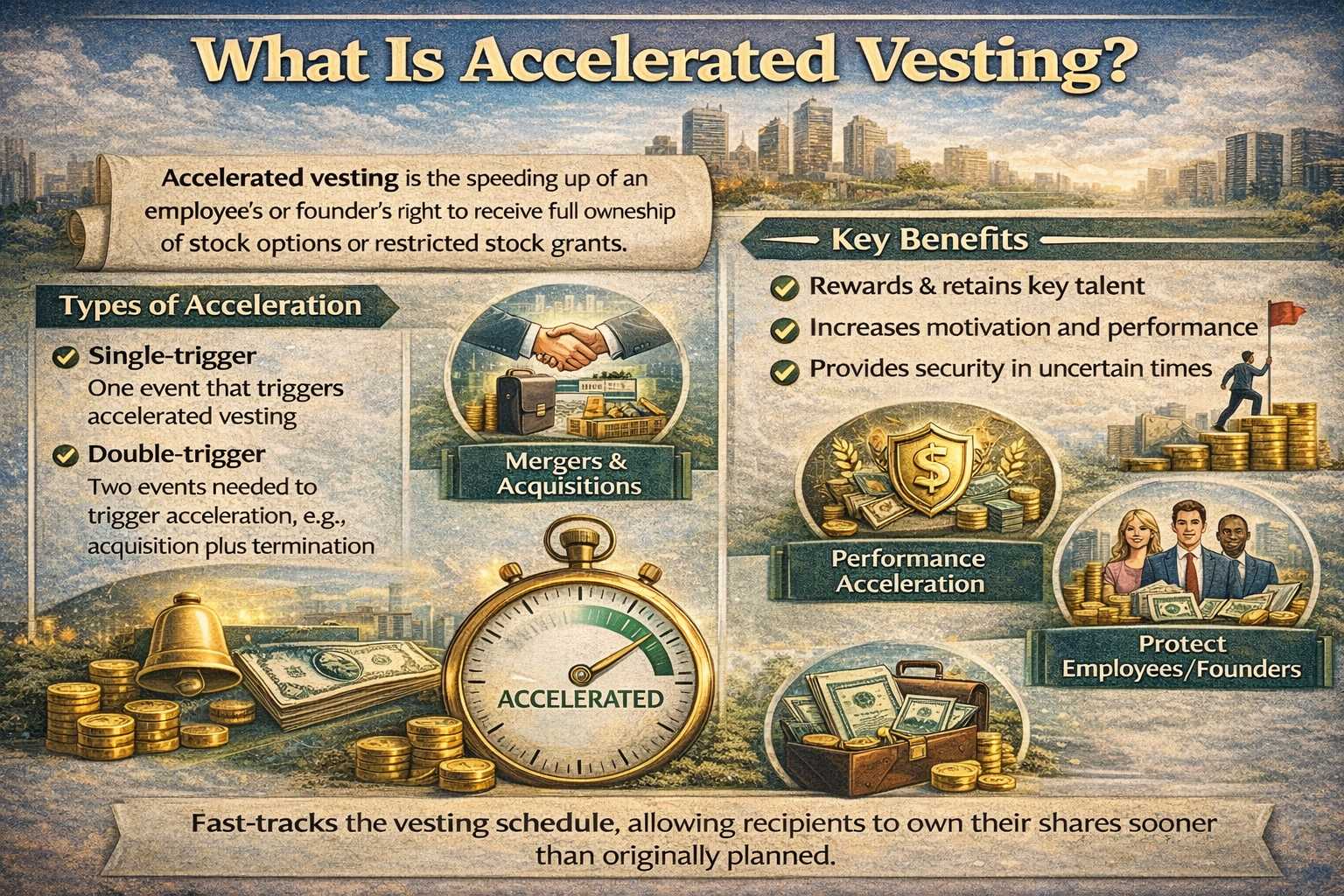
Accelerated vesting is a compensation feature that allows employees to gain ownership of their equity awards faster than originally scheduled. It most commonly applies to stock options or restricted stock units that would normally vest gradually over time. Under certain circumstances, a company may decide to shorten or eliminate the remaining vesting period, giving employees immediate or earlier access to their equity. Accelerated vesting is typically triggered during major corporate events or employment changes and is often outlined in employment contracts, equity plans, or severance agreements.
Understanding Accelerated Vesting
Many companies, especially startups and growth-stage firms, offer equity compensation to attract and retain talent. This equity usually comes with a vesting schedule, meaning employees earn ownership rights over time rather than immediately. Vesting can be structured as gradual vesting over several years, cliff vesting after a specific period, or a combination of both. Vesting may also depend on time served, performance milestones, or company-wide achievements. Accelerated vesting occurs when this schedule is sped up. Instead of continuing to vest equity over the remaining months or years, some or all unvested equity becomes vested at once. This means the employee gains immediate ownership of shares that would otherwise have been forfeited if they left the company early.
Situations That Can Trigger Accelerated Vesting
Accelerated vesting usually happens under specific conditions defined in advance or negotiated at the time of separation. One common trigger is a change in control, such as a merger, acquisition, or initial public offering. In these cases, accelerated vesting helps protect employees from losing unvested equity when company ownership changes. Another common trigger is termination or layoff, particularly when the employee is let go without cause. In restructuring or redundancy situations, accelerated vesting may be offered as part of a severance package to compensate for the loss of future equity earnings. Some companies also include performance-based acceleration, where vesting speeds up if the employee, team, or company meets certain predefined performance goals. This approach aligns incentives while rewarding exceptional outcomes.
Single-Trigger vs. Double-Trigger Accelerated Vesting
There are two primary forms of accelerated vesting, known as single-trigger and double-trigger acceleration. Single-trigger accelerated vesting occurs when one qualifying event takes place, most commonly a change in control. Once that event happens, some or all remaining equity vests automatically, regardless of whether the employee remains with the company. This structure is relatively uncommon because it can reduce retention incentives after an acquisition. Double-trigger accelerated vesting requires two separate events. Typically, the first trigger is a change in control, and the second trigger is the employee’s termination or a material change in their role within a specified time period. Double-trigger arrangements are more common because they balance employee protection with the employer’s desire to retain key talent after a transaction.
Pros and Cons of Accelerated Vesting
From an employee’s perspective, accelerated vesting is generally beneficial. It provides faster access to equity compensation, which can significantly improve financial security, especially for employees at startups who may accept lower cash pay in exchange for ownership potential. However, accelerated vesting can also create tax consequences, depending on the type of equity and local tax rules, which employees should carefully evaluate. From the employer’s perspective, accelerated vesting carries trade-offs. Vesting schedules are designed to encourage retention and long-term commitment. If equity vests too quickly, key employees may have less incentive to remain with the company after a triggering event. For this reason, companies tend to limit accelerated vesting provisions or structure them carefully.
Example of Accelerated Vesting
Consider an employee who joins a startup and receives stock options that vest over four years, with 25 percent vesting each year. After two years, the employee has vested in half of the options. If the company is acquired and the employee’s position is eliminated shortly afterward, the employment agreement may allow for accelerated vesting. Under a double-trigger arrangement, the acquisition serves as the first trigger and the termination as the second. As a result, the remaining unvested options vest immediately, allowing the employee to leave with full ownership of their equity award. Without accelerated vesting, the employee would have forfeited the unvested portion upon termination.
Final Thoughts
Accelerated vesting is an important feature of equity compensation that protects employees during major corporate or employment changes. By shortening or eliminating vesting timelines, it ensures that employees are not unfairly penalized when circumstances beyond their control affect their tenure. Understanding how accelerated vesting works, including the differences between single-trigger and double-trigger arrangements, can help employees negotiate better compensation packages and make informed decisions when joining or leaving a company. For employers, thoughtful use of accelerated vesting can balance fairness with long-term retention goals.