Institutional Edge: Why Hedge Funds and Family Offices Are Exploring Financial Astrology
Author: Shashi Prakash Agarwal
Introduction
In professional investing, edge rarely comes from having access to more news. By the time a major headline reaches everyone, markets have usually begun pricing it in. The same is true for earnings commentary, macro commentary, and many popular technical signals. This is why serious investors continually search for non-consensus frameworks that can improve timing, risk control, and capital allocation. They are not simply looking for more information. They are looking for better context. That search has opened the door to alternative data. In recent years, hedge funds, family offices, proprietary desks, and sophisticated allocators have expanded their research process far beyond traditional balance-sheet analysis and standard macro models. They now study satellite data, supply-chain intelligence, web traffic, sentiment analytics, options flows, and cross-asset positioning data. The logic is clear. If markets are shaped by complex interactions between information, psychology, liquidity, and timing, then a differentiated data layer can create meaningful advantage.
Why Institutional Investors Need More Than Traditional Analysis
Professional investors already operate with advanced research stacks. They have macro dashboards, earnings models, portfolio analytics, risk overlays, and cross-market monitoring tools. Yet even with these resources, they still face a persistent challenge. Markets do not move in straight lines, and they do not always respond to data in a rational sequence. Sometimes equities rise despite weak headlines. Sometimes strong earnings fail to support price. Sometimes markets reverse before the fundamental story visibly changes. That gap between information and timing is where many performance differences emerge. An investor can have the right long-term thesis and still suffer poor outcomes because exposure was added during a bad timing window. A hedge fund can correctly identify a sector opportunity but still underperform because volatility expanded before conviction could be monetized. A family office can hold excellent assets yet mismanage entry points or rebalancing periods because the emotional rhythm of the market was ignored.
Financial Astrology as an Alternative Data Layer
Alternative data becomes useful when it helps answer questions the standard toolkit cannot answer quickly or clearly. Financial astrology is relevant here because it adds a time-sensitive interpretive layer to market analysis. It does not merely ask what the market is doing. It asks what kind of environment the market is moving through. For institutional users, this matters because capital is not deployed in a vacuum. Every decision exists inside a broader cycle. The same trade idea can have very different outcomes depending on whether it is launched during a supportive phase, a fragile phase, or a high-volatility period. A timing layer helps distinguish those conditions. The strongest institutional case for financial astrology is not that it predicts every move. It is that it may help organize risk in a more intelligent way. It can function as a cyclical framework for identifying windows associated with expansion, contraction, crowd emotion, exhaustion, reversal pressure, or elevated volatility. That is valuable because professional investors do not need certainty to improve returns. They need probability-weighted context.
Why Hedge Funds Are Interested in Timing Intelligence
Hedge funds live and die by timing, risk-adjusted returns, and the efficient deployment of capital. Unlike passive allocators, they are expected to respond dynamically to changing market conditions. Their objective is not simply to be right eventually. It is to be right with disciplined timing and controlled downside. This makes hedge funds natural candidates for exploring nontraditional timing frameworks. Many already use quantitative signals, volatility surfaces, positioning data, and event-driven calendars to understand when opportunities are likely to be asymmetric. Financial astrology can enter this workflow as an additional layer of cycle intelligence. For example, a discretionary macro fund may already track central bank cycles, commodity trends, rates sensitivity, and geopolitical developments. The Financial Astrology Terminal can add a broader timing perspective by signaling periods when global sentiment may become unstable across asset classes. Likewise, an equity long-short fund may use the terminal to identify periods when market leadership is likely to rotate, when crowding risk may intensify, or when technical signals may be more fragile than they appear.
The Terminal as a Professional Decision-Support System
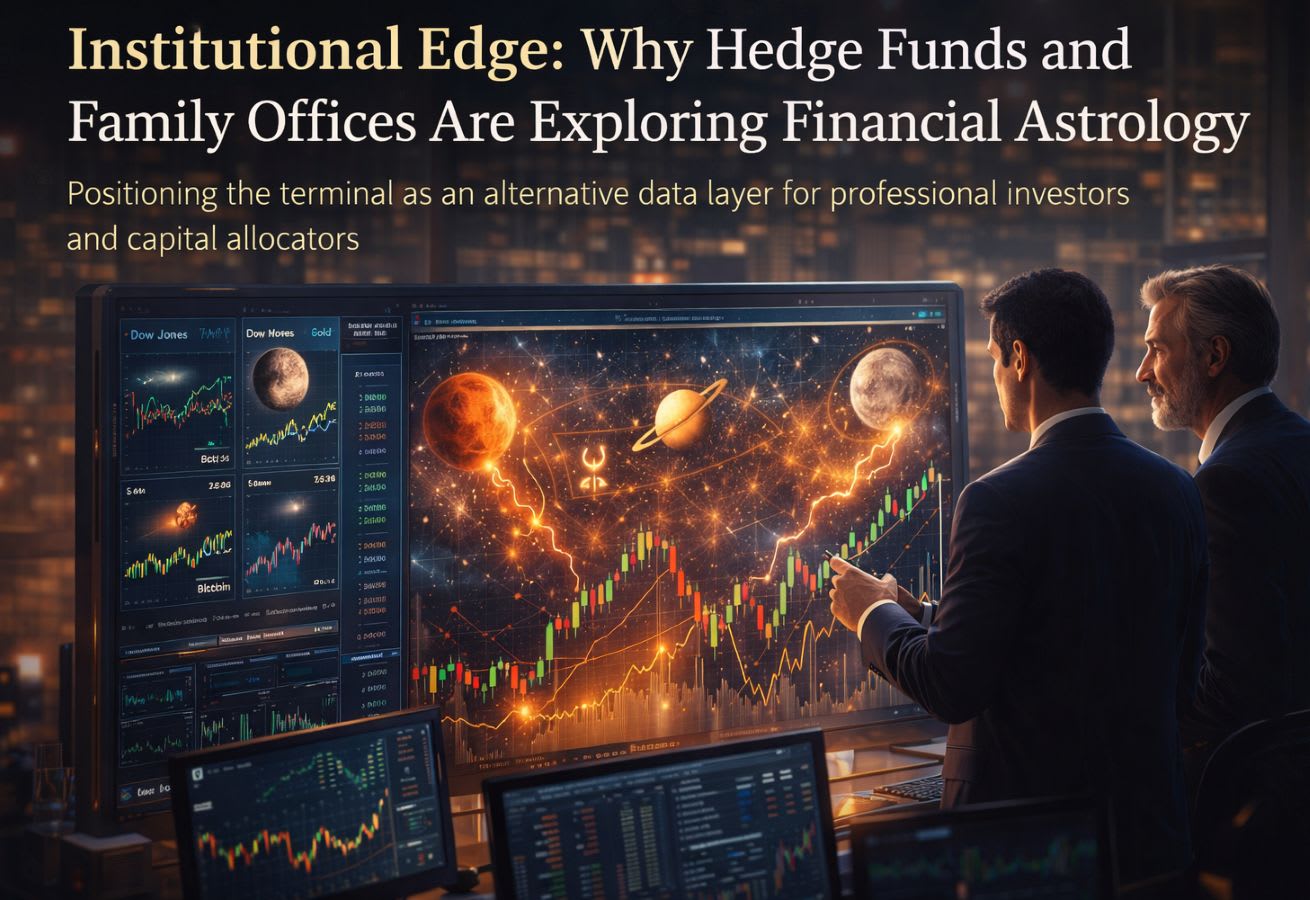
For institutional users, the Financial Astrology Terminal should not be presented as a curiosity. It should be presented as a structured decision-support system. Its real value lies in how it organizes data, cycles, and signals into a usable institutional workflow. A professional terminal can serve several functions. It can highlight key timing windows, map market mood, flag periods associated with volatility expansion, and show alignment or divergence across indices, commodities, currencies, and crypto. It can help investors identify whether current price action is taking place in a supportive or fragile environment. It can also provide a cleaner view of cross-market relationships by showing whether multiple assets are responding to a common timing influence. This matters for capital allocators because investment decisions are rarely single-variable judgments. They depend on sequencing, portfolio context, liquidity tolerance, and exposure concentration. A terminal that improves awareness of timing risk becomes a practical asset in position management and risk review.
Cross-Asset Relevance Strengthens the Institutional Case
One reason financial astrology becomes more compelling at the institutional level is its cross-asset relevance. Hedge funds and family offices do not look only at a single equity chart. They monitor indices, bond yields, commodities, currencies, credit spreads, and increasingly digital assets. Market stress often travels across all of them. A useful alternative data layer must therefore work across market types. The Financial Astrology Terminal can do this because its core focus is not asset-specific accounting. It is the rhythm of market behavior. It studies when sentiment expands, when contraction begins, when volatility clusters, and when correlations tighten or break. This allows professional investors to use the terminal as a portfolio-level overlay. Suppose equity indices look extended, gold begins to stabilize, crypto turns unstable, and commodity behaviour becomes erratic during a tense timing window. That combination may suggest a broader risk shift. A family office may respond by trimming cyclical exposure. A hedge fund may reduce net leverage or rotate into more defensive structures. In both cases, the terminal supports cross-asset interpretation.
The Strategic Appeal of Non-Consensus Tools
Institutional edge often comes from two things: disciplined execution and differentiated perspective. The second is impossible if everyone is looking at the same dashboards, the same earnings models, and the same consensus narratives. Professional investors know that markets are competitive precisely because information has become so widely distributed. That is why non-consensus tools matter. They help institutions see what others may be ignoring. Financial astrology appeals in this context because time itself remains under-modeled in most conventional frameworks. Analysts can price growth, inflation, margins, and probabilities, but many still struggle with the rhythm of turning points. A terminal focused on cycle intelligence speaks directly to that gap. For allocators willing to explore it seriously, the question is not whether the approach sounds unconventional. The real question is whether it improves timing, reduces blind spots, and helps protect or compound capital more effectively. If the answer is even partially yes, then the framework deserves attention.
Conclusion
Hedge funds and family offices are always searching for better ways to understand markets before consensus fully adjusts. In that search, the most valuable tools are not always the loudest or most widely accepted. Sometimes the real edge comes from a framework that helps interpret timing, crowd behavior, and volatility structure in a way traditional analysis does not. That is where the Financial Astrology Terminal fits. It positions financial astrology as an alternative data layer for professional investors and capital allocators. It is not about replacing fundamentals or technicals. It is about strengthening them with cycle awareness, sentiment mapping, and timing intelligence. Used responsibly, it can function as a decision-support system for exposure management, volatility preparation, and portfolio timing across asset classes.