How a Financial Astrology Terminal Helps Predict Stock Market Cycles
Author: Shashi Prakash Agarwal
Introduction
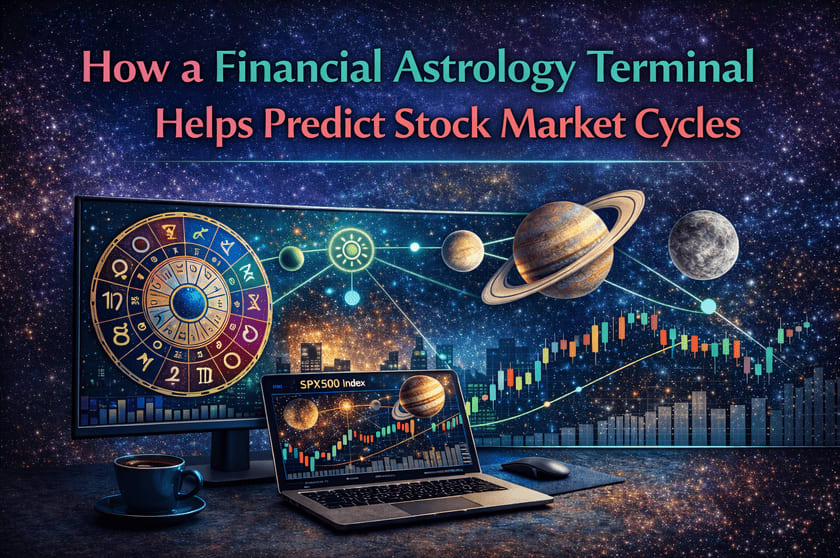
Financial markets move in cycles. Traders and investors constantly try to understand why markets rise, fall, and repeat patterns over time. Traditional analysis methods such as technical indicators, economic data, and corporate earnings explain part of the story. However, many analysts believe that deeper timing cycles also influence market behavior. One unconventional but increasingly discussed approach is financial astrology. A financial astrology terminal is a specialized analytical platform that combines astronomical data with financial market charts. These systems allow traders to study how planetary movements might correlate with stock market cycles. By analyzing historical planetary alignments and comparing them with past market events, traders attempt to identify potential timing windows for market reversals, expansions, or periods of volatility. Modern stock market astrology software integrates planetary cycles, trading charts, and cycle forecasting tools into a unified dashboard. Traders can visualize planetary transits alongside price movements, making it easier to study relationships between celestial cycles and financial markets. The concept may appear unconventional to some investors, yet financial astrology has been studied and used by market analysts for decades. Many traders believe that planetary movements influence collective psychology, and since markets are driven by human behavior, these psychological shifts may create repeating market patterns. Through advanced financial astrology terminals, traders attempt to understand these patterns and use them to improve market timing decisions. This article explores how planetary cycles may influence financial markets, how historical market cycles relate to astrological patterns, and how traders use financial astrology terminals to analyse and predict potential market trends.
Planetary Cycles and Financial Markets
Financial astrology is based on the idea that planetary cycles correspond with cycles of human behaviour and economic activity. Since financial markets are ultimately driven by human emotions such as optimism, fear, greed, and uncertainty, these emotional cycles may align with larger cosmic cycles. Certain planetary bodies are frequently studied in financial astrology. For example, the movements of Jupiter, Saturn, and Mercury are considered particularly important for analyzing financial trends. Jupiter is often associated with expansion, growth, and optimism. In financial astrology, periods influenced by Jupiter are sometimes linked with bullish market sentiment or economic growth. Traders may analyze Jupiter’s transits to identify periods when investor confidence could increase. Saturn, on the other hand, represents discipline, restriction, and structural change. Saturn cycles are sometimes associated with market corrections or periods when financial systems undergo restructuring. Financial astrologers often examine Saturn’s influence when studying long-term market cycles. Mercury is commonly associated with communication, information flow, and transactions. Its retrograde cycles are sometimes believed to correspond with confusion, delays, or volatility in markets. Traders who follow astrology may pay close attention to Mercury retrograde periods when planning short-term trading strategies. A financial astrology terminal helps traders track these planetary movements in real time. Instead of manually calculating planetary positions, traders can view astrological data directly alongside price charts. This integration allows analysts to explore correlations between planetary events and market reactions. While astrology does not claim to replace traditional analysis methods, many traders believe it provides a unique perspective on timing cycles that may otherwise remain hidden.
Historical Market Cycles and Astrology
One of the key reasons traders study financial astrology is the existence of repeating market cycles. Financial history shows that markets often move in long-term waves of expansion and contraction. These cycles sometimes span years or even decades. Financial astrologers analyze whether these long-term cycles correspond with major planetary alignments. For example, some researchers study the conjunction cycles of Jupiter and Saturn, which occur approximately every 20 years. These alignments have historically coincided with significant economic and political transitions. Throughout history, several major financial events have been studied through the lens of planetary cycles. Some astrologers claim that certain planetary alignments appeared near the timing of major stock market crashes, economic booms, or periods of financial instability. Financial astrology terminals make it possible to study these relationships more systematically. By overlaying planetary data onto historical price charts, traders can examine whether certain planetary configurations consistently appear near major market turning points. Another important concept in financial astrology is the idea of harmonic cycles. Planets move in predictable orbits, creating repeating geometric relationships known as aspects. These aspects may occur at regular intervals and can be mapped against historical market movements. For example, a trader might study whether a particular planetary alignment has historically coincided with market tops or bottoms. If a consistent pattern appears over multiple cycles, the trader may consider that timing window significant for future analysis. Although these correlations remain debated, the growing availability of digital tools has made it easier than ever for traders to explore these patterns.
Using Astrology for Timing Market Trends
Timing is one of the most challenging aspects of trading and investing. Many traders struggle with deciding when to enter a position, when to take profits, or when to exit the market to avoid losses. Financial astrology focuses primarily on timing rather than price prediction. Instead of forecasting exact price levels, astrology-based analysis attempts to identify time windows when markets may experience increased volatility or trend changes. A financial astrology terminal helps traders analyze these timing windows by displaying planetary events alongside market charts. Traders can observe when important planetary aspects occur and evaluate how markets reacted during similar alignments in the past. For example, if a trader notices that a particular planetary alignment historically coincided with strong market movements, they may monitor the next occurrence of that alignment more closely. If technical indicators also suggest a potential reversal, the combination of signals may strengthen the trader’s analysis. Another timing technique used in financial astrology involves studying planetary retrograde cycles. Retrograde periods occur when a planet appears to move backward relative to Earth. Some astrologers believe these periods correspond with increased uncertainty or miscommunication in markets. By tracking retrograde cycles through stock market astrology software, traders may adjust their trading strategies during these periods. For instance, they might reduce position sizes or avoid high-risk trades during times of expected volatility. Financial astrology terminals also allow traders to project planetary cycles into the future. This helps analysts anticipate periods when significant alignments may occur. By preparing in advance, traders can plan their strategies more carefully.
Practical Examples of Market Prediction Using Astrology
Financial astrology is most useful when combined with other analytical techniques. Professional traders rarely rely on astrology alone. Instead, they integrate planetary analysis with technical indicators, price action analysis, and macroeconomic data. Consider a scenario where a trader observes that a major planetary alignment historically coincided with market volatility. As that alignment approaches again, the trader studies the current market structure using technical analysis. If the market is approaching a strong resistance level and momentum indicators show weakening trends, the trader may interpret the combination of signals as a potential turning point. Another example involves long-term economic cycles. If a financial astrology terminal shows that a major planetary cycle associated with economic expansion is beginning, investors might analyze whether macroeconomic indicators support the possibility of a bullish trend. Planetary cycles can also help traders identify periods when markets may transition between trends. Markets rarely move in straight lines. Instead, they shift between phases of accumulation, expansion, distribution, and correction. Astrology-based timing tools attempt to identify when these transitions might occur. For instance, if multiple planetary cycles converge around the same time period, traders might anticipate increased market activity. They may watch for breakouts, trend reversals, or spikes in volatility during that window. While astrology does not guarantee market predictions, it can provide an additional layer of analysis that complements traditional methods.
Advantages of Using a Financial Astrology Terminal
Modern financial astrology terminals offer several advantages for traders interested in planetary cycle analysis. First, these platforms automate complex astronomical calculations. In the past, astrologers had to calculate planetary positions manually. Today, advanced software performs these calculations instantly, allowing traders to focus on analysis rather than mathematics. Second, financial astrology terminals integrate planetary data directly with financial charts. This visualization makes it easier to study correlations between celestial events and market movements. Third, these platforms often include historical databases that allow traders to analyze past planetary cycles and compare them with historical market events. This feature enables traders to conduct detailed cycle research. Finally, financial astrology software provides forecasting tools that help traders anticipate upcoming planetary alignments. By knowing when significant astrological events will occur, traders can prepare their trading strategies in advance.
Conclusion
Financial markets operate within complex systems influenced by economics, psychology, and global events. While traditional analysis methods remain essential, alternative approaches such as financial astrology provide a unique perspective on market timing. A financial astrology terminal allows traders to explore the potential relationship between planetary cycles and stock market behavior. By combining astronomical data with financial charts, these platforms help analysts study historical patterns and identify possible timing windows for market movements. Through stock market astrology software, traders can analyze planetary alignments, retrograde cycles, and long-term celestial patterns that may correspond with financial market cycles. While astrology should not replace technical or fundamental analysis, it can serve as a complementary tool for understanding market timing. As technology continues to evolve, financial astrology terminals are becoming more advanced and accessible. Traders who are open to exploring unconventional analytical methods may find valuable insights by studying the fascinating intersection between planetary cycles and financial markets.