Financial Benchmarks and Performance Measurement
Author: Shashi Prakash Agarwal
What Is a Benchmark
In finance, a benchmark acts as a reference point against which the performance of an investment, portfolio, or fund is measured. It provides investors with a standard to evaluate whether their returns are aligned with, better than, or worse than the broader market or a specific segment of it. Benchmarks are usually constructed using well-defined rules and represent a market index, asset class, or investment style, making them an essential tool in performance analysis. A well-chosen benchmark helps bring clarity and objectivity to investment decisions. For example, an equity mutual fund focused on large-cap stocks should ideally be compared with a large-cap index rather than a broad market index. By doing so, investors can better understand whether the fund manager’s strategy is adding real value or merely mirroring market movements. Without benchmarks, performance discussions would remain subjective and difficult to interpret.
Common Market Benchmarks
Market benchmarks are most often represented by widely recognized indices. Equity benchmarks such as the S&P 500, NASDAQ Composite, or FTSE 100 are commonly used to track stock market performance across regions and sectors. In fixed income markets, government bond indices or corporate bond indices serve as benchmarks to evaluate debt investments, while commodities and alternative assets also have their own representative indices. These benchmarks play a critical role not only for investors but also for fund managers and institutions. They help in setting performance expectations, designing investment strategies, and communicating results transparently to stakeholders. Because benchmarks reflect overall market behavior, they also offer insight into economic trends, risk appetite, and sector rotation, making them a valuable analytical tool beyond simple performance comparison.
Benchmarking Portfolio Returns
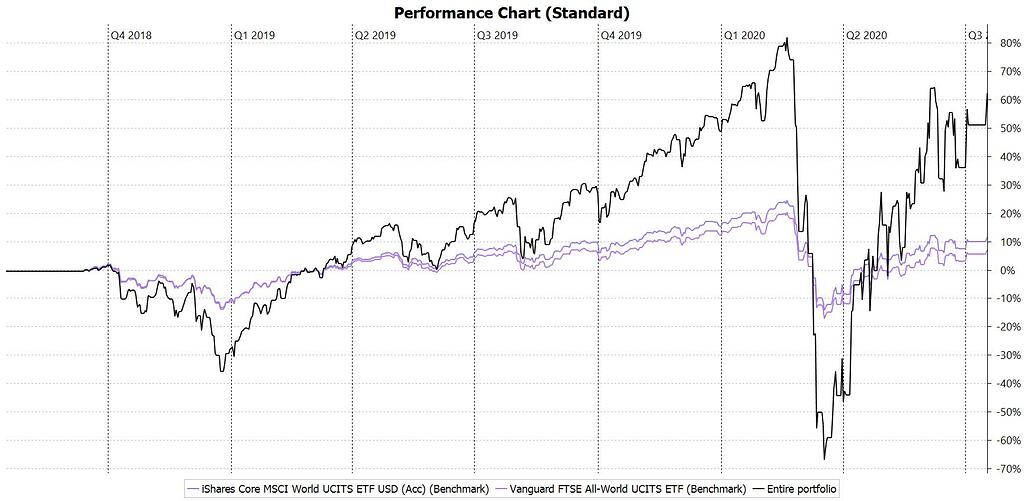
Benchmarking portfolio returns involves comparing the actual performance of a portfolio against its relevant benchmark over the same time period. This process allows investors to assess whether their asset allocation, security selection, and timing decisions have delivered superior returns after accounting for risk. A portfolio that consistently outperforms its benchmark may indicate effective strategy execution, while underperformance can signal the need for review or rebalancing. Beyond absolute returns, benchmarking also helps in understanding relative risk. Metrics such as tracking error and alpha are derived from benchmark comparisons and provide deeper insights into how closely a portfolio follows its benchmark and how much excess return it generates. For long-term investors, this comparison supports disciplined decision-making and helps avoid emotional reactions to short-term market volatility.
Limitations of Benchmarks
Despite their usefulness, benchmarks are not without limitations. A benchmark may not perfectly reflect an investor’s unique goals, risk tolerance, or investment horizon. For instance, a diversified personal portfolio may not align neatly with a single market index, making direct comparisons less meaningful. Additionally, benchmarks do not account for factors such as taxes, transaction costs, or liquidity constraints that can significantly impact real-world returns. Another limitation is that over-reliance on benchmarks can encourage short-term thinking. Investors and managers may focus excessively on beating an index rather than achieving long-term financial objectives. Therefore, while benchmarks are an essential component of performance measurement, they should be used alongside qualitative analysis, risk assessment, and individual financial planning to gain a more complete picture of investment success.