Mar 30, 2026 • 5 min read
Financial Astrology Terminal as a Decision-Support System: A Practical Framework for Traders
Author: Shashi Prakash Agarwal
Introduction
Modern trading is no longer a simple exercise in watching charts and reacting to headlines. Markets move across multiple layers at once. Price responds to liquidity, sentiment, macro policy, earnings expectations, geopolitical tension, and crowd behavior. A trader may have access to more data than ever before, yet still struggle with one central problem: timing. Knowing what to buy or sell is only part of the challenge. Knowing when to act, when to stay patient, and when to reduce risk often makes the difference between disciplined trading and emotional trading.
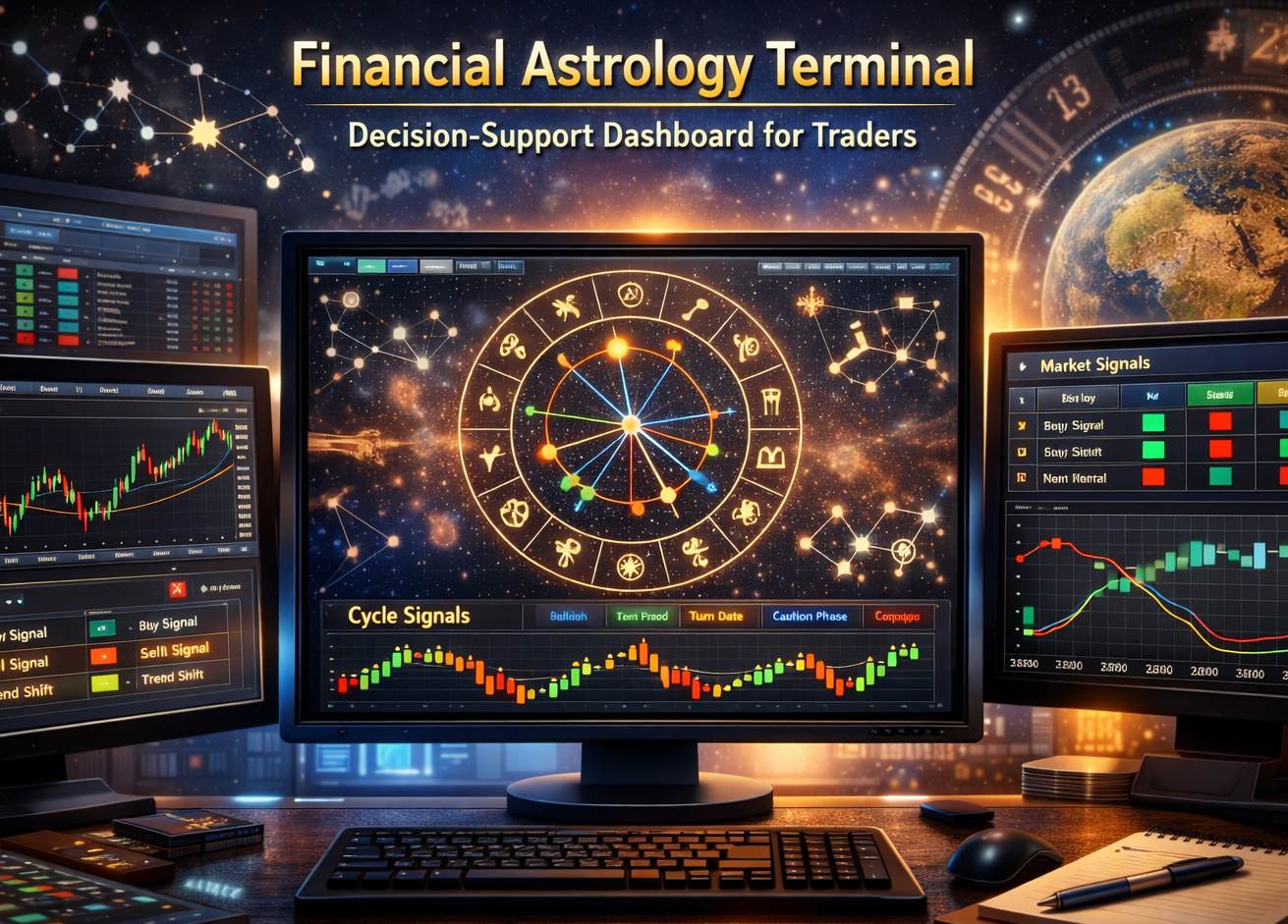
This is where the idea of a Financial Astrology Terminal becomes meaningful. It is not a replacement for technical analysis, macro research, or risk management. Rather, it functions as a decision-support system that brings together data, cycles, and signals into a single working framework. In practical terms, it acts like a dashboard for market timing. It helps traders organize information, understand the emotional climate of the market, track cycle-sensitive windows, and interpret signals with greater context.
Why Traders Need a Decision-Support System
Every trader faces the same problem in different forms. Markets generate too many signals. Some are useful, some are misleading, and many are incomplete when viewed in isolation. A breakout may look strong on a chart, but the broader market may be entering a volatile timing window. A macro narrative may appear bullish, but sentiment may already be stretched. A support level may hold technically, yet cross-market conditions may suggest caution.
This is why many traders make poor decisions even when they have solid analytical skills. The issue is often not intelligence. The issue is signal overload without a hierarchy of interpretation. A decision-support system helps solve this by organizing inputs into a framework that can guide action. It does not trade automatically. It does not remove judgment. It improves judgment by making the environment clearer.
The Meaning of a Dashboard in Trading
A dashboard is valuable because it simplifies complexity without oversimplifying reality. Good dashboards do not drown the user in information. They organize the most important information in a way that helps with decisions. In trading, this means giving the trader a real-time or near-real-time view of what matters most: price structure, momentum, volatility, cycle position, sentiment risk, and actionable signals.
The Financial Astrology Terminal should be understood in the same spirit. It is not just a collection of astrological data placed next to market charts. It is a practical interface that interprets timing conditions in a useful way. The trader should be able to open the terminal and answer key questions quickly. Is the market in a supportive cycle or a stressful cycle? Is the current period favorable for trend continuation, or does it carry reversal risk? Are indices, commodities, and crypto aligned or diverging? Are signals being confirmed across timeframes, or is the market entering confusion?
Combining Data, Cycles, and Signals
The core value of a Financial Astrology Terminal lies in the way it combines three essential dimensions of market analysis: data, cycles, and signals. Each of these on its own is useful. Together, they become far more powerful.
Data includes the measurable market environment. This covers price levels, trend direction, volatility behavior, breadth, sector leadership, macro indicators, bond yields, commodities, currency moves, and liquidity conditions. Data tells the trader what the market is doing and what the broader environment looks like.
Cycles provide timing context. They do not replace price action. They help interpret it. A cycle-based view asks whether the market is moving through an expansionary phase, a contractionary phase, a sentiment-heavy period, or a window that historically corresponds with instability or reversal. This is the layer that helps traders think in terms of timing rather than only direction.
From Market Noise to Market Context
One of the biggest causes of inconsistent trading is reacting to noise without context. A trader sees a strong candle and assumes momentum. Another sees a sharp decline and assumes collapse. But isolated movement can be misleading. What matters is context. Was that breakout supported by sector breadth? Was that drop part of a risk window already highlighted by the cycle model? Was volatility expanding across related markets?
A Financial Astrology Terminal is useful because it creates context around movement. It helps answer whether a price event is part of a larger pattern or merely temporary noise. For example, a bullish technical pattern appearing in a supportive timing phase is different from the same pattern appearing near a likely emotional peak. A terminal that combines cycle context with live market data helps reduce the temptation to overreact.
Emotional Discipline and Reduced Impulsiveness
Every experienced trader knows that the hardest opponent in markets is often not the market itself but the mind reacting to it. Fear of missing out leads to poor entries. Fear of loss causes premature exits. Greed encourages overtrading. Frustration leads to revenge trades. The quality of decisions often deteriorates when the trader loses perspective.
A good decision-support system helps protect perspective. The Financial Astrology Terminal does this by framing market behaviour in terms of cycles and context. Instead of reacting emotionally to every move, the trader can step back and ask whether the behaviour fits the broader environment. If the terminal already indicated a high-volatility or unstable period, sudden reversals become less psychologically disruptive. If the terminal suggested a strong timing window for trend continuation, the trader may hold valid positions with greater confidence rather than exiting too early.
This is one of the most underrated advantages of a structured framework. It does not just improve analysis. It improves emotional discipline. That alone can materially change trading performance over time.
Conclusion
The Financial Astrology Terminal should be understood as a practical framework for traders who want more than isolated indicators and reactive analysis. It functions like a dashboard because it combines the key elements that matter most in real trading: market data, timing cycles, and decision-support signals. It does not ask traders to ignore charts, fundamentals, or macro trends. It helps them interpret all of those with greater timing awareness.
In a market environment driven by both data and emotion, a structured dashboard becomes increasingly valuable. Traders need systems that improve clarity, not confusion. They need context, not noise. They need timing, not just opinion. That is why a Financial Astrology Terminal can serve as a meaningful decision-support system. It is not about replacing judgment. It is about strengthening judgment.