Mar 30, 2026 • 6 min read
Beyond Price Action: How Financial Astrology Helps Decode Market Psychology and Sentiment
Author: Shashi Prakash Agarwal
Introduction
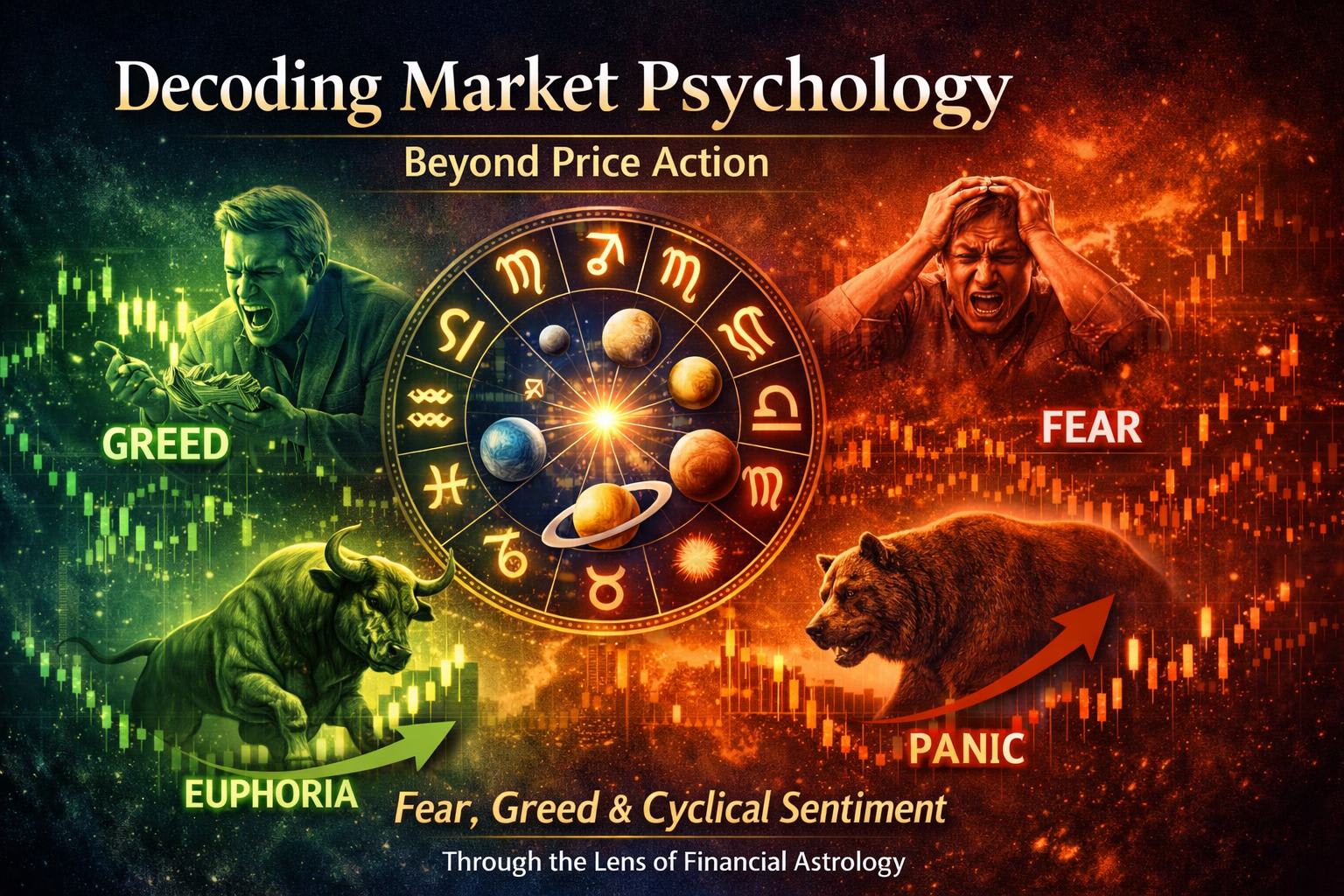
Financial markets are often described as rational systems driven by earnings, interest rates, inflation, liquidity, and economic expectations. Yet anyone who has spent enough time watching markets knows that price does not move on logic alone. Fear can erase months of gains in days. Greed can push overvalued assets far beyond any reasonable estimate of fair value. A rumor can shake a sector. A political event can trigger panic. A sudden wave of optimism can create momentum that feeds on itself. In other words, markets are not just mechanisms of valuation. They are living expressions of collective psychology.
This is where the conversation becomes more interesting. Traditional analysis explains what is happening in terms of data and structure. Technical analysis studies trend, momentum, resistance, and participation. Fundamental analysis studies revenues, margins, debt, and macroeconomic conditions. Both are important. However, neither fully captures the timing and emotional rhythm of market behavior. Markets often move before the news is fully understood. They peak when sentiment is euphoric and bottom when fear is deepest. The emotional cycle often leads the narrative, not the other way around.
Financial astrology enters this gap as a timing-oriented interpretive framework. It does not need to replace economics, charts, or valuation models. Instead, it adds a different layer by examining recurring cycles, periods of tension, and moments when collective sentiment may shift sharply. When used with discipline, financial astrology offers a way to think about crowd psychology through time rather than through price alone. It asks not only where the market is trading, but what kind of emotional environment is developing beneath the surface.
Why Price Action Alone Is Not Enough
Price action is powerful because it reflects real participation. It shows where buyers are willing to commit capital and where sellers gain control. It captures momentum, hesitation, breakout, reversal, and exhaustion. For many traders and investors, price is the final truth. Yet price action is still the visible result of invisible forces. It tells us what has happened and what is happening, but it does not always explain why emotional extremes appear when they do.
A market may continue rising even while valuations stretch, simply because confidence remains strong. A market may keep falling even after becoming cheap, simply because fear has not yet exhausted itself. The chart can show acceleration, but it cannot fully explain the psychological temperature that creates that acceleration. That temperature matters because markets are social systems. They rise when participants become more willing to take risk and they fall when participants become more desperate to avoid pain.
Markets Move in Emotional Cycles
Every market cycle has a psychological structure. In the early phase of a bull move, disbelief dominates. People doubt the rally. They call it temporary. As prices continue higher, skepticism weakens and acceptance grows. Then confidence expands. Risk appetite increases. Leverage becomes more attractive. Late in the cycle, confidence often turns into euphoria. Investors begin to believe that old valuation rules no longer matter. Narrative replaces discipline. At that stage, markets are highly vulnerable even if the trend still looks strong.
The same pattern appears in reverse during bearish phases. The first decline is dismissed as healthy consolidation. The second wave creates concern. The third wave produces stress. Then selling becomes emotional, forced, and indiscriminate. Good assets are sold with bad ones. Narratives turn dark. Forecasts are revised aggressively downward. Fear becomes contagious. This is usually the stage where the seeds of recovery are planted, because the emotional damage has become so intense that the market becomes oversold psychologically as well as technically.
Fear and Greed as Rhythmic Forces
Fear and greed are not constant. They expand and contract. They intensify under some conditions and relax under others. This is one of the most important ideas in market psychology. Greed dominates when the environment rewards risk-taking. Fear dominates when uncertainty rises faster than conviction. The emotional state of the crowd depends not just on data, but on the rhythm with which events unfold.
Financial astrology studies this rhythm by observing long-term and short-term planetary cycles that symbolically correspond to pressure, optimism, excess, contraction, confusion, and turning points. In practical terms, traders and investors use these cycles to identify periods when the market may be more reactive, more speculative, or more unstable. The value lies not in prediction as certainty, but in preparation as discipline.
Crowd Behaviour and the Logic of Extremes
Crowd behavior often appears irrational, but it follows recognizable patterns. People copy each other under uncertainty. They seek confirmation from price, headlines, and group opinion. They fear missing out during rising markets and fear total loss during declining markets. Social proof becomes stronger as volatility rises. This is why bubbles and crashes form. They are not just financial events. They are collective behavioral events.
Financial astrology offers a framework for understanding when collective behavior may become more extreme. It does not say that everyone suddenly changes personality. It suggests that certain time windows amplify particular tendencies. In one phase, speculation may flourish. In another, anxiety may dominate. In another, confusion may increase and signals may become mixed. This matters because crowd behaviour becomes most dangerous when people stop thinking independently.
The Role of Planetary Cycles in Market Mood
In financial astrology, planetary cycles are treated as symbolic markers of changing conditions rather than simplistic one-line causes of market moves. Some cycles are associated with expansion and confidence. Others are linked with pressure, structural adjustment, sudden shocks, or emotional confusion. The serious practitioner does not reduce markets to superstition. Instead, the goal is to study whether a period historically aligns with certain behavioral patterns.
This becomes especially useful when combined with market evidence. Suppose technical indicators show an extended rally, sentiment data shows excessive optimism, and a challenging astrological period is approaching. That combination may not mean an immediate crash, but it can justify greater caution. Similarly, if panic is widespread, valuations have compressed, technicals show exhaustion, and the cycle backdrop suggests relief, conditions may favor stabilization or reversal.
Why Serious Investors Are Paying Attention
Financial astrology has often been misunderstood because it is easy to caricature anything outside conventional finance. However, serious investors are not interested in caricatures. They are interested in edge. If markets are partly driven by crowd emotion, and if crowd emotion moves in cycles, then any framework that helps map those cycles deserves thoughtful attention.
The serious use of financial astrology is not about abandoning data. It is about integrating time with data. It recognizes that valuation, liquidity, technical structure, and macro conditions all matter, but so does emotional timing. A market may be fundamentally attractive and still decline if fear dominates. A market may be fundamentally stretched and still rise if optimism remains intense. Time determines how these contradictions resolve.
Beyond Price, Toward Deeper Market Understanding
Price action will always remain essential. It is immediate, observable, and practical. Yet price alone cannot fully explain the emotional engine that drives markets through booms, panics, reversals, and recoveries. To understand that engine, one must look beyond charts and into collective psychology.
Financial astrology provides a disciplined way to do that. It studies fear, greed, crowd behavior, and cyclical sentiment not as abstract ideas, but as recurring features of market life. Used responsibly, it can help investors recognize when the crowd is becoming too confident, too fearful, too reactive, or too confused. It can sharpen risk management, improve timing awareness, and reduce emotional decision-making.
In a world flooded with data, the true edge often comes from understanding behavior. Markets are moved by numbers, but they are also moved by human response to those numbers. When investors learn to read both, they gain a more complete view of reality. That is where financial astrology becomes valuable. It does not ask you to ignore price. It asks you to understand what price may be expressing beneath the surface.