Artificial Intelligence: How Machines Learn, Where It’s Used, and What It Means for Business and Society
Author: Shashi Prakash Agarwal
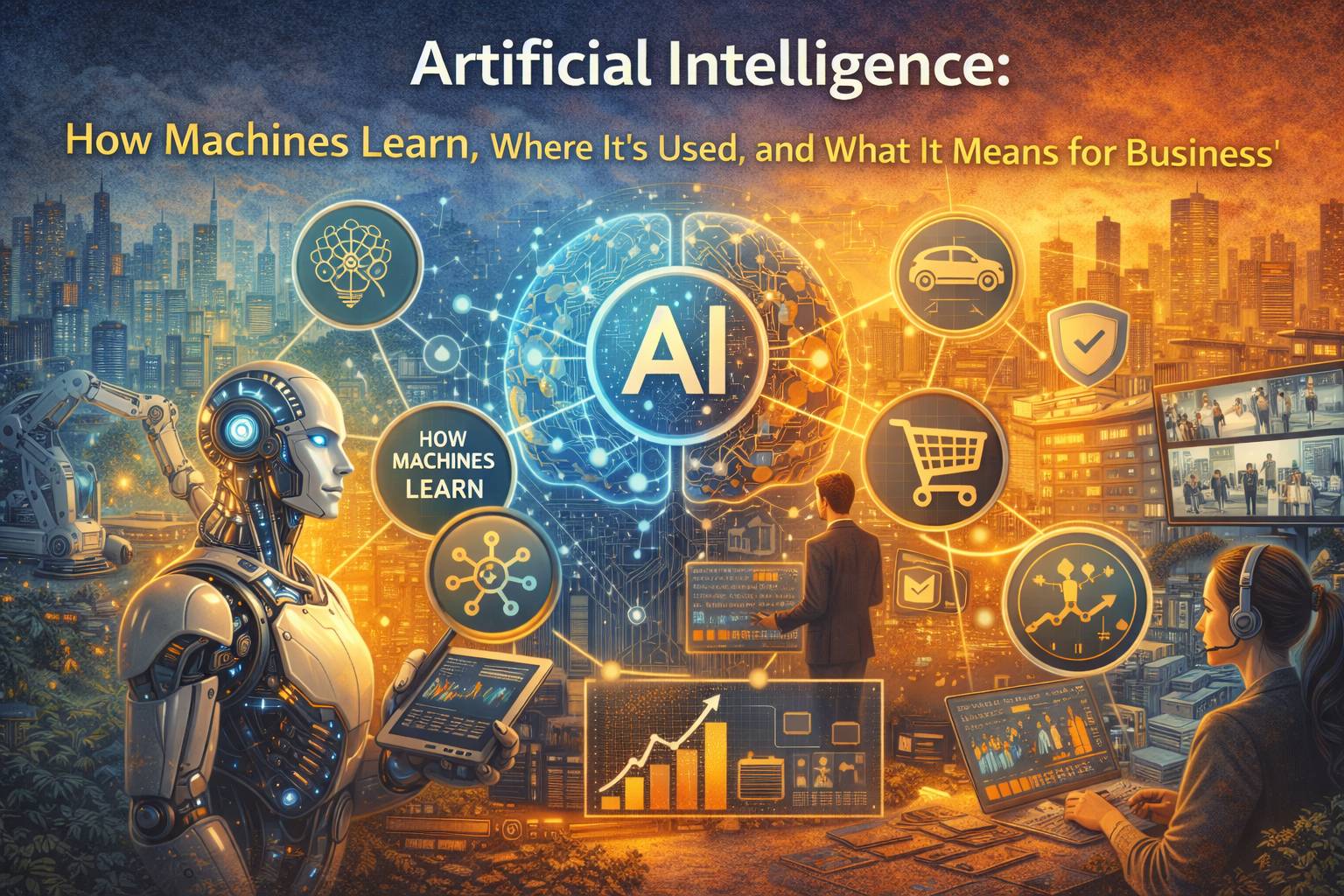
What Artificial Intelligence Is and How It Works in Simple Terms
Artificial intelligence, or AI, is a broad field of computer science focused on building systems that can perform tasks that normally require human intelligence. These tasks include recognising patterns, understanding language, making predictions, planning actions, and improving performance through experience. The key idea is not that a machine “thinks” like a person, but that it can process information and produce useful outputs in ways that feel intelligent because they solve real problems. AI systems typically rely on data, algorithms, and computing power. Data provides examples of the world, algorithms determine how the system learns from those examples, and computing power enables the system to train and run at scale. Modern AI is largely driven by machine learning, where the system learns patterns from data rather than being programmed with rigid rules for every scenario. For example, instead of manually writing rules to identify a fraudulent transaction, a machine learning model can be trained on historical transaction data that includes known fraud and non-fraud cases. Over time, it learns the signals that correlate with fraud and produces a probability score for new transactions. Deep learning, a subset of machine learning, uses multi-layer neural networks and has become especially effective for tasks like image recognition, speech-to-text, and language generation. These models learn complex patterns by processing large volumes of training data and adjusting internal parameters to reduce prediction errors. It is also important to understand that AI is not one technology. It includes approaches such as supervised learning, where models learn from labelled examples, and unsupervised learning, where models find structure in data without explicit labels. There is reinforcement learning, where systems learn through trial and error with rewards and penalties, and there are rule-based systems that still matter in domains where precision and explainability are critical. The real-world use of AI is usually a combination of these methods, layered with software engineering, data pipelines, and safeguards. When people talk about AI capabilities, they are often describing the performance of a model within a defined scope. An AI that excels at predicting demand may fail completely at handling a legal contract, and a chatbot that writes well may still hallucinate facts. That is why the practical definition of AI is best tied to outcomes: AI is a set of tools that can automate or augment tasks when supplied with the right data, design, and oversight.
Major Types of AI Applications: From Prediction to Generation and Automation
In business and everyday life, AI usually shows up in three major ways: prediction, perception, and generation. Predictive AI focuses on forecasting outcomes and supporting decisions. It powers credit scoring, churn prediction, demand forecasting, recommendation systems, fraud detection, and risk models. These systems are valuable because they turn patterns in historical data into actionable signals. A retailer can use AI to predict which products will sell next week, a bank can estimate default risk, and a logistics company can optimise routes based on traffic patterns and delivery constraints. Predictive AI is most powerful when the problem is well-defined and the environment is stable enough for past data to remain relevant. Perception AI deals with interpreting the physical or digital world through signals like images, audio, video, and sensor data. This includes facial recognition, quality inspection in manufacturing, medical imaging analysis, speech recognition, and monitoring systems in industrial environments. These models are often trained to detect or classify patterns quickly and consistently. In healthcare, for instance, perception models can help identify anomalies in scans, acting as a decision-support layer for clinicians. In factories, computer vision can detect defects faster than manual inspection. The benefit is speed and scale, but the risk is that errors can be subtle and hard to notice, especially when the system is deployed outside the conditions it was trained on. Generative AI creates outputs such as text, code, images, audio, and video. This category has grown rapidly because it enables new workflows rather than just improving old ones. Generative models can draft emails, summarise documents, write software scaffolding, produce marketing creatives, and help brainstorm product ideas. When integrated into tools, they can reduce the time needed to move from concept to first draft. However, generative AI introduces unique challenges. It can produce outputs that sound confident but are incorrect, and it can mix facts and fiction in ways that are difficult to detect without verification. This makes it powerful for creative and drafting tasks, but riskier for high-stakes contexts unless paired with strict controls and reliable validation steps. Beyond these categories, AI is increasingly used for automation, where the system not only recommends or generates, but also takes action. This can include automated customer support, document processing pipelines, workflow orchestration, and software agents that perform tasks across applications. Automation raises the stakes because a mistake can propagate quickly, so responsible deployment requires monitoring, approvals, and fallback mechanisms. The best implementations use AI to reduce human workload while preserving accountability, meaning humans remain responsible for outcomes and the system is designed to be interruptible, auditable, and measurable.
AI in the Real World: Benefits, Limits, and What Makes Projects Succeed
AI can deliver major benefits, but success is often less about the model and more about the full system around it. When AI works well, it increases productivity, reduces errors in repetitive work, enables personalisation at scale, and helps organisations respond faster to changing conditions. For example, AI can help customer service teams resolve tickets faster by suggesting responses and retrieving relevant information. In finance, it can improve risk assessment and detect suspicious activity early. In software development, it can speed up routine coding tasks and help developers explore solutions. In each case, the value comes from compressing time and improving consistency. However, AI systems also have limitations that determine where they should and should not be used. One limitation is data dependency. A model is only as strong as the data it was trained on, and if the data is biased, incomplete, or outdated, the system’s outputs will reflect those weaknesses. Another limitation is brittleness under change. If the environment shifts, such as consumer behaviour changing after a new policy or a new competitor entering the market, the model’s patterns may stop being predictive. This is sometimes called model drift, and it requires retraining, monitoring, and continuous evaluation. A third limitation is explainability. Some AI models, especially deep learning systems, can be hard to interpret. That can be acceptable in low-stakes tasks like recommending content, but it becomes a problem in regulated or high-impact decisions where people need to understand why a certain output occurred. Successful AI projects share a few practical characteristics. They start with a clear problem statement and a measurable outcome, not a vague desire to “use AI.” They have access to reliable data pipelines and strong data governance. They involve domain experts who can define what good looks like and spot errors early. They implement monitoring so performance is tracked after deployment, not just during development. They also include human-in-the-loop workflows when needed, where humans review outputs, correct mistakes, and provide feedback that improves the system over time. Many AI failures happen when organisations treat AI like a plug-and-play product rather than a living system that needs maintenance, evaluation, and ongoing adjustment. Another key factor is cost. Training and running AI models can be expensive, especially at scale. Therefore, the highest-return use cases are those where AI reduces meaningful labour costs, increases revenue through better decisions, or prevents expensive failures. A smart AI rollout is not about maximum automation. It is about placing AI where it improves the economics of the business while preserving trust and reliability.
Ethical, Legal, and Strategic Implications: Bias, Privacy, and Competitive Advantage
AI creates new ethical and legal questions because it can influence decisions at scale and with speed. Bias is one of the most discussed issues. If training data reflects historical discrimination or unequal access, an AI system can reproduce those patterns and amplify them. This matters in hiring, lending, insurance, and policing applications, where the consequences can be serious. The practical response is not simply “avoid AI,” but to build rigorous evaluation and fairness testing into systems, to ensure that performance is consistent across groups and that decisions can be justified. It also means choosing where AI should not be used, especially when the risk of harm outweighs the potential efficiency gain. Privacy and security are equally important. AI systems often depend on large datasets, which can include sensitive personal information. Storing, processing, and using that information introduces risks, including data breaches and misuse. Organisations need strong access controls, encryption, and policies that limit what data can be used and for what purpose. They also need to consider how AI outputs might leak information, such as models that inadvertently reveal details from training data or internal documents. Security becomes even more critical as AI systems gain the ability to take actions across digital workflows. Strategically, AI is becoming a source of competitive advantage, but not only because of the models themselves. The advantage often comes from data scale, distribution, and integration. Companies that own valuable data and have direct user relationships can use AI to personalise experiences and iterate quickly. Companies that embed AI deeply into their operations can reduce cycle time, improve decision-making, and increase resilience. However, AI can also commoditise certain skills. When basic content creation, routine code generation, and standard analysis become easier, differentiation shifts toward strategy, execution, trust, and proprietary assets. This means that businesses should treat AI as an amplifier. It can make strong teams stronger and weak processes more visible. It rewards organisations that are disciplined, data-literate, and operationally mature. Looking ahead, the most important question is not whether AI will be used, but how it will be governed. Responsible AI requires transparent policies, clear accountability, and thoughtful design that considers real-world consequences. For individuals, it means developing AI literacy so they can use tools effectively while recognising limitations. For organisations, it means building AI systems that are measurable, auditable, and aligned with user trust. Artificial intelligence is not a single wave that replaces everything. It is a toolkit that reshapes work, markets, and society through thousands of practical deployments. The winners will be those who use it with precision, discipline, and clear responsibility for outcomes.