Apple’s Walled Garden: How Control, Integration, and Trust Shape a Powerful Ecosystem
Author: Shashi Prakash Agarwal
What Apple’s Walled Garden Means in Practice
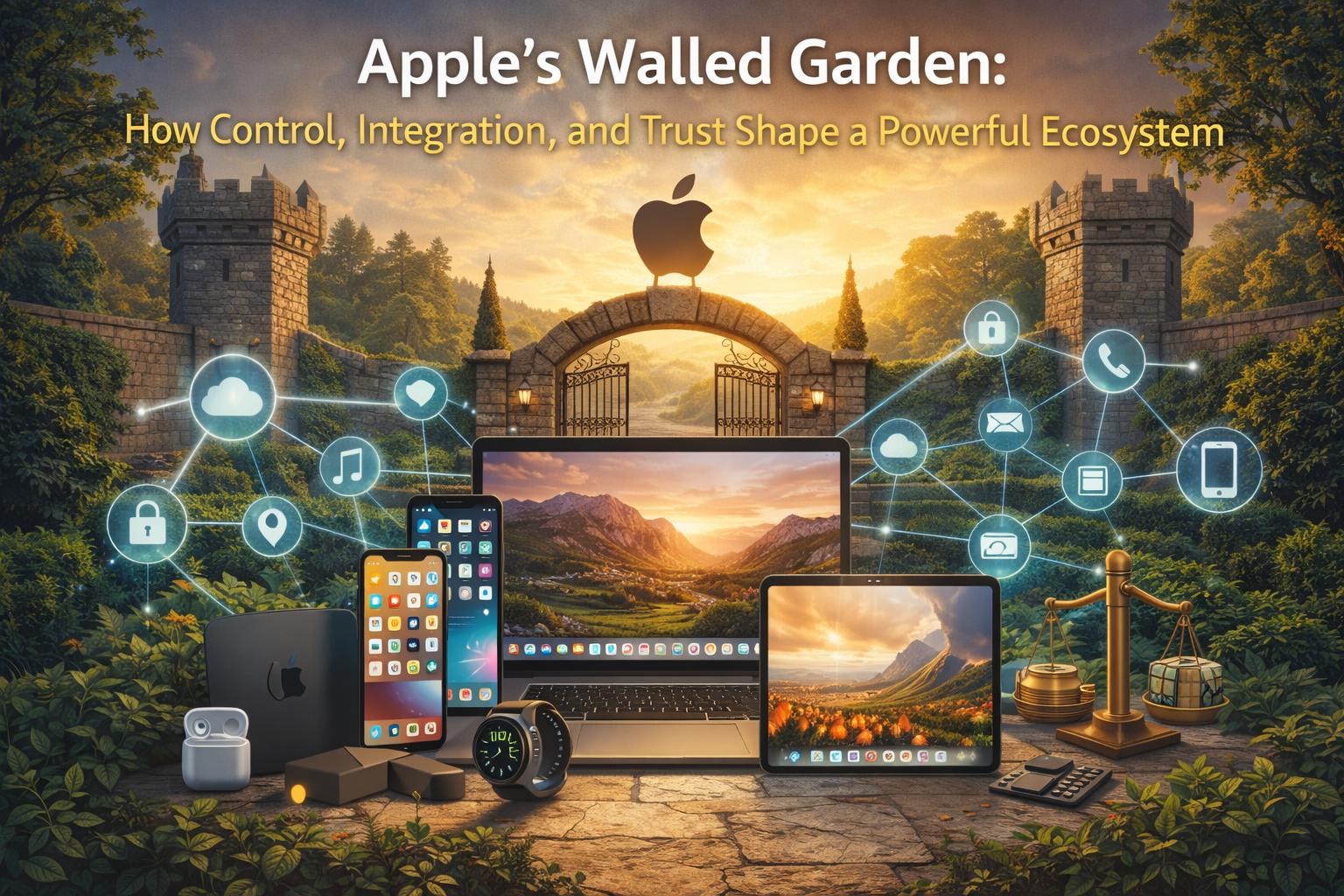
Apple’s walled garden refers to the tightly controlled ecosystem in which Apple designs the hardware, operating systems, software frameworks, and distribution channels that power its products. In this environment, Apple decides how devices interact with apps, how data flows across services, and how developers reach users. The idea of a “garden” captures the user experience: once inside, everything works smoothly together, but movement in and out is carefully managed. For consumers, this control often feels like simplicity and reliability. Devices sync seamlessly, updates are coordinated, and security standards are consistent. For Apple, the walled garden reinforces brand loyalty and creates switching costs, because the more products and services a user adopts, the harder it becomes to leave without sacrificing convenience. This structure is not accidental; it is a strategic choice that prioritises end-to-end integration over open interoperability. By owning the full stack, Apple can optimise performance, battery life, privacy controls, and design coherence in ways that are difficult for more fragmented platforms to replicate.
Why Apple Built It: Quality Control, Security, and Differentiation
One of the core motivations behind Apple’s walled garden is quality control. By setting strict guidelines for hardware compatibility and software distribution, Apple can ensure a predictable baseline of performance and user experience. This is especially important for a company that markets its products as premium, intuitive, and dependable. Security and privacy are also central to the strategy. A controlled ecosystem allows Apple to limit malicious software, enforce app review standards, and push security updates quickly across supported devices. From a differentiation perspective, the walled garden helps Apple stand apart in a competitive technology landscape. Instead of competing solely on specifications or price, Apple competes on experience. The integration between devices, such as phones, tablets, watches, and computers, creates a sense of continuity that strengthens customer attachment. This approach also supports Apple’s services business, because once users trust the platform, they are more willing to adopt subscriptions, digital content, and cloud-based features that are deeply embedded in the ecosystem.
Benefits and Trade-Offs for Users and Developers
For users, the benefits of Apple’s walled garden include ease of use, consistent design, and strong privacy protections. The learning curve is gentler because interactions are standardised across devices, and problems are often easier to diagnose when one company controls the system. However, this convenience comes with trade-offs. Users may face limitations on customisation, fewer choices in how software is installed, and higher costs compared with more open platforms. Developers experience a different set of benefits and constraints. On one hand, the ecosystem provides access to a large, engaged user base that is accustomed to paying for apps and services. Development tools are mature, documentation is extensive, and monetisation mechanisms are built into the platform. On the other hand, developers must comply with Apple’s rules, revenue-sharing models, and review processes, which can affect pricing, business models, and speed to market. These constraints can be frustrating, but they are also part of the stability that makes the ecosystem commercially attractive. The tension between opportunity and restriction is a defining feature of the walled garden model.
Long-Term Implications: Competition, Regulation, and Strategic Resilience
Apple’s walled garden has long-term implications that extend beyond individual products. As the ecosystem grows, it attracts regulatory attention, especially around competition, market power, and fair access for developers. Critics argue that too much control can stifle innovation and limit consumer choice, while supporters claim that the integrated model delivers better outcomes and stronger security. From a strategic perspective, the walled garden enhances resilience. It allows Apple to roll out new technologies, such as custom chips or privacy features, with tight integration across the stack. It also provides pricing power and recurring revenue through services that depend on the ecosystem’s cohesion. The challenge for Apple is balancing control with adaptability. As technology evolves and regulatory pressures increase, the company must decide how much openness to allow without diluting the core experience that defines its brand. Whether viewed as protective or restrictive, Apple’s walled garden remains one of the most influential strategic models in modern technology, shaping how products are built, how markets compete, and how users experience digital life.