Anti-ESG Investing: What It Means, Why It’s Gaining Attention, and How Investors Evaluate It
Author: Shashi Prakash Agarwal
What Anti-ESG Investing Is and What It’s Reacting To
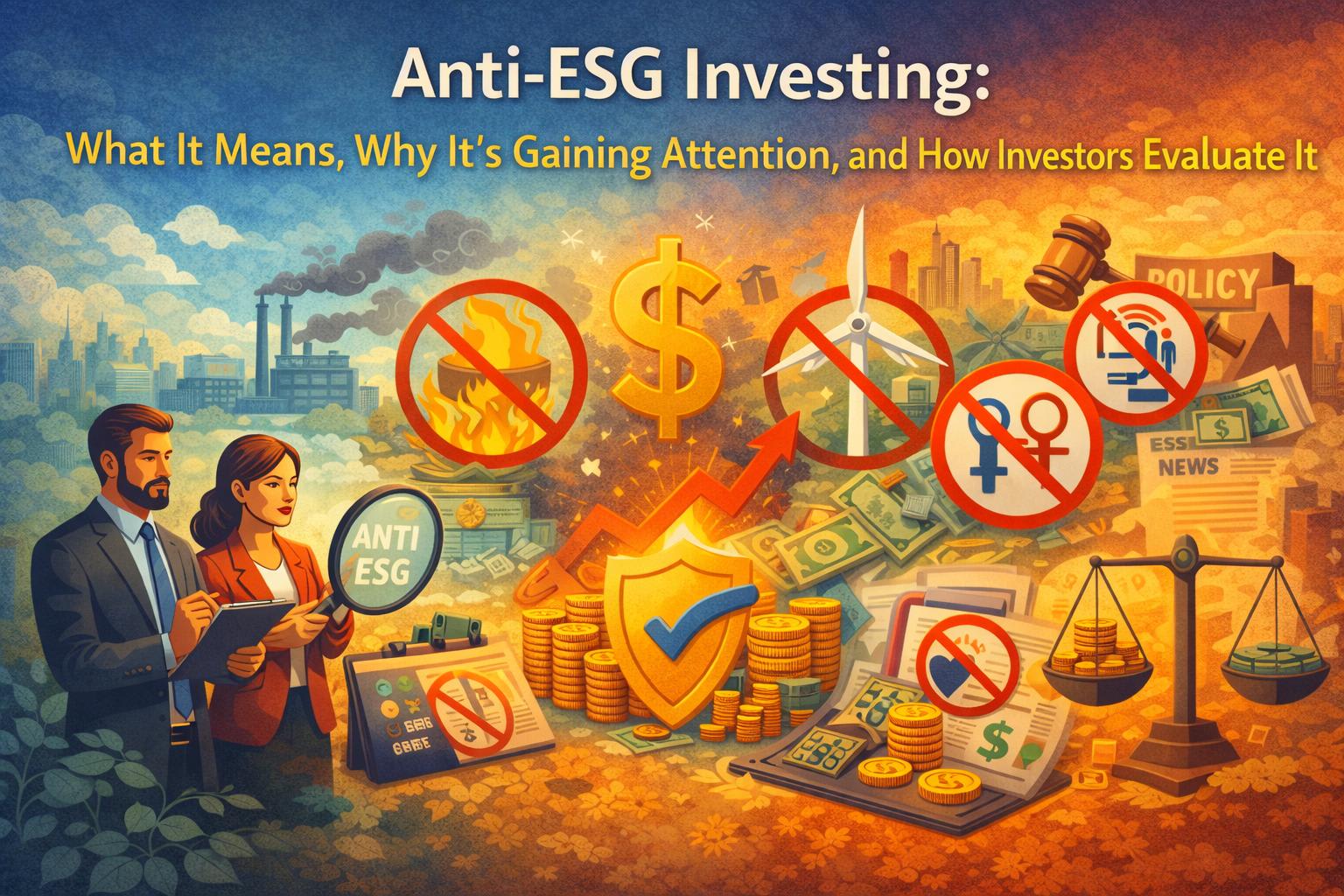
Anti-ESG investing is an approach that pushes back against the idea that environmental, social, and governance factors should meaningfully influence investment decisions. It is not one single strategy, but rather a family of viewpoints that share a common theme: investors should prioritise traditional financial objectives, such as risk-adjusted returns, cash flows, balance-sheet strength, and competitive positioning, without embedding social or political goals into capital allocation. In practice, anti-ESG investing often shows up in two ways. First, it can be a philosophical stance that rejects ESG frameworks as subjective, inconsistent, or vulnerable to marketing spin, and therefore not reliable for making disciplined investment decisions. Second, it can be a portfolio stance that intentionally includes sectors and companies sometimes screened out by ESG funds, such as energy, mining, defence, tobacco, or certain industrials, on the belief that these industries remain economically essential and can offer attractive valuations and cash yields when they are unpopular. Anti-ESG investing has gained visibility because ESG itself became mainstream across asset managers, corporate reporting, and public policy discussions. When a set of ideas becomes influential, it naturally attracts critique. Some critics worry ESG scores reward disclosure rather than real-world outcomes, or they argue that ESG constraints can reduce diversification, increase tracking error, and potentially harm returns. Others argue that ESG can blur the line between shareholder responsibility and stakeholder activism, and they want a stricter separation between investing and social objectives. Regardless of where someone stands, the anti-ESG label usually reflects a desire for clarity: a portfolio should be built on measurable fundamentals and explicit risk management rather than shifting standards or cultural narratives.
The Core Arguments: Performance, Fiduciary Duty, and Measurement Problems
A central argument in anti-ESG investing is that many ESG metrics are difficult to measure consistently across companies, sectors, and regions. Different rating providers can give the same company very different ESG scores, which creates confusion about what the scores truly represent. In that view, ESG can become a weak signal, and a weak signal can mislead decision-making. Another argument focuses on fiduciary duty, particularly for pension funds and institutions managing retirement savings. The anti-ESG stance often claims that introducing non-financial objectives may conflict with the primary obligation to maximise risk-adjusted returns for beneficiaries, unless the ESG factor clearly links to long-term financial performance. This is not necessarily a claim that environmental risks or governance failures are irrelevant. Rather, it is a claim about process: if an issue is financially material, it already belongs in traditional fundamental analysis, and it does not need a separate ESG label to justify its inclusion. Anti-ESG investors also argue that ESG can encourage “box-checking” behaviour among companies, where the focus shifts toward optimising disclosure and public messaging instead of improving operational performance. They may point to the risk of “greenwashing,” where firms appear sustainable on paper while real outcomes remain unchanged. Another thread of critique is about portfolio construction. ESG screens can tilt funds away from certain sectors, potentially reducing diversification and increasing concentration in popular industries. When markets rotate, these tilts can affect returns and volatility in unexpected ways. For anti-ESG investors, the core principle is not that sustainability is unimportant, but that the investment process should be anchored in transparent assumptions, consistent data, and measurable financial drivers rather than evolving scoring systems that may embed value judgments.
How Anti-ESG Portfolios Are Built: Sector Exposure, Valuation Discipline, and Risk Controls
Anti-ESG investing does not automatically mean ignoring environmental or governance risks. Many investors who dislike ESG branding still analyse climate transition risk, litigation exposure, regulatory shifts, labour relations, and governance quality because those factors can affect cash flows and cost of capital. The difference is usually in framing and constraints. Instead of excluding companies due to ESG screens, an anti-ESG portfolio may seek broad investability and then differentiate using valuation discipline, balance-sheet resilience, and competitive advantage. This can lead to a greater willingness to hold energy producers, pipeline businesses, commodity-linked companies, and defence or industrial firms, especially when those sectors are priced cheaply relative to earnings, cash flow, or replacement value. These investors often argue that unpopular sectors can become mispriced when large pools of capital avoid them, creating opportunities for patient capital. A second building block is cash yield and shareholder return. Anti-ESG strategies may emphasise dividends, buybacks, and free-cash-flow yield, particularly in mature industries that generate steady cash and trade at lower valuations. A third building block is staying honest about risk. Holding more commodity-linked exposure increases sensitivity to inflation, geopolitics, and cyclical downturns, so risk control becomes crucial. Anti-ESG portfolios that are built responsibly tend to use position sizing, diversification across industries, and clear downside scenarios rather than assuming that contrarian positioning will always be rewarded. Some approaches lean more actively managed, aiming to exploit mispricings created by sentiment and constraints. Others are simpler, aiming to maintain broad market exposure while rejecting ESG-based exclusions, essentially saying that markets already price risks, and an investor should focus on fundamentals and valuation rather than ideology. At its best, anti-ESG investing is less about reaction and more about method: define your edge, buy with a margin of safety, and manage risk explicitly.
What Investors Should Watch Out For: Politics, Marketing, and Long-Term Reality
One of the biggest risks with anti-ESG investing is that it can become just as ideological as the thing it critiques. If the motivation is primarily political, portfolio decisions can drift away from disciplined analysis and toward symbolic positioning. Markets do not reward symbolism consistently, and they punish sloppy underwriting. Another risk is marketing. Just as some products may overstate ESG impact, some “anti-ESG” products may overstate their uniqueness or imply that avoiding ESG guarantees higher returns. Neither claim is dependable. The real driver of long-term results is still the same: price paid, quality of business, durability of cash flows, and the investor’s ability to avoid large permanent losses. Investors should also recognise that certain issues often grouped under ESG are not optional in the real economy. Energy transition policy, carbon pricing, water scarcity, supply-chain resilience, cybersecurity, workforce stability, and governance quality can all create financial risks and opportunities regardless of what label you use. Ignoring them entirely can be reckless. The practical middle ground is to separate “values-based screening” from “financial materiality.” If a factor can materially affect earnings, costs, legal exposure, or competitive positioning, it belongs in the analysis whether or not you call it ESG. Finally, investors should consider time horizon. In the short run, sectors fall in and out of favour, and contrarian positioning can work. Over the long run, however, companies that adapt to regulation, technology, and consumer demand often earn lower capital costs and stronger franchise durability. Anti-ESG investing can still succeed in that world, but only if it stays anchored in reality: focus on fundamentals, remain flexible as the environment changes, and treat labels as noise compared with cash flows, balance sheets, and true competitive strength.