Agentic AI
Author: Shashi Prakash Agarwal
Introduction
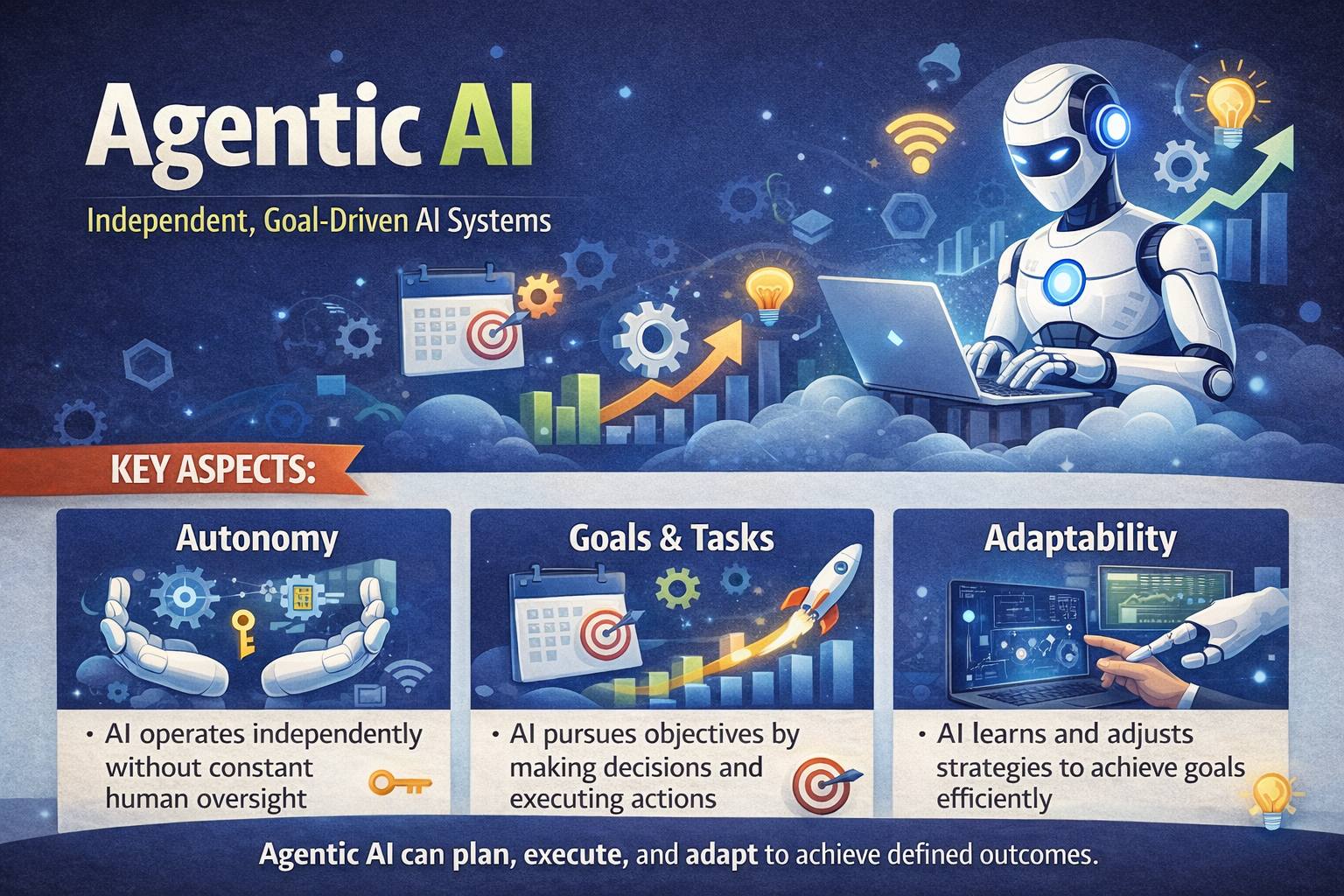
Agentic AI refers to artificial intelligence systems that can plan, decide, and take actions on their own to accomplish multi-step goals with minimal human supervision. Unlike most AI tools that respond to prompts and stop there, agentic AI is designed to behave more like a capable digital worker: it can interpret an objective, break it into tasks, use tools, coordinate with software systems, and adapt based on results. Because it moves AI beyond content generation into autonomous execution, agentic AI is often described as the next step in the evolution from “assistant AI” to “operator AI” across business and industry.
How Agentic AI Works
Although implementations vary, most agentic systems follow a repeating cycle that looks like how a human approaches complex work. First, the agent observes. It collects relevant inputs such as user instructions, internal documents, CRM data, market data, logs, or signals from sensors depending on the domain. Next, it reasons and plans. Using model-based reasoning (often involving large language models), the agent interprets the goal and breaks it into smaller steps. It may create a task list, prioritize steps, and determine which tools or systems it needs. Then, it acts. The agent executes steps by calling tools, running code, querying databases, sending messages, creating tickets, updating spreadsheets, or triggering workflows through APIs. Finally, it checks and learns. The agent evaluates the results against the goal. If something fails, it may retry, change strategy, ask a targeted clarification, or escalate to a human. The best systems keep audit logs, track outcomes, and improve performance over time through feedback loops. This observe–plan–act–evaluate loop is what gives agentic AI its practical power.
Why Agentic AI Matters
Agentic AI matters because it can automate entire workflows, not just individual tasks. That difference can translate into real changes in productivity, operating costs, speed of execution, and service quality. Instead of speeding up one step in a process, agentic AI can manage the process end-to-end. That makes it relevant across functions like customer support, finance operations, compliance, IT, sales operations, logistics, and research. It also changes how businesses think about scaling. Traditionally, scaling a workflow meant hiring more people or building complex automation. Agentic AI offers a middle path where intelligent automation can be deployed faster, adjusted more easily, and extended across systems.
Key Risks and Limitations
Agentic AI is powerful, but it also introduces new risks compared to standard chat-based AI. Autonomy increases the chance of errors becoming actions. If an agent has the ability to update systems, send emails, or trigger financial operations, it must be constrained with permissions, approvals, and monitoring. Another challenge is reliability. Multi-step tasks can compound small mistakes, so robust validation and fallback behavior are essential. Security and privacy also matter more. Agents interact with tools, APIs, and sensitive data. Strong access control, logging, and policy enforcement become non-negotiable. Finally, there’s governance. Companies need clarity on accountability, auditability, and safe deployment boundaries, especially in regulated industries.
Agentic AI and the Business Landscape
Many large technology companies are integrating agent-like capabilities into productivity tools, cloud platforms, and developer ecosystems. At the same time, the broader “agent stack” is forming across infrastructure, orchestration, observability, and security layers that help businesses deploy agents safely. For investors and business leaders, the key takeaway is that agentic AI is not just a feature. It is a shift toward AI systems that can execute, coordinate, and optimize workflows, which could reshape how organizations operate across sectors.