A Cycle-Based Timing Intelligence Layer for Modern Markets
The Financial Astrology Terminal by Rajeev Prakash is a professional research environment that structurally maps planetary cycles to macro regimes, volatility clusters, and cross-asset rotations. It is designed for traders and institutional investors who want a differentiated timing edge without sacrificing discipline, data, or risk control.
Instead of forecasting markets through stories or intuition, the terminal focuses on tested historical correlations between celestial configurations and market behaviour. Planetary transits, retrogrades, ingresses, and lunar phases are treated as a systematic alternative data factor, layered on top of traditional macro, technical, and quantitative frameworks.
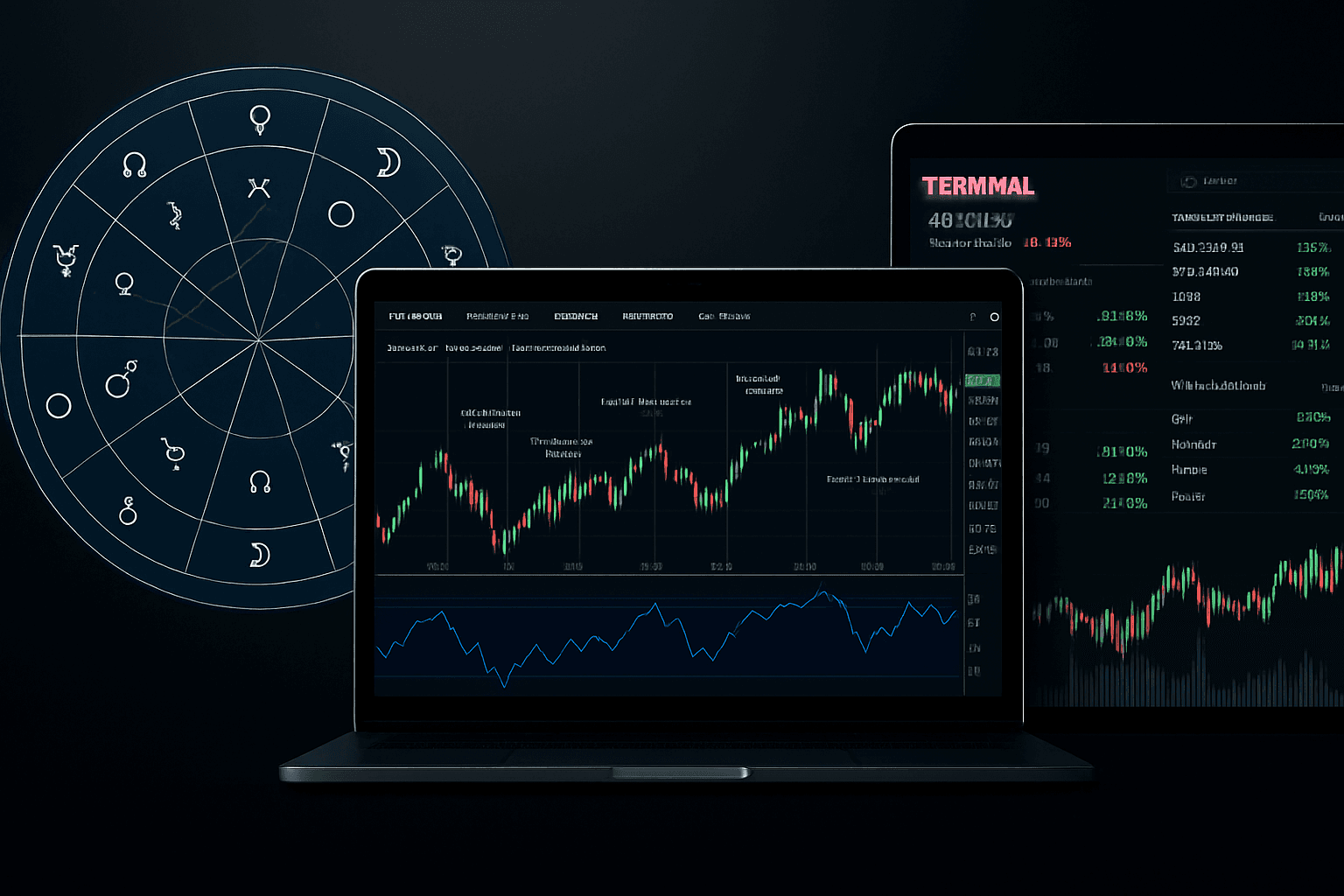
At a Glance
Core idea: treat planetary cycles as a statistically testable timing layer, not a belief system.
Primary users: hedge funds, family offices, active traders, wealth managers, and sophisticated individual investors.
Key outcome: avoid unstable windows, time entries and exits more cleanly, and align allocations with structural cycles.
What the Financial Astrology Terminal Actually Does
The terminal continuously tracks the positions and relationships of key celestial bodies – including the Sun, Moon, Mercury, Venus, Mars, Jupiter, Saturn, Uranus, Neptune, and Pluto – alongside lunar nodes, eclipses, and lunations. Each configuration is evaluated for its historical association with:
- Volatility spikes in major equity indices and commodities
- Trend exhaustion and reversal windows in key benchmarks
- Liquidity compressions and risk-off episodes
- Macro rotation between sectors, styles, and regions
These correlations are not treated as deterministic laws. Instead, they are encoded as conditional probability bands. When a historically sensitive configuration approaches, and when it overlaps with stretched technicals, crowded positioning, or macro stress, the terminal flags an elevated-risk or high-opportunity window.
For a user, that means seeing not just where price is, but where time itself has tended to matter most. The goal is simple: improve timing and risk management, not replace fundamental or quantitative work.
Key Design Principles
Non-mystical framing: planetary cycles are documented as cyclical markers, similar to seasonality or sentiment indicators.
Testable logic: signals and timing windows can be examined against historical data and integrated into existing research pipelines.
Complementary, not competing: the terminal does not replace macro research, valuations, or quant models. It overlays an additional axis of information.
How the Timing Intelligence Layer Works
At the heart of the Financial Astrology Terminal is a timing engine that synchronises astronomical data with financial time series. The system digests ephemeris information and converts planetary movements into structured signals: transits, aspects, retrograde phases, ingresses, and eclipse bands. Each of these is mapped to historical price and volatility data across indices, commodities, FX pairs, bonds, and crypto assets.
Based on this mapping, the terminal builds a library of cycle windows: time bands where certain types of market behaviour have repeatedly clustered. These might be windows where equity indices tend to experience sharp reversals, where safe-haven demand is more likely to surge, or where macro rotation typically accelerates.
Users do not see esoteric jargon. They see practical language: stress windows, breakout risk, shakeout zones, exhaustion bands, or high-probability continuation windows. The astrological logic sits underneath; the surface output speaks the language of risk and timing that professionals use every day.
From Celestial Data to Trading Context
1. Data ingestion: planetary positions, aspects, and phase changes are collected and normalised into machine-readable form.
2. Historical linkage: these time points are overlaid on price, volatility, and macro series to identify statistically notable clusters.
3. Signal construction: the system creates labelled windows, each tagged with probability, directionality bias, and asset sensitivity.
4. Live mapping: upcoming windows are projected onto the current market environment, giving traders a forward calendar of cycle-sensitive days and weeks.
Who Uses the Financial Astrology Terminal?
The terminal is built for professionals who already take markets seriously: portfolio managers, traders, risk officers, and sophisticated individuals who understand that most edges come from incremental improvements in timing, not from magical forecasts. For them, the question is not whether astrology “causes” market moves, but whether specific celestial configurations align with recognisable market outcomes often enough to matter.
Typical users blend the terminal with:
- Macro and fundamental analysis for regime and valuation context
- Technical structures for entries, exits, and risk placement
- Quantitative models, volatility surfaces, and flow data
- Portfolio-level risk frameworks focused on drawdown and exposure limits
In that environment, the Financial Astrology Terminal acts as a timing overlay. It helps users decide when to be aggressive, when to lean defensive, and when to simply reduce noise by avoiding historically unstable windows.
Why Institutions Pay Attention to Time
In a world where most information is widely available and factor models are heavily crowded, edges rarely come from knowing something dramatic that others do not. They come from understanding when to scale exposure up or down, when to avoid known stress periods, and when to ride a trend without getting shaken out by noise.
The Financial Astrology Terminal addresses exactly that dimension: it puts time on the same footing as price and fundamentals. By structurally encoding cycle windows, it offers an additional way to frame risk: not just “what could happen,” but “when is it more likely to matter.”
What We Offer
Choose a product to explore how our cycle-based research, annual strategy, and live guidance can fit into your trading or investment workflow.
Frequently Asked Questions
Is this about prediction or probability?
The terminal is probability-driven. It does not claim certainty or deterministic control. Instead, it highlights time bands where specific market behaviours have historically clustered and lets users decide how to overlay that information on their own frameworks.
Do I need to know astrology to use the terminal?
No. The interface is designed for market professionals, not astrologers. Internally, the system uses astrological concepts, but the output is expressed as timing windows, risk labels, and scenario notes that any trader or analyst can understand.
How does it fit with my existing tools and data?
The Financial Astrology Terminal is built to complement, not replace, existing workflows. It can sit alongside your macro dashboards, risk systems, back-testing tools, or charting platforms as an additional timing perspective. Many users treat it as a specialised overlay that refines when they implement decisions generated elsewhere.
Can I see how past forecasts aligned with actual markets?
A core part of the philosophy behind the terminal is accountability. Historical cycle windows, major calls, and macro timing bands can be reviewed against realised price action. Over time, this creates a track record that users can evaluate, stress-test, and integrate with their own research.
Explore the Financial Astrology Terminal in more detail
If you would like to understand how cycle windows, live signals, and institutional research packages can fit into your workflow, you can start with a detailed product overview.